. 2008 Jul;466(7):1562-8.
doi: 10.1007/s11999-008-0274-8. Epub 2008 May 6.

Loss of homeostatic tension induces apoptosis in tendon cells: an in vitro study

Affiliations

Loss of homeostatic tension induces apoptosis in tendon cells: an in vitro study

Monika Egerbacher et al. Clin Orthop Relat Res. 2008 Jul.

Abstract

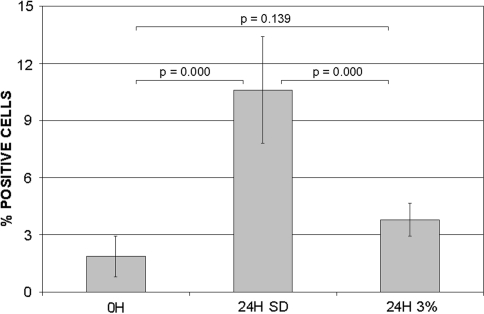
Apoptosis (programmed cell death) has been identified as a histopathologic feature of tendinopathy. While the precise mechanism(s) that triggers the apoptotic cascade in tendon cells has not been identified, it has been theorized that loss of cellular homeostatic tension following microscopic damage to individual tendon fibrils could be the stimulus for initiating the pathologic events associated with tendinopathy. To determine if loss of homeostatic tension following stress deprivation could induce apoptosis in tendon cells, rat tail tendons were stress-deprived or cyclically loaded (3% strain at 0.17 Hz) for 24 hours under tissue culture conditions. Caspase-3 (an upstream mediator of apoptosis) mRNA expression was evaluated using quantitative polymerase chain reaction and caspase-3 protein synthesis was identified using immunohistochemistry. Apoptotic cells were identified histologically using an antibody for single-stranded DNA. Stress deprivation for 24 hours resulted in an increase in caspase-3 mRNA expression when compared to fresh controls or cyclically loaded tendons. Stress deprivation also increased the percentage of apoptotic cells (10.59% +/- 2.80) compared to controls (1.87% +/- 1.07) or cyclically loaded tendons (3.73% +/- 0.87). These data suggest loss of homeostatic tension following stress deprivation induces apoptosis in rat tail tendon cells.


Figures
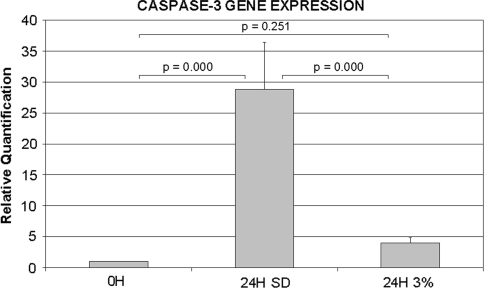
Fig. 1
Fig. 1
The graph shows the relative Q-PCR expression of caspase-3 mRNA in fresh control tendons, tendons following 24 hours of stress deprivation, and tendons following 24 hours of 3% cyclic tensile loading at 0.17 Hz.
Fig. 2A–C
Fig. 2A–C
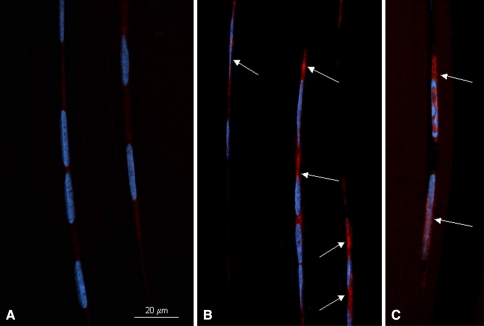
Fluorescent photomicrographs of rat tail tendons immunostained for caspase-3. Red staining within the cytoplasm (arrows) signifies a caspase-3 positive cell. Nuclei are stained blue (DAPI). Representative fields from fresh rat tail tendons (A), 24-hour stress-deprived rat tail tendons (B) and staurosporine-treated, positive control rat tail tendons (C) are shown. Bar = 20 μm.
Fig. 3A–C
Fig. 3A–C
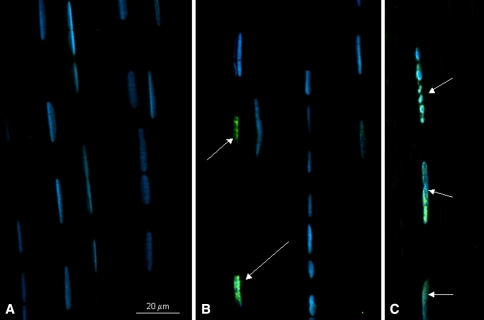
Fluorescent photomicrographs of rat tail tendons immunostained for single-stranded DNA using the F7-26 antibody. Cells undergoing apoptosis (arrows) stain positive for the F7-26 antibody. Nuclei are stained blue (DAPI). Representative fields from fresh rat tail tendons (A), 24-hour stress-deprived rat tail tendons (B) and staurosporine-treated, positive control rat tail tendons (C) are shown. Bar = 20 μm.
Fig. 4
Fig. 4
The graph depicts the percentage (number of F7-26 positive cells/total cell count × 100) of apoptotic cells in fresh control tendons, tendons following 24 hours of stress deprivation, and tendons following 24 hours of 3% cyclic tensile loading at 0.17 Hz.

References

    1. Arnoczky SP, Lavagnino M, Egerbacher M. The mechanical etiopathogenesis of tendinopathy: is it the over-stimulation or the under-stimulation of tendon cells? Int J Exp Pathol. 2007;88:217–226. - DOI - PMC - PubMed
    1. Arnoczky SP, Lavagnino M, Whallon JH, Hoonjan A. In situ cell nucleus deformation in tendons under tensile load; a morphological analysis using confocal laser microscopy. J Orthop Res. 2002;20:29–35. - DOI - PubMed
    1. Arnoczky SP, Tian T, Lavagnino M, Gardner K. Ex vivo static tensile loading inhibits MMP-1 expression in rat tail tendon cells through a cytoskeletally based mechanotransduction mechanism. J Orthop Res. 2004;22:328–333. - DOI - PubMed
    1. Bestwick CS, Maffulli N. Reactive oxygen species and tendinopathy: do they matter? Br J Sports Med. 2004;38:672–674. - DOI - PMC - PubMed
    1. Boatright KM, Salvesen GS. Mechanisms of caspase activation. Curr Opin Cell Biol. 2003;15:725–731. - DOI - PubMed