


Mitochondrial copper metabolism and delivery to cytochrome c oxidase
- PMID: 18459161
- PMCID: PMC2864105
- DOI: 10.1002/iub.50
Mitochondrial copper metabolism and delivery to cytochrome c oxidase
Abstract
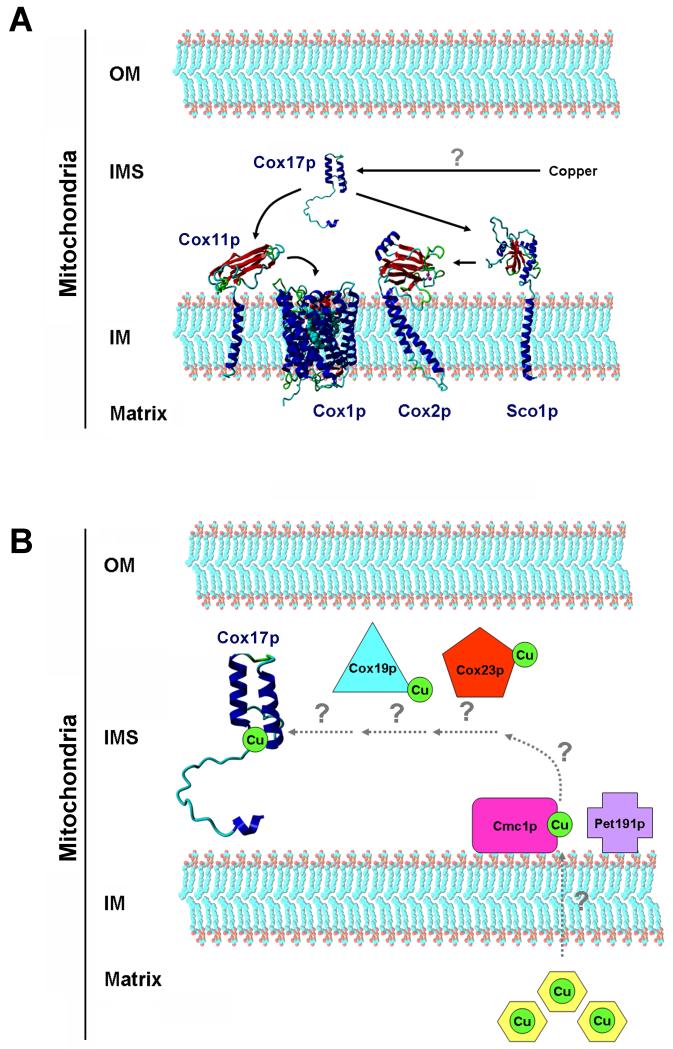
Metals are essential elements of all living organisms. Among them, copper is required for a multiplicity of functions including mitochondrial oxidative phosphorylation and protection against oxidative stress. Here we will focus on describing the pathways involved in the delivery of copper to cytochrome c oxidase (COX), a mitochondrial metalloenzyme acting as the terminal enzyme of the mitochondrial respiratory chain. The catalytic core of COX is formed by three mitochondrially-encoded subunits and contains three copper atoms. Two copper atoms bound to subunit 2 constitute the Cu(A) site, the primary acceptor of electrons from ferrocytochrome c. The third copper, Cu(B), is associated with the high-spin heme a(3) group of subunit 1. Recent studies, mostly performed in the yeast Saccharomyces cerevisiae, have provided new clues about 1) the source of the copper used for COX metallation; 2) the roles of Sco1p and Cox11p, the proteins involved in the direct delivery of copper to the Cu(A) and Cu(B) sites, respectively; 3) the action mechanism of Cox17p, a copper chaperone that provides copper to Sco1p and Cox11p; 4) the existence of at least four Cox17p homologues carrying a similar twin CX(9)C domain suggestive of metal binding, Cox19p, Cox23p, Pet191p and Cmc1p, that could be part of the same pathway; and 5) the presence of a disulfide relay system in the intermembrane space of mitochondria that mediates import of proteins with conserved cysteines motifs such as the CX(9)C characteristic of Cox17p and its homologues. The different pathways are reviewed and discussed in the context of both mitochondrial COX assembly and copper homeostasis.
Figures
References
-
- Pena MM, Lee J, Thiele DJ. A delicate balance: homeostatic control of copper uptake and distribution. J. Nutr. 1999;129:1251–60. - PubMed
-
- Solans A, Zambrano A, Barrientos A. Cytochrome c oxidase deficiency: from yeast to human. Preclinica. 2004;2:336–348.
-
- Pecina P, Houstkova H, Hansikova H, Zeman J, Houstek J. Genetic defects of cytochrome c oxidase assembly. Physiol. Res. 2004;53:S213–23. - PubMed
-
- Shoubridge EA. Cytochrome c oxidase deficiency. Am. J. Med. Genet. 2001;106:46–52. - PubMed
-
- Valnot I, Osmond S, Gigarel N, Mehaye B, Amiel J, Cormier-Daire V, Munnich A, Bonnefont JP, Rustin P, Rotig A. Mutations of the SCO1 gene in mitochondrial cytochrome c oxidase deficiency with neonatal-onset hepatic failure and encephalopathy. Am. J. Hum. Genet. 2000;67:1104–9. Epub 2000 Sep 28. - PMC - PubMed
Publication types
MeSH terms
Substances
Grants and funding
LinkOut - more resources
Full Text Sources
Molecular Biology Databases
