


Autoantibodies as potential biomarkers for breast cancer
- PMID: 18460216
- PMCID: PMC2481487
- DOI: 10.1186/bcr2091
Autoantibodies as potential biomarkers for breast cancer
Abstract
Introduction: Only a limited number of tumor markers for breast cancer are currently available. Antibodies to tumor-associated proteins may expand the number of available tumor markers for breast cancer and may be used together in a serum profile to enhance sensitivity and specificity.
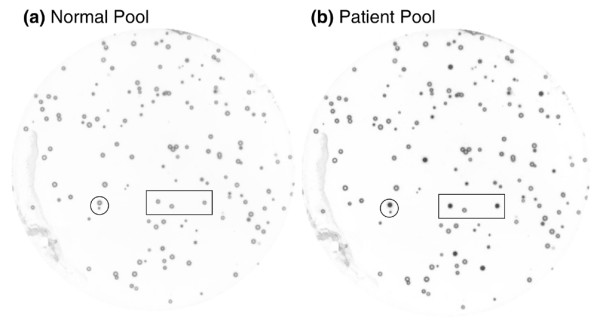
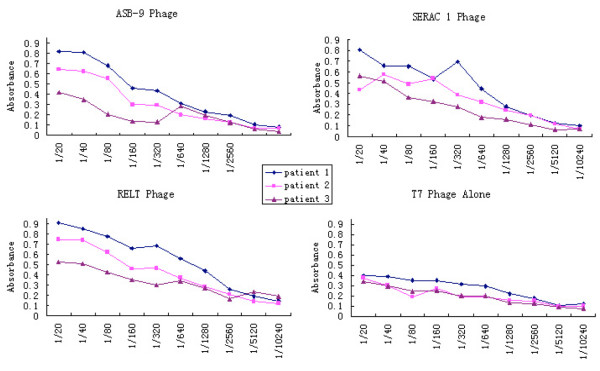
Methods: In the present study, we interrogated a breast cancer cDNA T7 phage library for tumor-associated proteins using biopan enrichment techniques with sera from normal individuals and from breast cancer patients. The enrichment of tumor-associated proteins after biopanning was tested using a plaque-lift assay and immunochemical detection. The putative tumor-associated phage clones were collected for PCR and sequencing analysis. Unique and open reading frame phage-expressed proteins were then used to develop phage protein ELISAs to measure corresponding autoantibodies using 87 breast cancer patients and 87 normal serum samples. A logistic regression model and leave-one-out validation were used to evaluate predictive accuracies with a single marker as well as with combined markers. Identities of those selected proteins were revealed through the sequence BLAST program.
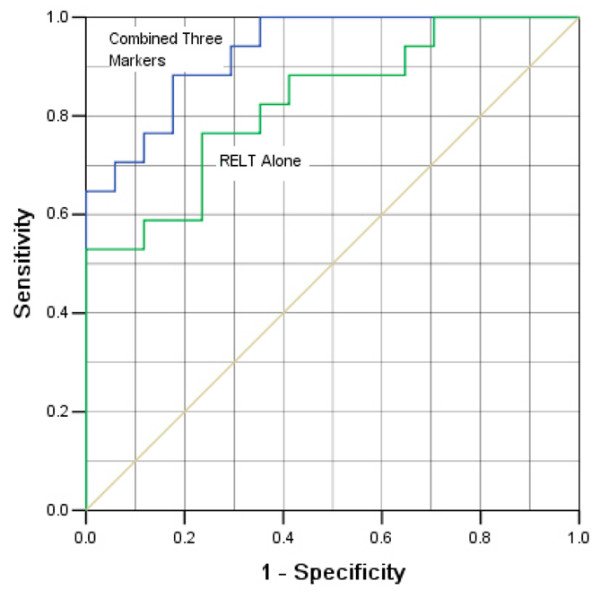
Results: We harvested 100 putative tumor-associated phage clones after biopan enrichment. Sequencing analysis revealed that six phage proteins were inframe and unique. Antibodies to these six phage-expressed proteins were measured by ELISAs, and the results showed that three of the phage clones had statistical significance in discriminating patients from normal individuals. BLAST results of the three proteins showed great matches to ASB-9, SERAC1, and RELT. Measurements of the three predictive phage proteins were combined in a logistic regression model that achieved 80% sensitivity and 100% specificity in prediction of sample status, whereas leave-one-out validation achieved 77.0% sensitivity and 82.8% specificity among 87 patient samples and 87 control samples. Receiver operating characteristic curve analysis and the leave-one-out method both showed that combined measurements of the three antibodies were more predictive of disease than any of the single antibodies studied, underscoring the importance of identifying multiple potential markers.
Conclusion: Serum autoantibody profiling is a promising approach for early detection and diagnosis of breast cancer. Rather than one autoantibody, a panel of autoantibodies appears preferable to achieve superior accuracy. Further refinements will need to be made to further improve the accuracy. Once refined, the assay must be applied to a prospective patient population to demonstrate applicability.
Figures
References
-
- Jemal A, Siegel R, Ward E, Murray T, Xu J, Thun MJ. Cancer Statistics, 2007. CA Cancer J Clin. 2007;57:43–66. - PubMed
-
- Scanlan MJ, Chen YT, Williamson B, Gure AO, Stockert E, Gordan JD, Türeci O, Sahin U, Pfreundschuh M, Old LJ. Characterization of human colon cancer antigens recognized by autologous antibodies. Int J Cancer. 1998;76:652–658. doi: 10.1002/(SICI)1097-0215(19980529)76:5<652::AID-IJC7>3.0.CO;2-P. - DOI - PubMed
-
- Scanlan MJ, Gordan JD, Williamson B, Stockert E, Bander NH, Jongeneel V, Gure AO, Jäger D, Jäger E, Knuth A, Chen YT, Old LJ. Antigens recognized by autologous antibody in patients with renal-cell carcinoma. Int J Cancer. 1999;83:456–464. doi: 10.1002/(SICI)1097-0215(19991112)83:4<456::AID-IJC4>3.0.CO;2-5. - DOI - PubMed
Publication types
MeSH terms
Substances
LinkOut - more resources
Full Text Sources
Other Literature Sources
Medical
Research Materials
