. 2008 Aug 22;275(1645):1875-85.
doi: 10.1098/rspb.2008.0227.

Developmental model of static allometry in holometabolous insects

Affiliations

Developmental model of static allometry in holometabolous insects

Alexander W Shingleton et al. Proc Biol Sci. .

Abstract

The regulation of static allometry is a fundamental developmental process, yet little is understood of the mechanisms that ensure organs scale correctly across a range of body sizes. Recent studies have revealed the physiological and genetic mechanisms that control nutritional variation in the final body and organ size in holometabolous insects. The implications these mechanisms have for the regulation of static allometry is, however, unknown. Here, we formulate a mathematical description of the nutritional control of body and organ size in Drosophila melanogaster and use it to explore how the developmental regulators of size influence static allometry. The model suggests that the slope of nutritional static allometries, the 'allometric coefficient', is controlled by the relative sensitivity of an organ's growth rate to changes in nutrition, and the relative duration of development when nutrition affects an organ's final size. The model also predicts that, in order to maintain correct scaling, sensitivity to changes in nutrition varies among organs, and within organs through time. We present experimental data that support these predictions. By revealing how specific physiological and genetic regulators of size influence allometry, the model serves to identify developmental processes upon which evolution may act to alter scaling relationships.


Figures
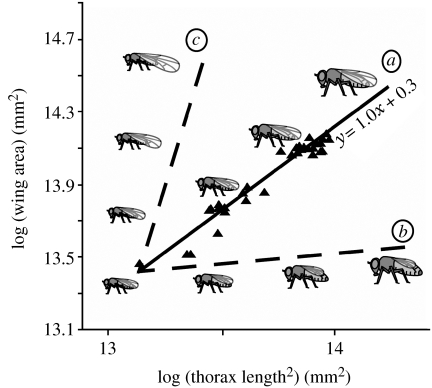
Figure 1
Figure 1
Isometry, hypoallometry and hyperallometry. The relationship between wing area and body area (thorax length2) in wild-type Drosophila melanogaster is linear and isometric (α=1.0) (a). Example of a (hypothetical) hypoallometric (b) and hyperallometric (c) relationship between wing and body size. Illustrations show example flies for each allometric relationship. See electronic supplementary material for methods.
Figure 2
Figure 2
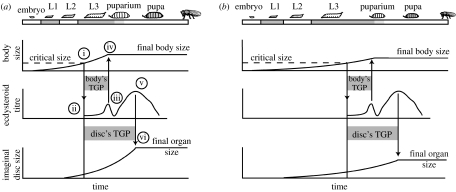
General model of body and imaginal disc growth in Drosophila. (a) The growth of the body and imaginal discs under optimal nutritional conditions. See main text for details. (b) A reduction in nutrition slows growth and delays attainment of critical size, extending total developmental time. Attainment of critical size initiates the same hormonal cascade that brings about the cessation of body and imaginal disc growth. The temporal dynamics of this cascade are unaffected by nutrition. Slow growth of the body and imaginal discs now reduces the amount of growth they can achieve during their TGPs, reducing final body and organ size. Hormones other than ecdsyteroids may be involved in the cessation of disc growth. L1–L3, first to third larval instar; TGP, terminal growth period.
Figure 3
Figure 3
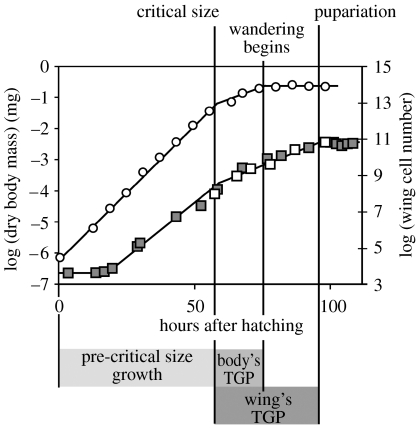
The fit between the model and observed growth trajectories for the body and wing. Growth of the body and wing imaginal discs can be modelled as two exponential periods of growth, one before the attainment of critical size and one after the attainment of critical size. Growth of the body begins at hatching and ends at the beginning of larvae wandering. Growth of the wing imaginal discs begins towards the end of the first larval instar and pauses at pupariation. Points show published data: open circles, body (Bakker 1959); open squares, wing (Martin 1982); filled squares, wing (Bryant & Levinson 1985). Lines show modelled growth trajectory using parameter values from table 1.
Figure 4
Figure 4
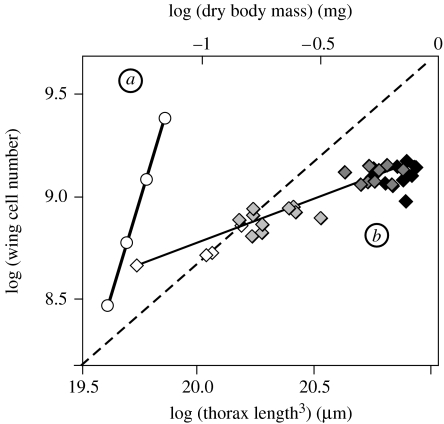
Modelled and observed allometric relationship between wing size and body size in Drosophila. (a) When both the wing and the body have no intrinsic growth rate (cb, cb, cd and cd=0) the model predicts a highly hyperallometric relationship between wing cell number and body size (values as in table 1). (b) In fact, the nutritional static allometry between wing cell number and body volume (thorax length3) is linear but hypoallometric, such that α=0.43. Flies reared on diets of increasing nutritional quality (2–100% of standard diet). White diamonds, 2% diet; grey diamonds, 5% diet; dark grey diamonds, 10% diet; black diamonds, 100% diet. Dashed line is isometry. See electronic supplementary material for methods.
Figure 5
Figure 5
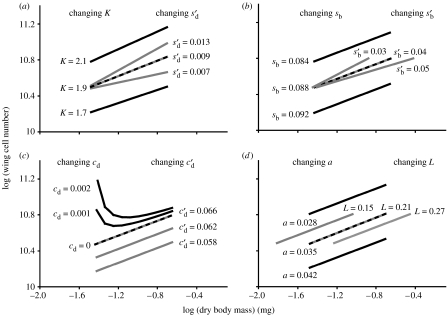
(ad) The effect of changing parameter values on the modelled allometry between wing cell number and body size in Drosophila. Dashed line is the predicted wild-type allometry, based on the observed data. Values at the end of each line show the parameter values used; parameter values in black correspond to the black lines and parameter values in grey correspond to the grey lines. All other parameter values are from table 1.
Figure 6
Figure 6
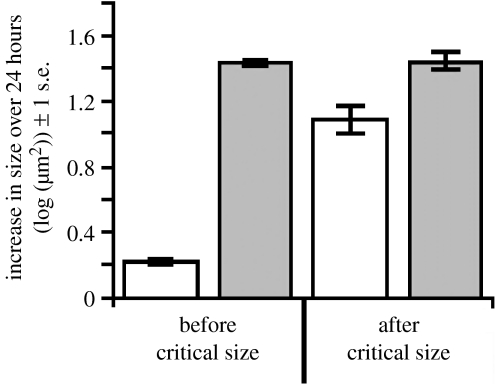
The wings of pre- and post-critical size larvae differ in their response to starvation. Third-instar larvae were starved (open bars) or fed (filled bars) for 24 hours, either before or after attainment of critical size (approx. 8 hours after the moult from second to third instar), and the increase in their wing area (μm2) over that period was measured. Each bar represents 10–18 discs. See electronic supplementary material for methods.

References

    1. Ashburner M. Cold Spring Harbor Laboratory Press; Cold Spring Harbor, NY: 1989. Drosophila: a laboratory handbook.
    1. Baehrecke E.H. Ecdysone signaling cascade and regulation of Drosophila metamorphosis. Arch. Insect Biochem. Physiol. 1996;33:231–244. doi:10.1002/(SICI)1520-6327(1996)33:3/4<231::AID-ARCH5>3.0.CO;2-V - DOI - PubMed
    1. Bakker K. Feeding period, growth, and pupation in larvae of Drosophila melanogaster. Entomol. Exp. Appl. 1959;2:171–186. doi:10.1007/BF00302537 - DOI
    1. Basler K, Hafen E. Dynamics of Drosophila eye development and temporal requirements of sevenless expression. Development. 1989;107:723–731. - PubMed
    1. Beadle G, Tatum E, Clancy C. Food level in relation to rate of development and eye pigmentation in Drosophila melanogaster. Biol. Bull. 1938;75:447–462. doi:10.2307/1537573 - DOI

Publication types

LinkOut - more resources