


Distribution of genes for virulence and ecological fitness among diverse Vibrio cholerae population in a cholera endemic area: tracking the evolution of pathogenic strains
- PMID: 18462070
- PMCID: PMC2980768
- DOI: 10.1089/dna.2008.0737
Distribution of genes for virulence and ecological fitness among diverse Vibrio cholerae population in a cholera endemic area: tracking the evolution of pathogenic strains
Abstract
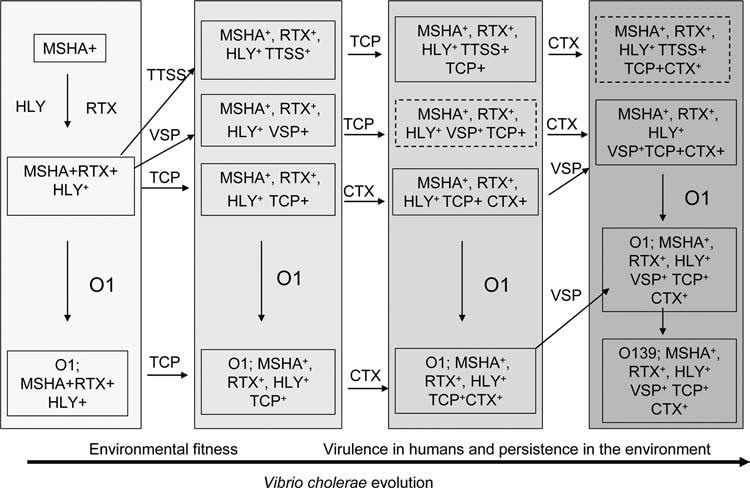
The pathogenic strains of Vibrio cholerae that cause acute enteric infections in humans are derived from environmental nonpathogenic strains. To track the evolution of pathogenic V. cholerae and identify potential precursors of new pathogenic strains, we analyzed 324 environmental or clinical V. cholerae isolates for the presence of diverse genes involved in virulence or ecological fitness. Of 251 environmental non-O1, non-O139 strains tested, 10 (3.9%) carried the toxin coregulated pilus (TCP) pathogenicity island encoding TCPs, and the CTX prophage encoding cholera toxin, whereas another 10 isolates carried the TCP island alone, and were susceptible to transduction with CTX phage. Most V. cholerae O1 and O139 strains carried these two major virulence determinants, as well as the Vibrio seventh pandemic islands (VSP-1 and VSP-2), whereas 23 (9.1%) non-O1, non-O139 strains carried several VSP island genes, but none carried a complete VSP island. Conversely, 30 (11.9%) non-O1, non-O139 strains carried type III secretion system (TTSS) genes, but none of 63 V. cholerae O1 or O139 strains tested were positive for TTSS. Thus, the distribution of major virulence genes in the non-O1, non-O139 serogroups of V. cholerae is largely different from that of the O1 or O139 serogroups. However, the prevalence of putative accessory virulence genes (mshA, hlyA, and RTX) was similar in all strains, with the mshA being most prevalent (98.8%) followed by RTX genes (96.2%) and hlyA (94.6%), supporting more recent assumptions that these genes imparts increased environmental fitness. Since all pathogenic strains retain these genes, the epidemiological success of the strains presumably depends on their environmental persistence in addition to the ability to produce major virulence factors. Potential precursors of new pathogenic strains would thus require to assemble a combination of genes for both ecological fitness and virulence to attain epidemiological predominance.
Figures
References
-
- Colwell R.R. Spira W.M. The ecology of Vibrio cholerae. In: Barua D., editor; Greenough W.B. III, editor. Cholera. Plenum Medical Book; New York, NY: 1992. pp. 107–127.
Publication types
MeSH terms
Substances
Grants and funding
LinkOut - more resources
Full Text Sources
Other Literature Sources
Medical
