. 2008 Jul;19(7):2984-94.
doi: 10.1091/mbc.e08-02-0138. Epub 2008 May 7.

The involvement of the tyrosine kinase c-Src in the regulation of reactive oxygen species generation mediated by NADPH oxidase-1

Affiliations

The involvement of the tyrosine kinase c-Src in the regulation of reactive oxygen species generation mediated by NADPH oxidase-1

Davide Gianni et al. Mol Biol Cell. 2008 Jul.

Abstract

NADPH oxidase (Nox) family enzymes are one of the main sources of cellular reactive oxygen species (ROS), which have been shown to function as second messenger molecules. To date, seven members of this family have been reported, including Nox1-5 and Duox1 and -2. With the exception of Nox2, the regulation of the Nox enzymes is still poorly understood. Nox1 is highly expressed in the colon, and it requires two cytosolic regulators, NoxO1 and NoxA1, as well as the binding of Rac1 GTPase, for its activity. In this study, we investigate the role of the tyrosine kinase c-Src in the regulation of ROS formation by Nox1. We show that c-Src induces Nox1-mediated ROS generation in the HT29 human colon carcinoma cell line through a Rac-dependent mechanism. Treatment of HT29 cells with the Src inhibitor PP2, expression of a kinase-inactive form of c-Src, and c-Src depletion by small interfering RNA (siRNA) reduce both ROS generation and the levels of active Rac1. This is associated with decreased Src-mediated phosphorylation and activation of the Rac1-guanine nucleotide exchange factor Vav2. Consistent with this, Vav2 siRNA that specifically reduces endogenous Vav2 protein is able to dramatically decrease Nox1-dependent ROS generation and abolish c-Src-induced Nox1 activity. Together, these results establish c-Src as an important regulator of Nox1 activity, and they may provide insight into the mechanisms of tumor formation in colon cancers.


Figures
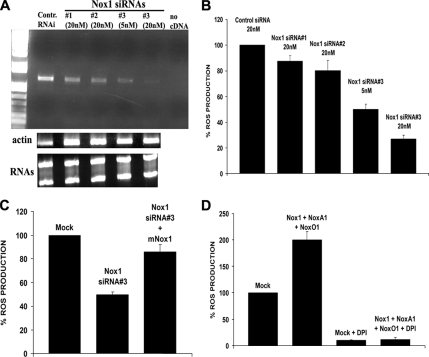
Figure 1.
Figure 1.
HT29 cell ROS generation is dependent on the Nox1 pathway. (A) The Nox1 siRNA#3 was the most effective in specifically knocking down the level of Nox1 mRNA in a dose-dependent manner. HT29 cells were transfected with the indicated amounts of three different Nox1-specific siRNAs or with control siRNA, and total RNA was extracted after 72 h as in Materials and Methods. RT-PCR was performed using Nox1-specific primers (top) or actin-specific primers (middle) and PCR products were run on a 1% agarose gel. Bottom, total RNA from each extraction was run on 1% agarose, showing no difference in the amount of the total RNA between different experimental conditions. (B) The transfection of Nox1-specific siRNA #3 results in the strongest dose-dependent reduction of cellular ROS production. HT29 cells were transfected (as indicated) with different amounts of three different Nox1-specific siRNAs or with control siRNA, and after 72 h ROS generation was measured by CL-assay as described in Materials and Methods. One representative experiment from three separate experiments is shown, and results are given as mean of triplicates ± SD. (C) The inhibition of ROS generation caused by Nox1 siRNA#3 in HT29 cells is rescued by the overexpression of mNox1. HT29 cells were transfected with control siRNA or Nox1 siRNA#3 (20 nM) as described in Materials and Methods. After 48 h, Nox1 siRNA-transfected cells were transfected again with expression plasmid for mNox1 or with empty vector by Lipofectamine 2000. Twenty-four hours later ROS generation was measured. One representative experiment from three separate experiments is shown, and results are given as mean of triplicates ± SD. (D) Treatment of HT29 cells with 10 μM DPI, a flavoenzyme inhibitor of NADPH oxidases, blocks both the increase in ROS production due to the transfection of Nox1, NoxA1, and NoxO1, and it reduces the amount of cellular ROS in mock-transfected HT29 cells. HT29 cells were transfected as indicated with empty vector or with the expression vector for Nox1, NoxO1, and NoxA1. After 24 h, cells were treated with 10 μM DPI or DMSO, and ROS production was monitored by CL assay. One representative experiment from three separate experiments is shown, and results are given as mean of triplicates ± SD.
Figure 2.
Figure 2.
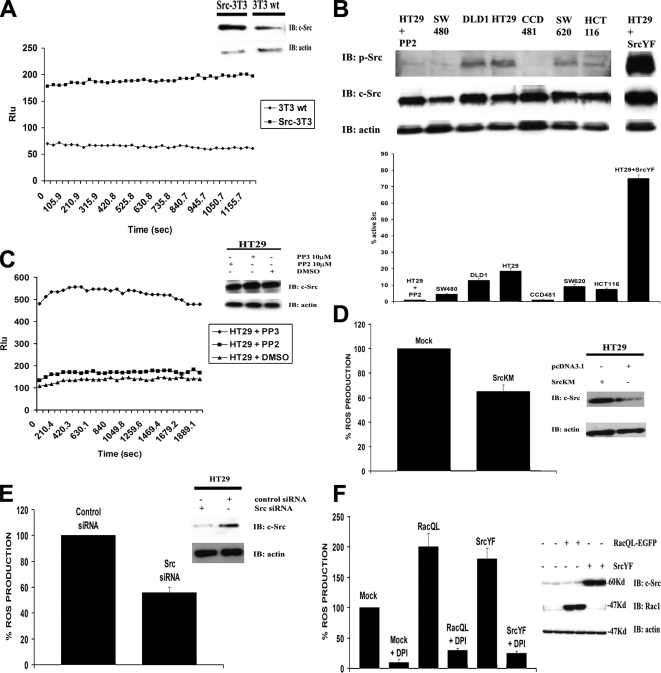
c-Src regulates cellular ROS generation. (A) NIH3T3 cells stably expressing c-Src (Src-3T3) produce significantly more ROS than wild-type NIH3T3 (3T3) cells. ROS production was measured by CL-assay in Src-3T3 and 3T3 cells without additional stimulation (left). The different levels of Src expression in these two cell lines was confirmed by WB, as described in Materials and Methods (right). One representative experiment from three separate experiments is shown. (B) Variation of endogenous c-Src activity in different human colon cell lines. Top, protein extracts (20 μg) from several human colon cell lines were analyzed by SDS-PAGE using anti-p-Src antibody (Tyr418). PP2-treated and SrcYF-transfected HT29 cells were used as negative and positive control, respectively. Blots were reprobed with anti-total Src and anti-actin antibody (bottom). Bottom, the results from three independent experiments performed as described above were quantified. First, the values from p-Src and total Src were normalized to actin. Successively, the ratio between actin-normalized p-Src and total-Src was calculated, and the values were normalized to the value of PP2-treated HT29 cells and are shown as mean ± SD. (C) In HT29 cells, the inhibition of Src activity by PP2 treatment significantly decreases ROS generation compared with HT29 cells treated with the nonfunctional inhibitor PP3. HT29 cells were treated with 10 μM Src inhibitor PP2 or its nonfunctional analogue PP3, and ROS production was monitored by CL-assay (left). Right, PP2 and PP3 treatment in HT29 cells did not affect c-Src protein expression level. One representative experiment from three independent experiments is shown. (D) The overexpression of Src dominant-negative (SrcKM) in HT29 cells significantly inhibits ROS generation compared with mock-transfected cells. HT29 cells were transfected as indicated with empty vector or with expression plasmid for SrcKM. After 24 h, cells were harvested and ROS production was measured by CL-assay (left). The Western blot in the right panel shows the level of SrcKM overexpression (c-Src immunoblot) and equal amount of loading (actin immunoblot). One representative experiment from three independent experiments is shown. (E) Src-specific siRNA, which strongly decreases Src protein level also inhibits ROS generation in HT29 cells. HT29 cells were transfected as described in Materials and Methods with Src-specific siRNA or with control siRNA (20 nM), and after 72 h the ROS formation was quantified by CL-assay (left). Right, Src-specific siRNA significantly decreases endogenous Src protein levels without affecting actin levels. (F) The treatment of HT29 cells with DPI blocks the increase in ROS production due to the transfection of both SrcYF and RacQL, and it reduces the amount of cellular ROS in mock-transfected compared with DMSO-treated cells. HT29 cells were transfected as indicated with empty vector or with constitutive active Rac1 (RacQL) or with constitutive active Src (SrcYF). After 24 h, cells were treated with 10 μM DPI, and ROS production was measured (left). The Western blot (right) shows that the block caused by DPI to the SrcYF- and RacQL-mediated increase in ROS production in HT29 cells is not due to any effect on expression of the transfected proteins. One representative experiment from three separate experiments is shown, and results are given as mean of triplicates ± SD.
Figure 3.
Figure 3.
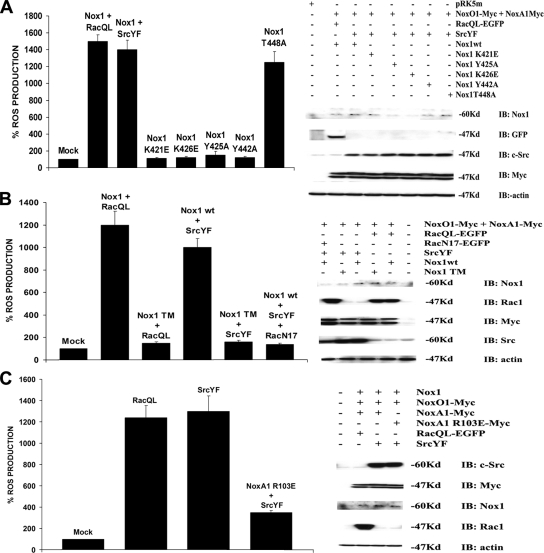
c-Src induces Nox1-dependent ROS generation through a Rac1-dependent mechanism. (A) The integrity of Nox1 residues required for Rac1 binding is necessary for Src-mediated ROS generation in HEK293 cells. HEK293 cells were transfected with empty vector or with NoxO1 and NoxA1 and, where indicated, with SrcYF, RacQL, Nox1 wild-type, the Nox1 mutants unable to bind Rac1 (K421E, Y425A, K426E), the Nox1 mutant in the NADPH binding site (Y442A), or with Nox1 bearing a mutation outside the Rac and NADPH binding domains (T448A). ROS production was monitored after 24 h (left). Right, comparable expression levels of all the transfected proteins. (B) Blockade of the Rac1 pathway abolishes the Nox1-dependent ROS generation in HEK293 cells. HEK293 cells were transfected with empty vector or with NoxO1 and NoxA1, and, where indicated, with RacQL, SrcYF, the dominant-negative Rac (RacN17), and Nox1 wt or Nox1 TM bearing all three the mutations responsible for Rac1 binding. ROS generation was measured after 24 h (left). The Western blot (right) indicates similar expression levels of all the above-mentioned proteins. (C) The presence of the NoxA1 mutant R103E, which is unable to bind Rac, completely blocks the induction in the Nox1-dependent superoxide formation caused by SrcYF. HEK293 cells were transfected with empty vector or with NoxO1 and Nox1, and, where indicated, with RacQL, SrcYF, and with NoxA1 wild type or with NoxA1 R103E. ROS formation was determined after 24 h (left). Right, all transfected proteins are expressed at similar levels. Results are representative of one experiment from three separate experiments, and data are given as mean of triplicates ± SD.
Figure 4.
Figure 4.
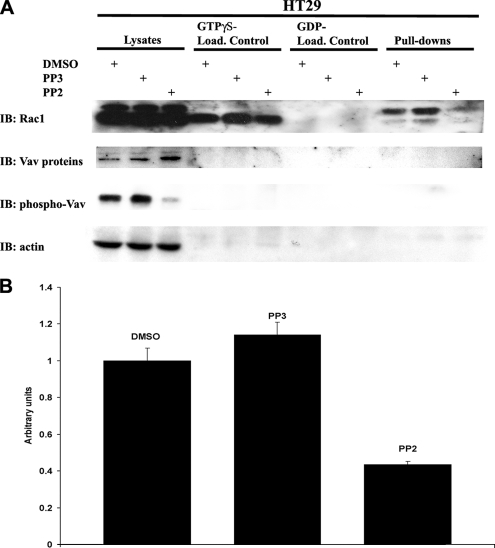
c-Src activity regulates the levels of Rac1-GTP in HT29 cells. (A) The inhibition of Src activity significantly lowers the levels of active Rac1 in HT29 cells. HT29 cells were treated Src inhibitor PP2, its nonfunctional analogue PP3, or DMSO alone. Total Rac and Rac1-GTP levels were measured by PBD assay as indicated in Materials and Methods. A nonhydrolysable analogue of GTP, GTPγS, was used as positive loading control and GDP was used for the negative control. Inhibition of Src activity was confirmed by Western blotting of the Src tyrosine phosphorylation target pTyr418-Vav, whereas similar levels of total Vav protein in HT29 cells was confirmed by Vav immunoblot. Finally, equal loading of lanes was confirmed by actin immunoblot. (B) PP2 treatment significantly lowers the levels of active Rac1 in HT29 cells compared with treatment with PP3 or DMSO alone. The results from three independent experiments, performed as described above, were quantified, normalized to the value of DMSO-treated cells, and they are shown as mean ± SD.
Figure 5.
Figure 5.
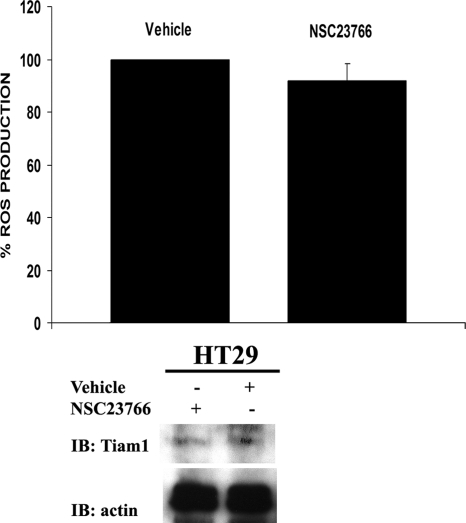
The Src-regulated Rac-GEF Tiam 1 is not involved in HT29 cell Src-induced ROS generation. HT29 cells were treated with 100 μM NSC23766, an inhibitor of the Rac-Tiam1 interaction, or with vehicle and ROS generation was measured by CL-assay (top). One representative experiment from three separate experiments is shown, and results are given as mean of triplicates ± SD. Bottom, under these conditions the treatment with NSC23766 did not change Tiam1 expression levels in HT29 cells.
Figure 6.
Figure 6.
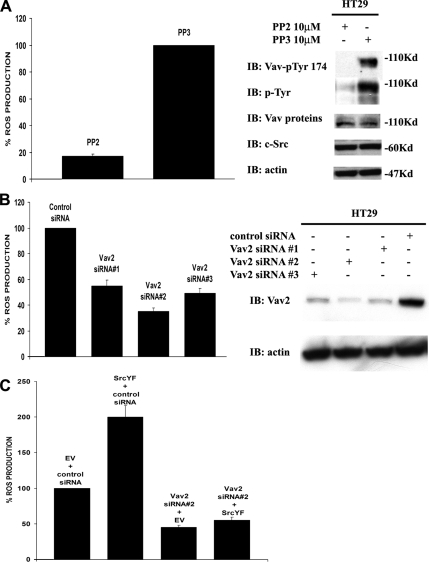
c-Src activates Vav2 to regulate Nox1-dependent ROS formation. (A) Inhibition of Src activity in HT29 cells by PP2 treatment reduces ROS generation and blocks endogenous Vav2 tyrosine-phosphorylation. HT29 cells were treated with 10 μM Src inhibitor PP2 or with its nonfunctional analogue PP3, and ROS production was monitored (left). One representative experiment from three separate experiments is shown, and results are given as mean of triplicates ± SD. The inhibition of Src activity by PP2 blocks tyrosine-phosphorylation of endogenous Vav2 without affecting the expression level of endogenous c-Src and Vav2 (right). The results shown are typical of at least three separate experiments. (B) Vav2-specific siRNAs that strongly decrease endogenous Vav2 protein levels also potently decrease ROS generation in HT29 cells. HT29 cells were transfected as described in Materials and Methods with three different Vav2-specific siRNAs (20 nM), and after 72 h the ROS formation was quantified by CL-assay (left). The right panel shows that all three Vav2-specific siRNAs significantly decrease endogenous Vav2 protein levels, with oligo#2 being the most effective. One representative experiment from three separate experiments is shown, and results are given as mean of triplicates ± SD. (C) SrcYF-induced ROS generation in HT29 cells is blocked by the transfection of Vav2-specific siRNA#2, which strongly decreases the level of endogenous Vav2 protein. HT29 cells were transfected by RNAiMax with empty vector or SrcYF (as indicated), and with control siRNA or with Vav2 siRNA#2. After 48 h, ROS generation was measured by CL-assay. One representative experiment from three separate experiments is shown, and results are given as mean of triplicates ± SD.
Figure 7.
Figure 7.
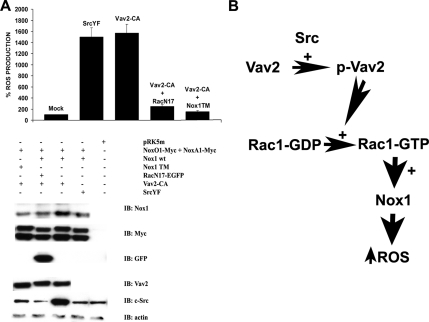
Vav2 induces Nox1-dependent ROS generation through a Rac-dependent mechanism. (A) The increase in ROS formation caused by the presence of constitutively active Vav2 (Vav2-CA) is blocked in HEK293 cells by the cotransfection of dominant-negative Rac1 (RacN17) and/or is prevented by Nox1 TM unable to bind Rac. HEK293 cells were transfected with empty vector or with NoxO1 and NoxA1, and, where indicated, with SrcYF, Vav2-CA, RacN17, and Nox1 wt or Nox1 TM. The ROS production was checked after 24 h (top). All transfected proteins were expressed at similar levels (bottom). One representative experiment from three separate experiments is shown and results are given as mean of triplicates ± SD. (B) A schematic representation of the mechanism described in this paper through which c-Src induces the Nox1-dependent ROS generation in HT29 cells. c-Src activates the member of the Rac-GEF superfamily Vav2 by tyrosine-phosphorylation, thereby increasing the cellular levels of Rac1-GTP and leading to the generation of superoxide anion by Nox1.

References

    1. Abe J., Takahashi M., Ishida M., Lee J. D., Berk B. C. c-Src is required for oxidative stress-mediated activation of big mitogen-activated protein kinase 1. J. Biol. Chem. 1997;272:20389–20394. - PubMed
    1. Abid M. R., Kachra Z., Spokes K. C., Aird W. C. NADPH oxidase activity is required for endothelial cell proliferation and migration. FEBS Lett. 2000;486:252–256. - PubMed
    1. Abram C. L., Courtneidge S. A. Src family tyrosine kinases and growth factor signaling. Exp. Cell Res. 2000;254:1–13. - PubMed
    1. Alvarez R. H., Kantarjian H. M., Cortes J. E. The role of Src in solid and hematologic malignancies: development of new-generation Src inhibitors. Cancer. 2006;107:1918–1929. - PubMed
    1. Arnold R. S., Shi J., Murad E., Whalen A. M., Sun C. Q., Polavarapu R., Parthasarathy S., Petros J. A., Lambeth J. D. Hydrogen peroxide mediates the cell growth and transformation caused by the mitogenic oxidase Nox1. Proc. Natl. Acad. Sci. USA. 2001;98:5550–5555. - PMC - PubMed

Publication types