


Phylogenetic backgrounds and virulence profiles of atypical enteropathogenic Escherichia coli strains from a case-control study using multilocus sequence typing and DNA microarray analysis
- PMID: 18463209
- PMCID: PMC2446914
- DOI: 10.1128/JCM.01752-07
Phylogenetic backgrounds and virulence profiles of atypical enteropathogenic Escherichia coli strains from a case-control study using multilocus sequence typing and DNA microarray analysis
Abstract
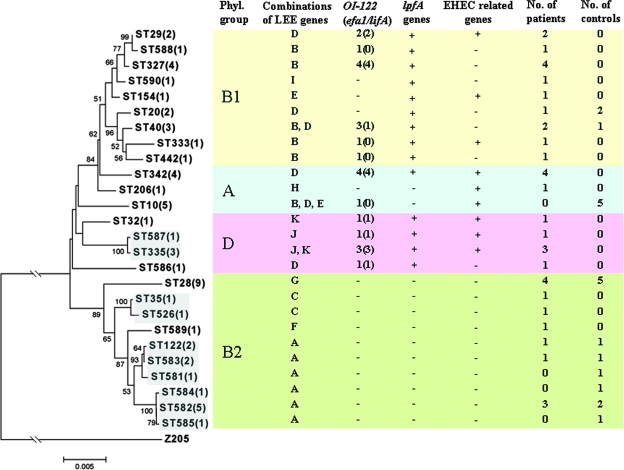
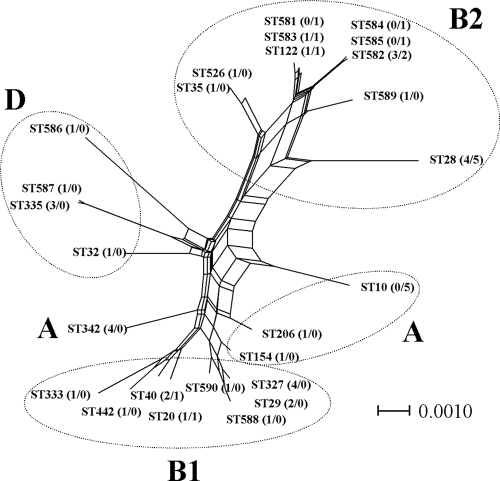
Atypical enteropathogenetic Escherichia coli (EPEC) strains are frequently detected in children with diarrhea but are also a common finding in healthy children. The aim of this study was to compare the phylogenetic ancestry and virulence characteristics of atypical (eae positive, stx and bfpA negative) EPEC strains from Norwegian children with (n = 37) or without (n = 19) diarrhea and to search for an association between phylogenetic ancestry and diarrhea. The strains were classified in phylogenetic groups by phylogenetic marker genes and in sequence types (STs) by multilocus sequence typing. Phylogenetic ancestry was compared to virulence characteristics based on DNA microarray analysis. Serotyping and pulsed-field gel electrophoresis (PFGE) were also performed. All four phylogenetic groups, 26 different STs, and 20 different clonal groups were represented among the 56 atypical EPEC strains. The strains were separated into three clusters by overall virulence gene profile; one large cluster with A, B1, and D strains and two clusters with group B2 strains. There was considerable heterogeneity in the PFGE profiles and serotypes, and almost half of the strains were O nontypeable. The efa1/lifA gene, previously shown to be statistically linked with diarrhea in this strain collection (J. E. Afset et al., J. Clin. Microbiol. 44:3703-3711, 2006), was present in 8 of 26 STs. The two phylogenetic groups B1 and D were weakly associated with diarrhea (P = 0.06 and P = 0.09, respectively). In contrast, group B2 was isolated most frequently from healthy controls (P = 0.05). In conclusion, the atypical EPEC strains were heterogeneous both phylogenetically and by virulence profile. Phylogenetic ancestry was less useful as a predictor of diarrhea than were specific virulence genes.
Figures


References
-
- Afset, J. E., L. Bevanger, P. Romundstad, and K. Bergh. 2004. Association of atypical enteropathogenic Escherichia coli (EPEC) with prolonged diarrhoea. J. Med. Microbiol. 531137-1144. - PubMed
-
- Aktan, I., K. A. Sprigings, R. M. La Ragione, L. M. Faulkner, G. A. Paiba, and M. J. Woodward. 2004. Characterisation of attaching-effacing Escherichia coli isolated from animals at slaughter in England and Wales. Vet. Microbiol. 10243-53. - PubMed
-
- Alikhani, M. Y., A. Mirsalehian, and M. M. Aslani. 2006. Detection of typical and atypical enteropathogenic Escherichia coli (EPEC) in Iranian children with and without diarrhoea. J. Med. Microbiol. 551159-1163. - PubMed
Publication types
MeSH terms
Substances
LinkOut - more resources
Full Text Sources
Medical
