


Perceptions of childhood immunization in a minority community: qualitative study
- PMID: 18463280
- PMCID: PMC2376260
- DOI: 10.1258/jrsm.2008.070363
Perceptions of childhood immunization in a minority community: qualitative study
Abstract
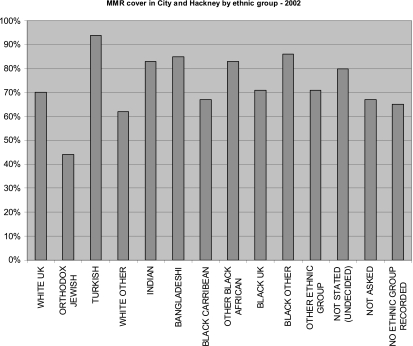
Objective: To assess reasons for low uptake of immunization amongst orthodox Jewish families.
Design: Qualitative interviews with 25 orthodox Jewish mothers and 10 local health care workers.
Setting: The orthodox Jewish community in North East London.
Main outcome measures: Identification of views on immunization in the orthodox Jewish community.
Results: In a community assumed to be relatively insulated from direct media influence, word of mouth is nevertheless a potent source of rumours about vaccination dangers. The origins of these may lie in media scares that contribute to anxieties about MMR. At the same time, close community cohesion leads to a sense of relative safety in relation to tuberculosis, with consequent low rates of BCG uptake. Thus low uptake of different immunizations arises from enhanced feelings of both safety and danger. Low uptake was not found to be due to the practical difficulties associated with large families, or to perceived insensitive cultural practices of health care providers.
Conclusions: The views and practices of members of this community are not homogeneous and may change over time. It is important that assumptions concerning the role of religious beliefs do not act as an obstacle for providing clear messages concerning immunization, and community norms may be challenged by explicitly using its social networks to communicate more positive messages about immunization. The study provides a useful example of how social networks may reinforce or challenge misinformation about health and risk and the complex nature of decision making about children's health.
Figures
Comment in
-
MMR and the value of word of mouth in social networks.J R Soc Med. 2008 May;101(5):215. doi: 10.1258/jrsm.2008.101005. J R Soc Med. 2008. PMID: 18463267 Free PMC article. No abstract available.
References
-
- Wakefield A, Murch S, Anthony A, et al. Ileal-lymphoid-nodular hyperplasia, non-specific colitis, and pervasive developmental disorder in children. Lancet. 1998;351:637–41. - PubMed
-
- NHS Immunisation Statistics, England: 2003/04. http://www.dh.gov.uk/assetRoot/04/09/95/77/04099577.pdf
Publication types
MeSH terms
Substances
LinkOut - more resources
Full Text Sources
Medical
