


doi: 10.3390/molecules13040822.
A structure-activity study of antibacterial diterpenoids
Affiliations
- PMID: 18463590
- PMCID: PMC6245368
- DOI: 10.3390/molecules13040822
Item in Clipboard
A structure-activity study of antibacterial diterpenoids
Molecules.
.
Abstract
An analysis of the antibacterial activities of 15 terpenoids, eleven of which were previously described by us and four were extracted from the literature, suggested two structural requirements for activity of these and related compounds: a hydrophobic moiety,consisting of a substituted decalin skeleton, and a hydrophilic region possessing one hydrogen-bond-donor group. These structural requirements are responsible for an optimal insertion of these and related compounds into cell membranes, as suggested by the results of docking some of these compounds into a model phospholipid bilayer.
Figures
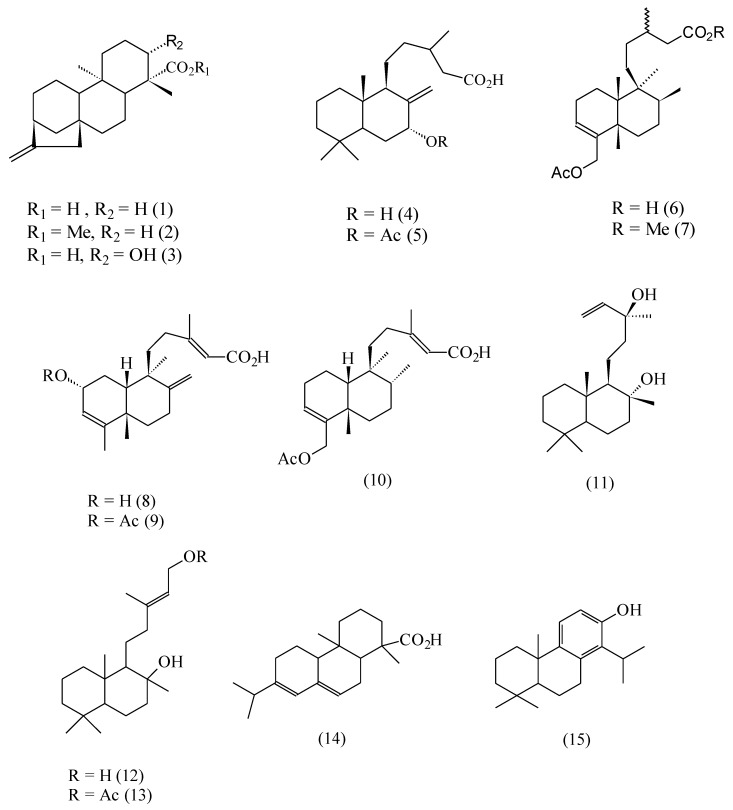
Diterpenoid structures.

Mode of insertion of one molecule of kaurenoic acid (1) into a POPC bilayer, showing the hydrogen-bond interaction between the carboxylic group of the diterpenoid and a phosphoryl oxygen atom of the surfactant.
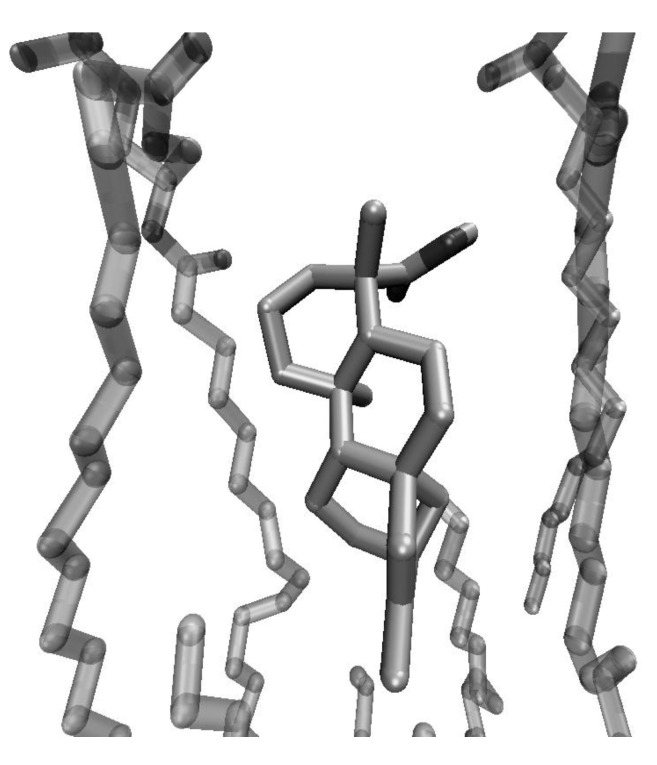
Mode of insertion of one molecule of methyl kaurenoate (2) into a POPC bilayer

Mode of insertion of one molecule of ent–3-β-hydroxykaurenoic acid (3) into a POPC bilayer. The –CO2H----O=P hydrogen-bond is now larger (3.11 Å) than the one depicted in Figure 1 (1.91 Å).
References
-
- Bankova V., Marcucci M.C., Simova S., Nikolova N., Ujumgiev A., Popova M. Antibacterial diterpenic acids from Brazilian propolis. Z. Naturforsch. [C] 1996;51:277–280. - PubMed
-
- Velikova M., Bankova V., Marcucci M.C., Tsvetkova I., Kujumgiev A. Chemical composition and biological activity of propolis from Brazilian meliponinae. Z. Naturforsch. [C] 2000b;55:785–789. - PubMed
Publication types
MeSH terms
Substances
LinkOut - more resources
Full Text Sources
Medical
Molecular Biology Databases
