. 2008 Jun 19;453(7198):1094-7.
doi: 10.1038/nature06943. Epub 2008 May 7.

Cytokinin and auxin interaction in root stem-cell specification during early embryogenesis

Affiliations

Cytokinin and auxin interaction in root stem-cell specification during early embryogenesis

Bruno Müller et al. Nature. .

Abstract

Plant stem-cell pools, the source for all organs, are first established during embryogenesis. It has been known for decades that cytokinin and auxin interact to control organ regeneration in cultured tissue. Auxin has a critical role in root stem-cell specification in zygotic embryogenesis, but the early embryonic function of cytokinin is obscure. Here, we introduce a synthetic reporter to visualize universally cytokinin output in vivo. Notably, the first embryonic signal is detected in the hypophysis, the founder cell of the root stem-cell system. Its apical daughter cell, the precursor of the quiescent centre, maintains phosphorelay activity, whereas the basal daughter cell represses signalling output. Auxin activity levels, however, exhibit the inverse profile. Furthermore, we show that auxin antagonizes cytokinin output in the basal cell lineage by direct transcriptional activation of ARABIDOPSIS RESPONSE REGULATOR genes, ARR7 and ARR15, feedback repressors of cytokinin signalling. Loss of ARR7 and ARR15 function or ectopic cytokinin signalling in the basal cell during early embryogenesis results in a defective root stem-cell system. These results provide a molecular model of transient and antagonistic interaction between auxin and cytokinin critical for specifying the first root stem-cell niche.


Figures

Figure 1
Figure 1. Sensitive and specific response of TCS
a, 100 nM trans-zeatin (tZ) induces TCS-LUC, not 1 μM auxin (NAA), 100μM abscisic acid (ABA), or 50 μM gibberellic acid (GA). TCS*-LUC negative control. b, TCS-LUC induced by cZ, cis-zeatin; oT, ortho-topolin; TDZ, thidiazuron; iP, N6-(Δ2-isopentenyl)adenine; AD, adenine (negative control), all at 100 nM. c–e, TCS-LUCinduction by tz (c) reduced in double-mutant ahk2–2, ahk3–3, cre1–16 Combinations, (d) stimulated by B-type ARRs, (e) reduced by A-type ARRs. f, Dose responses. g–k, Embryonic TCS∷GFP activity. s, suspensor; hy, hypophysis; lsc, lens-shaped cell; bc, basal cell lineage; qc, quiescent centre. Error bars s.d. (n=3), scale bars 10μM.
Figure 2
Figure 2. Inverse correlation between cytokinin and auxin signalling
a, Two-component gene transcription by quantitative real time reverse transcriptase polymerase chain reaction (qRT-PCR) at transition stage. Error bars s.d. (n=3). b, TCS∷GFP in hy at early globular stage. c, Downregulation in bc at late globular stage. d, First ARR7∷GFP expression peaks in bc. e, ARR15∷GFP expression. f, DR5∷GFP activity highest in bc. Zoomed view in middle row. Schematic interpretation in bottom row. NGE, normalized gene expression; HK/AHK, Arabidopsis histidine kinases; HPT/AHP, histidine-phosphotransfer proteins; RR/ARR, response regulators; CKI1, cytokinin independent 1; ETR1, ethylene response 1; ERS1, ethylene response sensor 1.
Figure 3
Figure 3. ARR7 and ARR15 mediate auxin control of cytokinin signalling
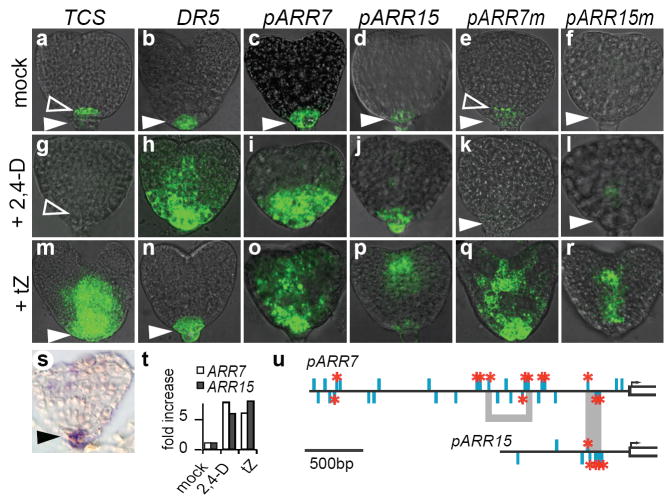
a–r, Over-night treatment with water, 50 μM 2,4-D or tZ. pARR7m (e, k, q) pARR15m (f, l, r) explained in (u). Filled arrowheads denote bc, open arrowheads qc. s, In situ hybridisation to ARR7 mRNA. t, ARR7 and ARR15 mRNA induction assayed by qRT-PCR after 4-hour treatment of embryos with 1 μM tZ or 2,4-D. u, ARR7 and ARR15 promoters. TGTC on sense and antisense strands as blue bars. Red asterisks: TGTC -> TGgC. Grey shade connects conserved regions; see text for detail.
Figure 4
Figure 4. Function of differential phosphorelay output for root-stem cell establishment
a–l, Embryos are arr15, RPS5a∷AlcA AlcR∷ARR7-i. a–f, Control embryos, no ethanol. g–l, Embryos after ARR7-i induction in the arr15 mutant background. Induction for 10 h (g), 36 h (h) and 60 h (i–l). d–f, j–l, In situ hybridisations. Artificial colours (c) denote stem-cell identity, with qc in pink. Cells shaded in grey (i) have unclear identity. Filled arrowheads point to bc, open arrowheads to qc (d–f, j–l), or missing qc (i–l). m, Model for auxin-dependent phosphorelay downregulation in bc. Scale bars 10 μm.

References

    1. Skoog F, Miller CO. Chemical regulation of growth and organ formation in plant tissues cultured in vitro. Symp Soc Exp Biol. 1957;54:118–130. - PubMed
    1. Friml J, Vieten A, Sauer M, Weijers D, Schwarz H, Hamann T, Offringa R, Jürgens G. Efflux-dependent auxin gradients establish the apical-basal axis of Arabidopsis. Nature. 2003;426:147–153. - PubMed
    1. Weijers D, Jürgens G. Auxin and embryo axis formation: the ends in sight? Curr Opin Plant Biol. 2005;8:32–37. - PubMed
    1. Riefler M, Novak O, Strnad M, Schmülling T. Arabidopsis cytokinin receptor mutants reveal functions in shoot growth, leaf senescence, seed size, germination, root development, and cytokinin metabolism. Plant Cell. 2006;18:40–54. - PMC - PubMed
    1. Nishimura C, Ohashi Y, Sato S, Kato T, Tabata S, Ueguchi C. Histidine kinase homologs that act as cytokinin receptors possess overlapping functions in the regulation of shoot and root growth in Arabidopsis. Plant Cell. 2004;16:1365–1377. - PMC - PubMed

Publication types

MeSH terms