


Fracture rates in urban South African children of different ethnic origins: the Birth to Twenty cohort
- PMID: 18465189
- PMCID: PMC2859163
- DOI: 10.1007/s00198-008-0627-x
Fracture rates in urban South African children of different ethnic origins: the Birth to Twenty cohort
Abstract
Fracture rates were compared in children of different ethnic backgrounds from Johannesburg, South Africa. More white children fracture than black and mixed ancestry children. Reasons for this may be due to greater sports participation by whites and genetic protective factors in blacks. This has to be further investigated.
Introduction: Fracture rates in childhood are as high as those in the elderly. Recent research has been undertaken to understand the reasons for this, but there is little information available on ethnic differences in childhood fracture rates.
Methods: Using the birth to twenty longitudinal cohort of children, we retrospectively obtained information on fractures and their sites from birth to 14.9 years of age on 2031 participants. The ethnic breakdown of the children was black (B) 78%, white (W) 9%, mixed ancestry (MA) 10.5% and Indian (I) 1.5%.
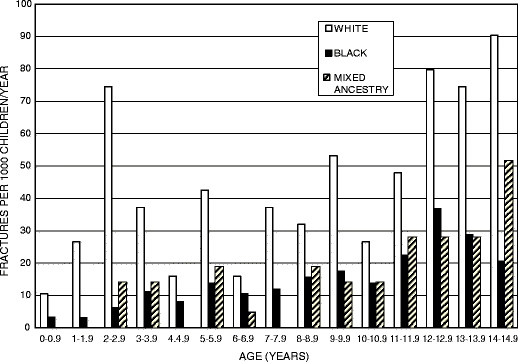
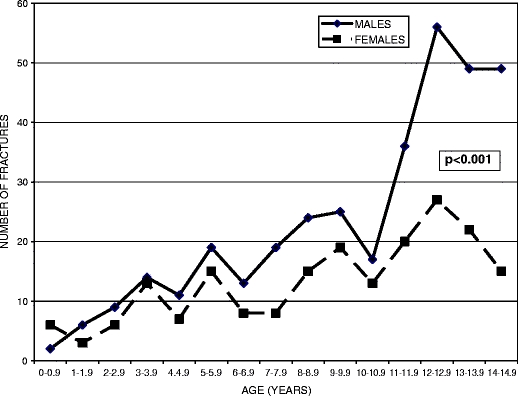
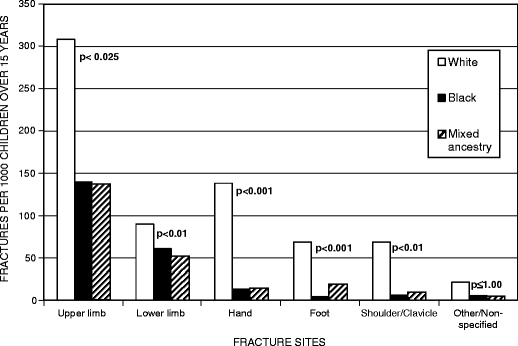
Results: Four hundred and forty-one (22%) children had sustained a fracture one or more times during their lifetime (males 27.5% and females 16.3%; p < 0.001). The percentage of children fracturing differed between the ethnic groups (W 41.5%, B 19%, MA 21%, I 30%; p < 0.001). Of the 441 children reporting fractures, 89(20%) sustained multiple fractures. The most common site of fracture was the upper limb (57%).
Conclusion: More white children fracture than black and mixed ancestry children. This is the first study to show ethnic differences in fracture rates among children. The reasons for these differences have to be further elucidated. Greater sports participation by whites and genetic protective factors in blacks may be contributing factors.
Figures
References
-
- Landin LA. Fracture patterns in childrenAnalysis of 8,682 fractures with special reference to incidence, etiology and secular changes in a Swedish urban population 1950–1979. Acta Orthop Scand Suppl. 1983;202:1–109. - PubMed
-
- Luckey MM, Meier DE, Mandeli JP, et al. Radial and vertebral bone density in white and black women: evidence for racial differences in premenopausal bone homeostasis. J Clin Endocrinol Metab. 1989;69:762–770. - PubMed
Publication types
MeSH terms
Grants and funding
LinkOut - more resources
Full Text Sources
Medical
