


Cuckoo-hawk mimicry? An experimental test
- PMID: 18467298
- PMCID: PMC2587796
- DOI: 10.1098/rspb.2008.0331
Cuckoo-hawk mimicry? An experimental test
Abstract
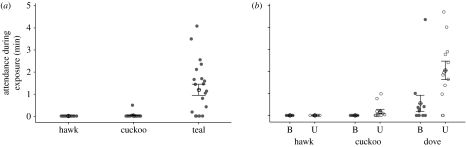
The similarity between many Old World parasitic cuckoos (Cuculinae) and Accipiter hawks, in size, shape and plumage, has been noted since ancient times. In particular, hawk-like underpart barring is more prevalent in parasitic than in non-parasitic cuckoos. Cuckoo-hawk resemblance may reflect convergent evolution of cryptic plumage that reduces detection by hosts and prey, or evolved mimicry of hawks by parasitic cuckoos, either for protection against hawk attacks or to facilitate brood parasitism by influencing host behaviour. Here, we provide the first evidence that some small birds respond to common cuckoos Cuculus canorus as if they were sparrowhawks Accipiter nisus. Great tits and blue tits were equally alarmed and reduced attendance at feeders during and after the presentation of mounted specimens of common cuckoos and sparrowhawks, but not in response to control presentations of collared doves or teal. Plumage manipulations revealed that the strong alarm response to cuckoos depended on their resemblance to hawks; cuckoos with barred underparts were treated like hawks, while those with unbarred underparts were treated like doves. However, barring was not the only feature inducing alarm because tits showed similarly strong alarm to barred and unbarred hawks, and little alarm to barred doves. These responses of tits, unsuitable as hosts and hence with no history of cuckoo parasitism, suggest that naive small birds can mistake cuckoos for hawks. Thus, any cuckoo-hawk discrimination by host species is likely to be an evolved response to brood parasitism.
Figures

References
-
- Barnett C.A, Bateson M, Rowe C. State-dependent decision making: educated predators strategically trade off the costs and benefits of consuming aposematic prey. Behav. Ecol. 2007;18:645–651. doi:10.1093/beheco/arm027 - DOI
-
- Brooke M. de L, Davies N.B. Egg mimicry by cuckoos Cuculus canorus in relation to discrimination by hosts. Nature. 1988;335:630–632. doi:10.1038/335630a0 - DOI
-
- Chance E.P. Country Life; London, UK: 1940. The truth about the cuckoo.
-
- Cheney K.L, Côté I.M. Aggressive mimics profit from a model-signal receiver mutualism. Proc. R. Soc. B. 2007;274:2087–2091. doi:10.1098/rspb.2007.0543 - DOI - PMC - PubMed
-
- Craib J. Why do common cuckoos resemble raptors? Br. Birds. 1994;87:78–79.
Publication types
MeSH terms
LinkOut - more resources
Full Text Sources