Epididymis expresses the highest 5'-deiodinase activity in the male reproductive system: kinetic characterization, distribution, and hormonal regulation
- PMID: 18467445
- PMCID: PMC2488221
- DOI: 10.1210/en.2007-1679
Epididymis expresses the highest 5'-deiodinase activity in the male reproductive system: kinetic characterization, distribution, and hormonal regulation
Abstract
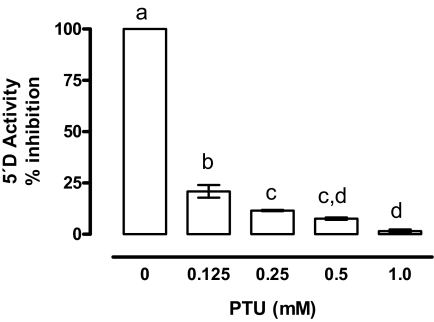
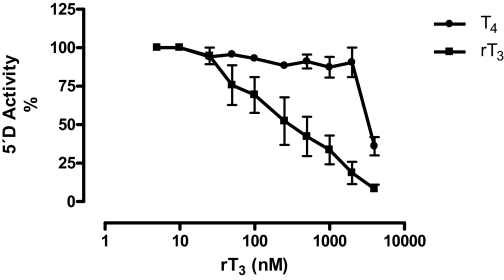
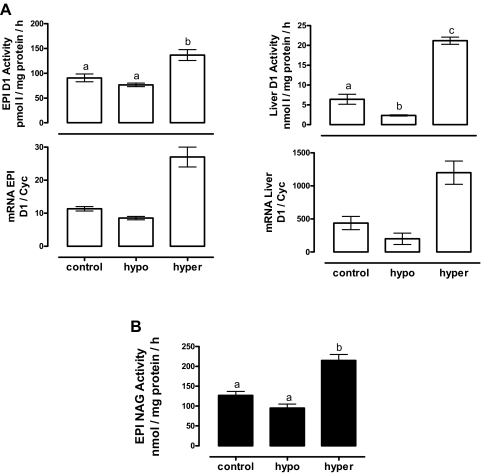
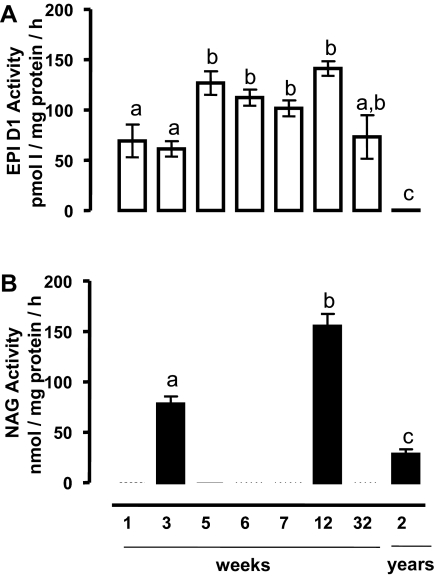
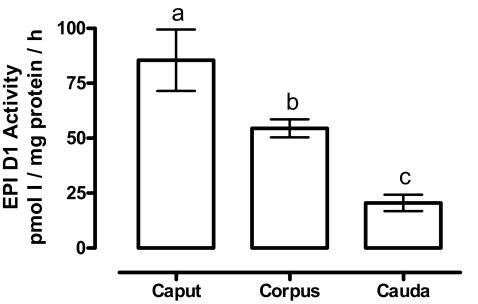
We characterized the enzymes that catalyze the deiodination of T(4) to T(3) in the male reproductive tract. Testis, epididymis (EPI), seminal vesicles, prostate, bulbourethral glands, spermatozoa, and semen were taken from sexually mature rats (300 g). Iodothyronine 5'-deiodinase (5'-D) activity was quantified by the radiolabeled-iodide-release method. 5'-D activity was 10-fold higher in EPI and semen than in the rest of the tissues. In EPI, semen, and prostate, the enzymatic activity was completely inhibited by 1 mm 6-n-propyl-2-thiouracil, whereas in the other tissues the inhibition was partial (50%). The high susceptibility to 6-n-propyl-2-thiouracil inhibition, a ping-pong kinetic pattern, and low cofactor (Michaelis Menten constant for dithiothreitol=0.7 mm) and high substrate (Michaelis Menten constant for reverse T(3)=0.4 microm) requirements indicate that EPI 5'-D corresponds to type 1 deiodinase (D1). Real-time RT-PCR amplification of D1 mRNA in this tissue confirms this conclusion. The highest EPI D1 expression occurred at the onset of puberty and sexual maturity, and in the adult, this activity was more abundant in corpus and caput than in the caudal region. EPI D1 expression was elevated under conditions of hyperthyroidism and with addition of 17beta-estradiol. Our data also showed a direct association between D1 and a functional epididymis marker, the neutral alpha-glucosidase enzyme, suggesting that local generation of T(3) could be associated with the development and function of EPI and/or spermatozoa maturation. Further studies are necessary to analyze the possible physiological relevance of 5'-D in the male reproductive system.
Figures




References
-
- Jannini EA, Ulisse S, D'Armiento M 1995 Thyroid hormone and male gonadal function. Endocr Rev 16:443–459 - PubMed
-
- Cooke PS, Holsberger DR, Witorsch RJ, Sylvester PW, Meredith JM, Treinen KA, Chapin RE 2004 Thyroid hormone, glucocorticoids, and prolactin at the nexus of physiology, reproduction, and toxicology. Toxicol Appl Pharmacol 194:309–335 - PubMed
-
- Ariyaratne HB, Mendis-Handagama SM, Mason JI 2000 Effects of tri-iodothyronine on testicular interstitial cells and androgen secretory capacity of the prepubertal rat. Biol Reprod 63:493–502 - PubMed
-
- Holsberger DR, Cooke PS 2005 Understanding the role of thyroid hormone in Sertoli cell development: a mechanistic hypothesis. Cell Tissue Res 322:133–140 - PubMed
-
- Buzzard JJ, Morrison JR, O'Bryan MK, Song Q, Wreford NG 2000 Developmental expression of thyroid hormone receptors in the rat testis. Biol Reprod 62:664–669 - PubMed