. 2008 Jul;147(3):1199-211.
doi: 10.1104/pp.108.117812. Epub 2008 May 8.

Involvement of CBF transcription factors in winter hardiness in birch

Affiliations

Involvement of CBF transcription factors in winter hardiness in birch

Annikki Welling et al. Plant Physiol. 2008 Jul.

Abstract

Cold acclimation of plants involves extensive reprogramming of gene expression. In Arabidopsis (Arabidopsis thaliana), three cold-inducible transcriptional activators designated CBF1 to -3/DREB1a to -c have been shown to play an important regulatory role in this acclimation process. Similarly to Arabidopsis, boreal zone trees can increase their freezing tolerance (FT) in response to low temperature during the growing season. However, maximal FT of these trees requires short daylength-induced dormancy development followed by exposure to both low and freezing temperatures. To elucidate the molecular basis of FT in overwintering trees, we characterized the role of birch (Betula pendula) CBF transcription factors in the cold acclimation process. We identified four putative CBF orthologs in a birch expressed sequence tag collection designated BpCBF1 to -4. Ectopic expression of birch CBFs in Arabidopsis resulted in constitutive expression of endogenous CBF target genes and increased FT of nonacclimated transgenic plants. In addition, these plants showed stunted growth and delayed flowering, typical features for CBF-overexpressing plants. Expression analysis in birch showed that BpCBF1 to -4 are low temperature responsive but differentially regulated in dormant and growing plants, the expression being delayed in dormant tissues. Freeze-thaw treatment, simulating wintertime conditions in nature, resulted in strong induction of BpCBF genes during thawing, followed by induction of a CBF target gene, BpLTI36. These results suggest that in addition to their role in cold acclimation during the growing season, birch CBFs appear to contribute to control of winter hardiness in birch.


Figures
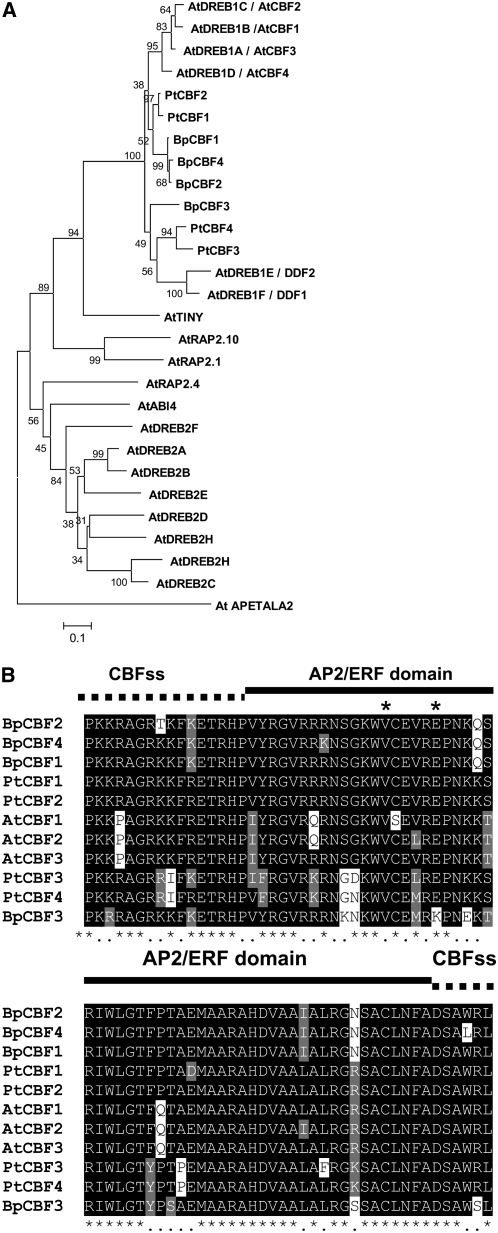
Figure 1.
Figure 1.
Comparison of CBF/DREB1 protein family members of Arabidopsis, poplar, and birch. A, A phylogenetic analysis of birch and poplar CBF proteins and the Arabidopsis DREB family of proteins. Analysis, based on minimum evolution, was performed with the full-length protein sequences using the AP2 transcription factor as an out group. Alignment was made using four birch CBF proteins: BpCBF1 (ABP98987), BpCBF2 (ABP98988), BpCBF3 (ABP98989), and BpCBF4 (FG124897); four poplar CBF proteins: PtCBF1 (JGI666968), PtCBF2 (JGI346104), PtCBF3 (JGI548519), and PtCBF4 (JGI63608); and the Arabidopsis DREB family of proteins, which includes four CBF/DREB1 proteins: AtDREB1b/AtCBF1 (At4g25490), AtDREB1c/AtCBF2 (At4g25470), AtDREB1a/AtCBF3 (At4g25480), and AtDREB1d/AtCBF4 (At5g51990), as well as AtDREB1F/DDF1 (At1g12610), AtDREB1E/DDF2 (At1g63030), AtTINY (At5g25810), AtRAP2.10 (At4g36900), AtRAP2.1 (At1g46768), AtABI4 (At2g40220), AtRAP2.4 (At1g78080), AtDREB2D (At1g75490), AtDREB2G (At5g18450), AtDREB2F (At3g57600), AtDREB2E (At2g38340), AtDREB2A (At5g05410), AtDREB2B (At3g11020), AtDREB2H (At2g40350), AtDREB2C (At2g40340), and AtAP2 (At4g36920). CBF proteins were initially aligned using ClustalW and used to conduct phylogenetic analysis using MEGA version 4.1 software (http://www.megasoftware.net/). The phylogenetic tree was constructed using the neighbor-joining method on 1,000 bootstrap replications. Bootstrap percentages are shown on the dendrogram branch points. B, Alignment of AP2 and flanking CBF signature sequences of Arabidopsis, poplar, and birch CBF transcription factors. CBF signature sequences (CBFss) are marked with a dotted line, and the AP2/ERF domain is marked with a solid line. The 14th and 19th amino acids of AP2/ERF domain are marked with asterisks.
Figure 2.
Figure 2.
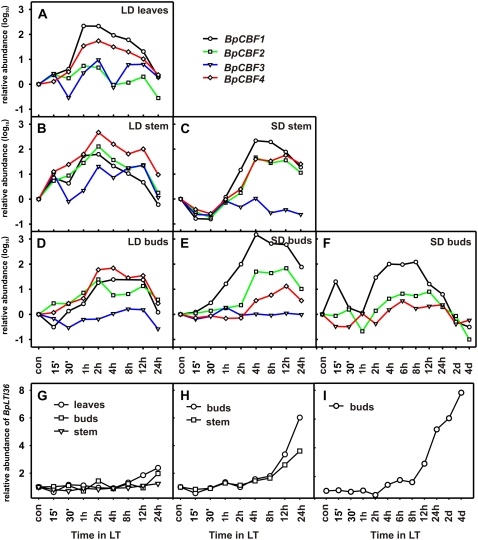
Real-time quantitative RT-PCR analysis of BpCBF1 to -4 and BpLTI36 gene expression in growing and dormant birch in response to LT. Samples were collected from leaves (A), stems (B), and buds (D) of growing birch under LD conditions (22-h day, 18°C) or from stems (C) or buds of dormant birch grown under SD conditions (12-h day, 18°C) prior to LT treatment for 6 weeks (E) or 11 weeks (F). BpLTI36 was analyzed in corresponding samples under LD (G) or after 6 (H) or 11 (I) weeks under SD conditions. Samples were collected at 18°C (control) and after 15 or 30 min, 1, 2, 4, 6 (only after 11 weeks of SD), 8, 12, or 24 h, and 2 or 4 d (only after 11 weeks of SD) of LT (2°C) treatment in the corresponding daylength.
Figure 3.
Figure 3.
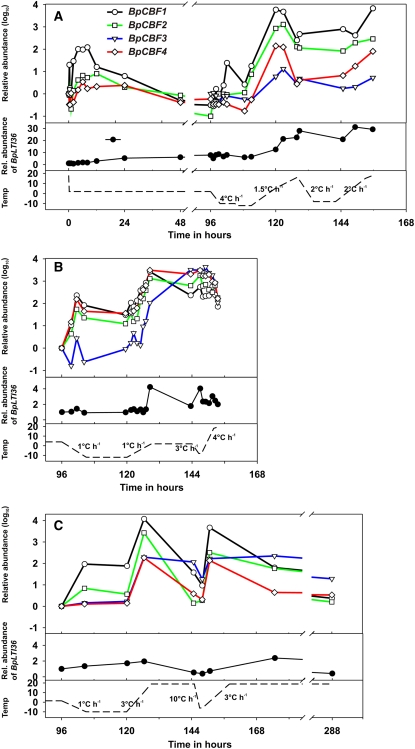
Real-time quantitative RT-PCR analysis of BpCBF1 to -4 and BpLTI36 gene expression in dormant birch buds (A) and stems (B and C) in response to freeze-thaw treatment. A, Four-month-old birch seedlings were grown under SD conditions (12-h day, 20°C; lights were on from 6 am to 6 pm) for 6 weeks (B and C) or 11 weeks (A), after which they were exposed to LT (2°C [A and C] or 4°C [B]) under the same daylength for 4 d. After this, seedlings were exposed to different freeze-thaw temperatures indicated by the dashed line in the bottom panels. The rate of temperature change is indicated in numbers each time. Freezing treatment started at 9 am in each experiment, 3 h after the lights were switched on. Trees were sprayed with tap water after 1 h at below-zero temperatures to initiate extracellular freezing. Relative transcript abundance was compared with SD control samples before LT treatment (0-h time point; A) or with combined SD and 4-d LT treatment (96-h time point; B and C).
Figure 4.
Figure 4.
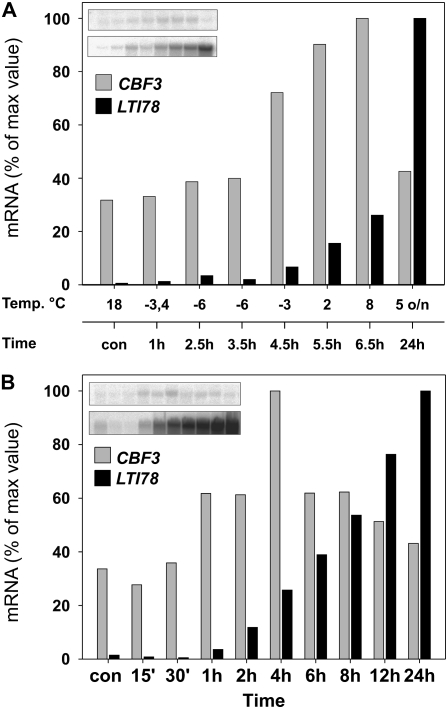
Effects of low and freezing temperatures on the expression response of Arabidopsis CBF3 and LTI78 genes. A, Expression response of CBF3 and LTI78 genes to freezing temperature in Arabidopsis. Three-week-old soil-grown (23°C, 12-h day; lights were on from 6 am to 6 pm) Arabidopsis plants were exposed to freezing temperatures by placing them directly in −2.6°C for 0.5 h, after which the temperature was decreased to −6°C at 1°C h−1. Temperature was kept at −6°C for 1 h, after which it was allowed to increase to 8°C during the next 3 h. Plants were kept at low positive temperature overnight. The experiment started at 8:30 am, and after 1 h at freezing temperature plants were sprayed with tap water to initiate extracellular freezing. The 1-h time sample was collected just before spraying. All of the leaves in the rosette were collected for RNA analysis. B, Expression response of CBF3 and LTI78 genes in Arabidopsis in response to LT. The experimental design was the same as in the freezing experiment, except that plants were exposed to LT (2°C, 12-h day) for the indicated times. LT treatment started at 9 am. The samples were analyzed with RNA gel-blot hybridization using a 32P-labeled cDNA probe for LTI78 and a gene-specific probe for CBF3. The histograms show normalized values for each gene after standardization to ribosomal signal intensities, presented as percentages of the highest value.

References

    1. Aalto MK, Palva ET (2006) Control of growth and cold acclimation in silver birch. In THH Chen, M Uemura, S Fujikawa, eds, Cold Hardiness in Plants. Molecular Genetics, Cell Biology and Physiology. CABI Publishing, Oxfordshire, UK, pp 153–166
    1. Améglio T, Ewers FW, Cochard H, Martignac M, Vandame M, Bodet C, Cruiziat P (2001) Winter stem xylem pressure in walnut trees: effects of carbohydrates, cooling and freezing. Tree Physiol 21 387–394 - PubMed
    1. Artlip TS, Callahan AM, Basset CL, Wisniewski ME (1997) Seasonal expression of a dehydrin gene in sibling deciduous and evergreen genotypes of peach (Prunus persica [L.] Batsch). Plant Mol Biol 33 61–70 - PubMed
    1. Baker SS, Wilhelm KS, Thomashow MF (1994) The 5′-region of Arabidopsis thaliana cor15a has cis-acting elements that confer cold-, drought- and ABA-regulated gene expression. Plant Mol Biol 24 701–713 - PubMed
    1. Bassett CL, Wisniewski ME, Artlip TS, Norelli JL, Renaut J, Farrell RE Jr (2006) Global analysis of genes regulated by low temperature and photoperiod in peach bark. J Am Soc Hortic Sci 131 551–563

Publication types

Substances

LinkOut - more resources