


CTLA-4 trafficking and surface expression
- PMID: 18468488
- PMCID: PMC4186961
- DOI: 10.1016/j.it.2008.02.011
CTLA-4 trafficking and surface expression
Abstract
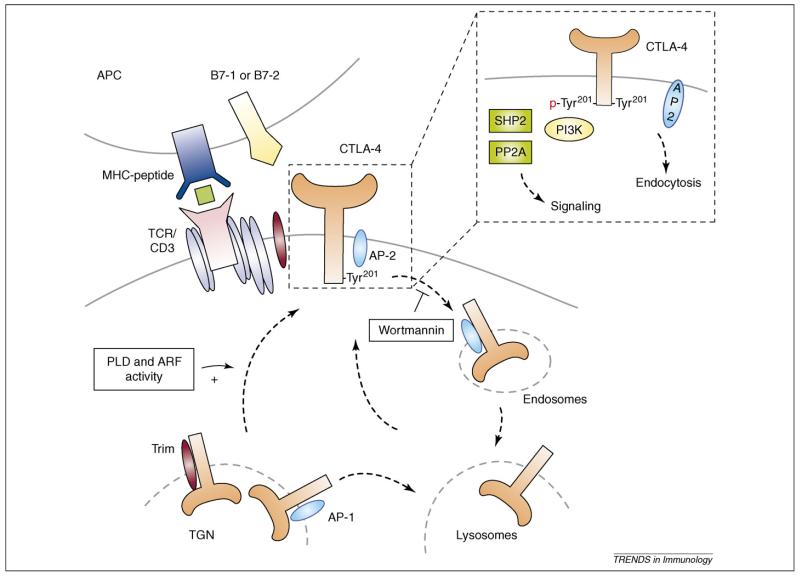
The T-cell co-receptor cytotoxic T-cell antigen 4 (CTLA-4) has a strong inhibitory role as shown by the lymphoproliferative phenotype of CTLA-4-deficient mice. Despite its potent effects on T-cell function, CTLA-4 is primarily an intracellular antigen whose surface expression is tightly regulated by restricted trafficking to the cell surface and rapid internalisation. Recently, several signalling molecules such as Trim, PLD, ARF-1 and TIRC7 have been described to be involved in the transport of CTLA-4 to the cell surface. Minor changes in surface expression levels have major effects on the outcome of T-cell activation. Optimal regulation of CTLA-4 surface expression is crucial for the balance of stimulatory and inhibitory signals to maximize protective immune responses while maintaining immunological tolerance and preventing autoimmunity.
Figures
References
-
- Tivol EA, et al. Loss of CTLA-4 leads to massive lymphoproliferation and fatal multiorgan tissue destruction, revealing a critical negative regulatory role of CTLA-4. Immunity. 1995;3:541–547. - PubMed
-
- Waterhouse P, et al. Lymphoproliferative disorders with early lethality in mice deficient in Ctla-4. Science. 1995;270:985–988. - PubMed
-
- Chambers CA, et al. Lymphoproliferation in CTLA-4-deficient mice is mediated by costimulation-dependent activation of CD4+ T cells. Immunity. 1997;7:885–895. - PubMed
-
- Thompson CB, Allison JP. The emerging role of CTLA-4 as an immune attenuator. Immunity. 1997;7:445–450. - PubMed
-
- Fraser JH, et al. CTLA4 ligation attenuates AP-1, NF-AT and NF-kappaB activity in activated T cells. Eur. J. Immunol. 1999;29:838–844. - PubMed
Publication types
MeSH terms
Substances
Grants and funding
LinkOut - more resources
Full Text Sources
Other Literature Sources
Molecular Biology Databases
Research Materials
