


Energy metabolism among eukaryotic anaerobes in light of Proterozoic ocean chemistry
- PMID: 18468979
- PMCID: PMC2606767
- DOI: 10.1098/rstb.2008.0031
Energy metabolism among eukaryotic anaerobes in light of Proterozoic ocean chemistry
Abstract
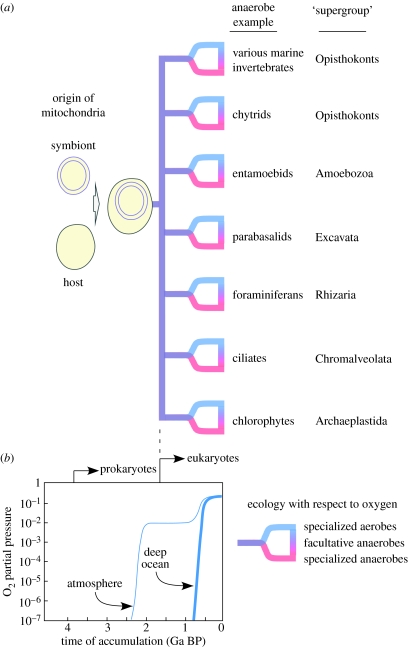
Recent years have witnessed major upheavals in views about early eukaryotic evolution. One very significant finding was that mitochondria, including hydrogenosomes and the newly discovered mitosomes, are just as ubiquitous and defining among eukaryotes as the nucleus itself. A second important advance concerns the readjustment, still in progress, about phylogenetic relationships among eukaryotic groups and the roughly six new eukaryotic supergroups that are currently at the focus of much attention. From the standpoint of energy metabolism (the biochemical means through which eukaryotes gain their ATP, thereby enabling any and all evolution of other traits), understanding of mitochondria among eukaryotic anaerobes has improved. The mainstream formulations of endosymbiotic theory did not predict the ubiquity of mitochondria among anaerobic eukaryotes, while an alternative hypothesis that specifically addressed the evolutionary origin of energy metabolism among eukaryotic anaerobes did. Those developments in biology have been paralleled by a similar upheaval in the Earth sciences regarding views about the prevalence of oxygen in the oceans during the Proterozoic (the time from ca 2.5 to 0.6 Ga ago). The new model of Proterozoic ocean chemistry indicates that the oceans were anoxic and sulphidic during most of the Proterozoic. Its proponents suggest the underlying geochemical mechanism to entail the weathering of continental sulphides by atmospheric oxygen to sulphate, which was carried into the oceans as sulphate, fueling marine sulphate reducers (anaerobic, hydrogen sulphide-producing prokaryotes) on a global scale. Taken together, these two mutually compatible developments in biology and geology underscore the evolutionary significance of oxygen-independent ATP-generating pathways in mitochondria, including those of various metazoan groups, as a watermark of the environments within which eukaryotes arose and diversified into their major lineages.
Figures
References
-
- Abe T, Hoshino T, Nakamura A, Takaya N. Anaerobic elemental sulfur reduction by fungus Fusarium oxysporum. Biosci. Biotechnol. Biochem. 2007;71:2402–2407. doi:10.1271/bbb.70083 - DOI - PubMed
-
- Adl S.M, et al. The new higher level classification of eukaryotes with emphasis on the taxonomy of protists. J. Eukaryot. Microbiol. 2005;52:399–451. doi:10.1111/j.1550-7408.2005.00053.x - DOI - PubMed
-
- Aklujkar M, Prince R.C, Beatty J.T. The puhE gene of Rhodobacter capsulatus is needed for optimal transition from aerobic to photosynthetic growth and encodes a putative negative modulator of bacteriochlorophyll production. Arch. Biochem. Biophys. 2005;437:186–198. doi:10.1016/j.abb.2005.03.012 - DOI - PubMed
-
- Amend J.P, Shock E.L. Energetics of overall metabolic reactions of thermophilic and hyperthermophilic Archaea and Bacteria. FEMS Microbiol. Rev. 2001;25:175–243. doi:10.1111/j.1574-6976.2001.tb00576.x - DOI - PubMed
Publication types
MeSH terms
Substances
LinkOut - more resources
Full Text Sources
