


Effects of diet, physical activity and performance, and body weight on incident gout in ostensibly healthy, vigorously active men
- PMID: 18469274
- PMCID: PMC4090353
- DOI: 10.1093/ajcn/87.5.1480
Effects of diet, physical activity and performance, and body weight on incident gout in ostensibly healthy, vigorously active men
Abstract
Background: Physical activity and cardiorespiratory fitness are not currently recognized as factors related to preventing gout, nor are risk factors for gout in physically active men well understood.
Objective: The objective was to identify risk factors for gout in ostensibly healthy, vigorously active men.
Design: Incident self-reported gout was compared with baseline diet, body mass index (BMI; in kg/m(2)), physical activity (in km/d run), and cardiorespiratory fitness (in m/s during 10-km footrace) prospectively in 28,990 male runners.
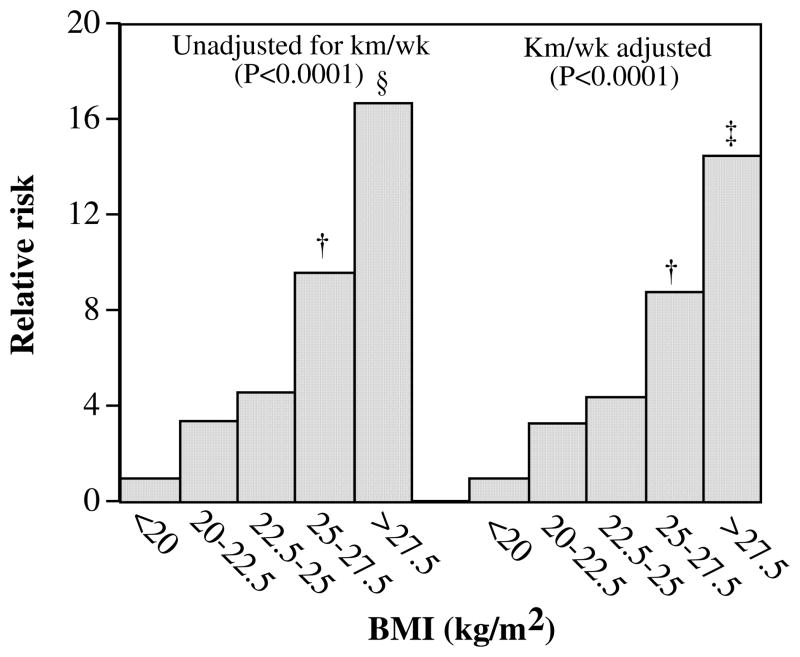
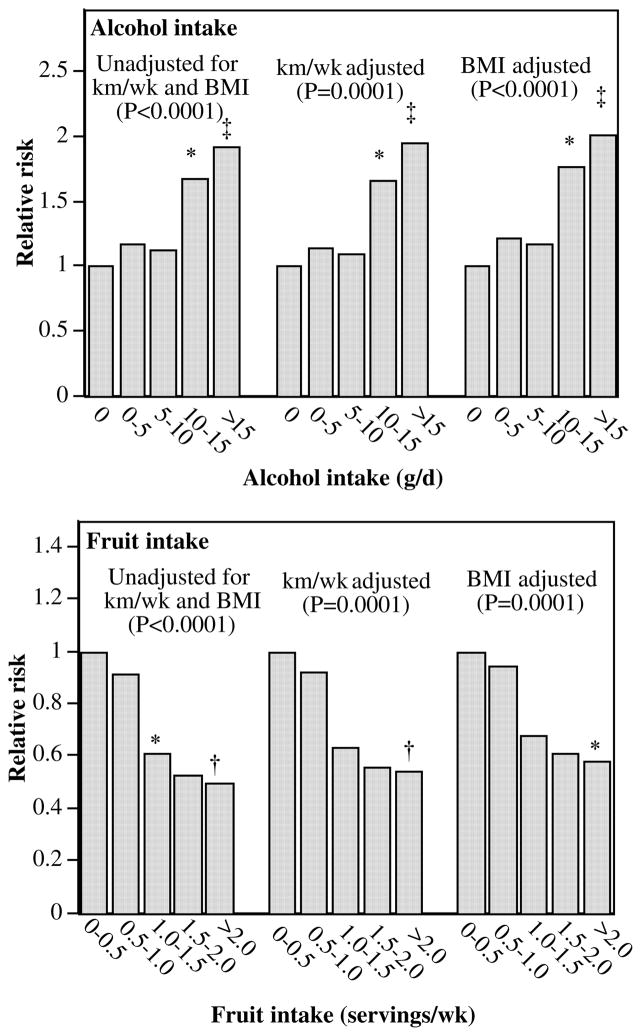
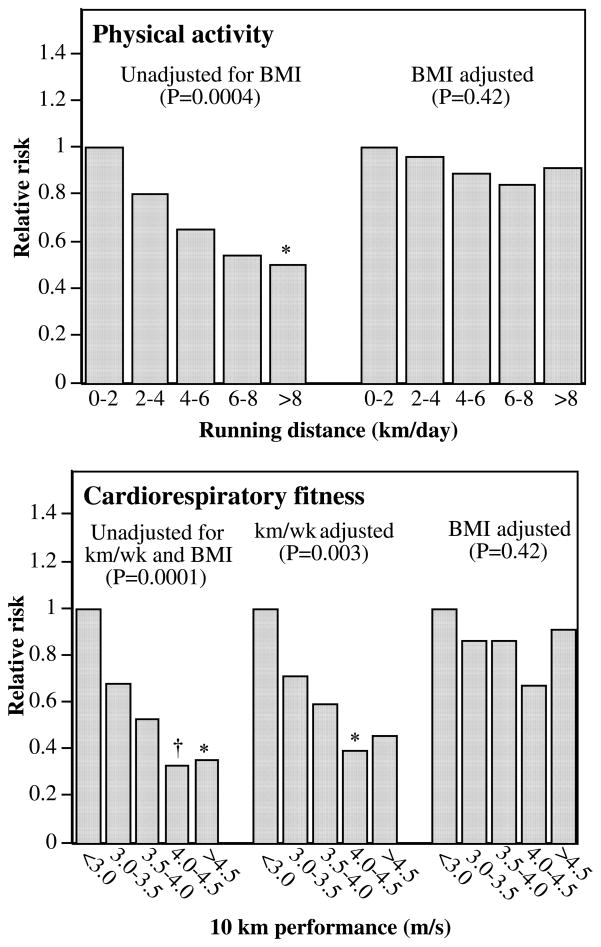
Results: Men (n = 228; 0.79%) self-reported incident gout during 7.74 y of follow-up. The risk of gout increased with higher alcohol intake [per 10 g/d; relative risk (RR): 1.19; 95% CI: 1.12, 1.26; P < 0.0001], meat consumption (per servings/d; RR: 1.45; 95% CI: 1.06, 1.92; P = 0.002), and BMI (RR: 1.19; 95% CI: 1.15, 1.23; P < 0.0001) and declined with greater fruit intake (per pieces/d; RR: 0.73; 95% CI: 0.62, 0.84; P < 0.0001), running distance (per km/d; RR: 0.92; 95% CI: 0.88, 0.97; P < 0.001), and fitness (per m/s; RR: 0.55; 95% CI: 0.41, 0.75; P < 0.0001). The RR per 10 g alcohol/d consumed as wine (1.27; P = 0.002), beer (1.19; P < 0.0001), and mixed drinks (1.13; P = 0.18) was not significantly different from each other. Men who consumed > 15 g alcohol/d had 93% greater risk than abstainers, and men who averaged > 2 pieces fruit/d had 50% less risk than those who ate < 0.5 fruit/d. Risk of gout was 16-fold greater for BMI > 27.5 than < 20. Compared with the least active or fit men, those who ran > or = 8 km/d or > 4.0 m/s had 50% and 65% lower risk of gout, respectively. Lower BMI contributed to the risk reductions associated with distance run and fitness.
Conclusion: These findings, based on male runners, suggest that the risk of gout is lower in men who are more physically active, maintain ideal body weight, and consume diets enriched in fruit and limited in meat and alcohol.
Conflict of interest statement
The author had no personal or financial conflict of interest.
Figures
References
-
- Pascual E. Hyperuricemia and gout. Curr Opin Rheumatol. 1994;6:454–8. - PubMed
-
- Roubenoff R, Klag MJ, Mead LA, Liang KY, Seidler AJ, Hochberg MC. Incidence and risk factors for gout in white men. JAMA. 1991;266:3004–7. - PubMed
-
- Campion EW, Glynn RJ, DeLabry LO. Asymptomatic hyperuricemia. Risks and consequences in the Normative Aging Study. Am J Med. 1987;82:421–6. - PubMed
-
- McCarty DJ. Gout without hyperuricemia. JAMA. 1994;271:302–3. - PubMed
Publication types
MeSH terms
Grants and funding
LinkOut - more resources
Full Text Sources
Medical
Research Materials
Miscellaneous
