


Metabolic syndrome and inflammatory responses to long-term particulate air pollutants
- PMID: 18470293
- PMCID: PMC2367655
- DOI: 10.1289/ehp.10565
Metabolic syndrome and inflammatory responses to long-term particulate air pollutants
Abstract
Background: Human data linking inflammation with long-term particulate matter (PM) exposure are still lacking. Emerging evidence suggests that people with metabolic syndrome (MS) may be a more susceptible population.
Objectives: Our goal was to examine potential inflammatory responses associated with long-term PM exposure and MS-dependent susceptibility.
Methods: We conducted secondary analyses of white blood cell (WBC) count and MS data from The Third National Health and Nutrition Examination Survey and PM10 (PM with aerodynamic diameter < 10 microm) data from the U.S. Environmental Protection Agency Aerometric Information Retrieval System. Estimated 1-year PM10 exposures were aggregated at the centroid of each residential census-block group, using distance-weighted averages from all monitors in the residing and adjoining counties. We restricted our analyses to adults (20-89 years of age) with normal WBC (4,000-11,000 x 10(6)/L), no existing cardiovascular disease, complete PM10 and MS data, and living in current residences > 1 year (n = 2,978; age 48.5 +/- 17.8 years). Mixed-effects models were constructed to account for autocorrelation and potential confounders.
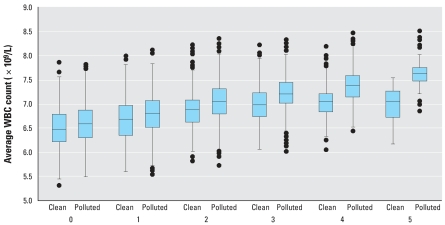
Results: After adjustment for demographics, socioeconomic factors, lifestyles, residential characteristics, and MS, we observed a statistically significant association between WBC count and estimated local PM10 levels (p = 0.035). Participants from the least polluted areas (1-year PM10 < 1st quartile cutoff: 27.8 mug/m3) had lower WBC counts than the others (difference = 145 x 10(6)/L; 95% confidence interval, 10-281). We also noted a graded association between PM10 and WBC across subpopulations with increasing MS components, with 91 x 10(6)/L difference in WBC for those with no MS versus 214, 338, and 461 x 10(6)/L for those with 3, 4, and 5 metabolic abnormalities (trend-test p = 0.15).
Conclusions: Our study revealed a positive association between long-term PM exposure and hematological markers of inflammation and supported the hypothesized MS-dependent susceptibility.
Keywords: air pollution; environmental health; metabolic syndrome; particles; risk factors; susceptibility; white blood cells.
Figures
References
-
- Bennett WD, Zeman KL. Effect of body size on breathing pattern and fine-particle deposition in children. J Appl Physiol. 2004;97:821–826. - PubMed
-
- Butler MA, Beale CL. Washington, DC: U.S. Department of Agriculture, Agriculture and Rural Economy Division, Economic Research Services; 1994. Rural-urban continuum codes for metro and non-metro counties. Staff Report No. AGES-9425, 1993.
-
- Dockery DW, Pope CA, III, Xu X, Spengler JD, Ware JH, Fay ME, et al. An association between air pollution and mortality in six U.S. cities. N Engl J Med. 1993;329:1753–1759. - PubMed
Publication types
MeSH terms
Substances
Grants and funding
LinkOut - more resources
Full Text Sources
Medical