Review
. 2008 May 12:10:e12.
doi: 10.1017/S1462399408000665.

Molecular mechanisms of antibody-mediated neutralisation of flavivirus infection

Affiliations
Review

Molecular mechanisms of antibody-mediated neutralisation of flavivirus infection

Theodore C Pierson et al. Expert Rev Mol Med. .

Abstract

Flaviviruses are a group of positive-stranded RNA viruses that cause a spectrum of severe illnesses globally in more than 50 million individuals each year. While effective vaccines exist for three members of this group (yellow fever, Japanese encephalitis, and tick-borne encephalitis viruses), safe and effective vaccines for several other flaviviruses of clinical importance, including West Nile and dengue viruses, remain in development. An effective humoral immune response is critical for protection against flaviviruses and an essential goal of vaccine development. The effectiveness of virus-specific antibodies in vivo reflects their capacity to inhibit virus entry and spread through several mechanisms, including the direct neutralisation of virus infection. Recent advances in our understanding of the structural biology of flaviviruses, coupled with the use of small-animal models of flavivirus infection, have promoted significant advances in our appreciation of the factors that govern antibody recognition and inhibition of flaviviruses in vitro and in vivo. In this review, we discuss the properties that define the potency of neutralising antibodies and the molecular mechanisms by which they inhibit virus infection. How recent advances in this area have the potential to improve the development of safe and effective vaccines and immunotherapeutics is also addressed.


Figures
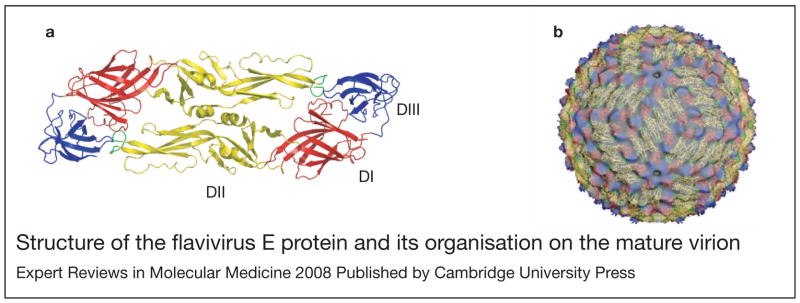
Figure 1
Figure 1. Structure of the flavivirus E protein and its organisation on the mature virion
(a) Ribbon diagram of a dengue virus E protein dimer with domains II, I and III shown as yellow, red and blue ribbons, respectively. The fusion loop at the tip of DII is shown in green. (b) Cryoelectron reconstruction of the dengue virus mature virion illustrating the arrangement of E proteins on the virion with pseudo-icosahedral symmetry (for a detailed explanation of the icosahedral symmetry patterns of viruses see the weblink for the virus particle explorer: http://viperdb.scripps.edu/) (Ref. 21). Image kindly provided by Drs Richard Kuhn and Michael Rossmann, Purdue University, IN, USA.
Figure 2
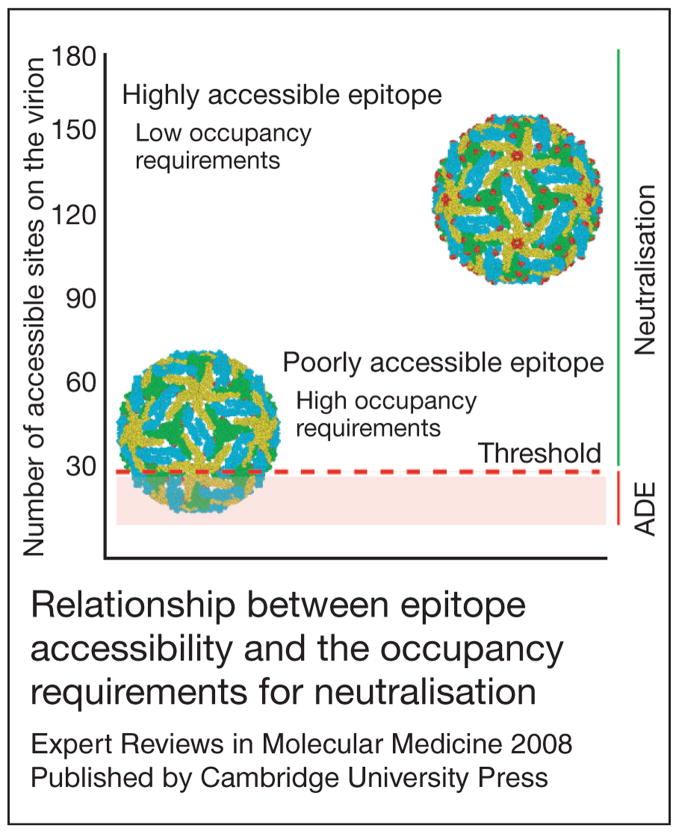
Figure 2. Relationship between epitope accessibility and the occupancy requirements for neutralisation
The accessibility of epitopes recognised by two different antibodies on the mature West Nile virion is illustrated using molecular modelling: residues that form each determinant are illustrated as solid spheres. E proteins are coloured according to their proximity to the twofold, threefold or fivefold symmetry axes (blue, green and yellow, respectively). The number of accessible binding sites for each antibody is indicated on the left, whereas the ‘threshold’ for neutralisation is indicated as a red line [modelled in this instance as 30 monoclonal antibodies (mAbs) based on studies using the mAb E16] (Ref. 68). To exceed the threshold requirements for neutralisation, only a fraction of highly accessible determinants must be simultaneously occupied by antibody (a low occupancy requirement). By contrast, a significantly greater percentage of poorly accessible epitopes must be bound to achieve the same number of antibodies docked on the average virion (a high occupancy requirement). Not all epitopes appear to exist on the average virion at levels that exceed this threshold.

References

    1. Mackenzie JS, Gubler DJ, Petersen LR. Emerging flaviviruses: the spread and resurgence of Japanese encephalitis, West Nile and dengue viruses. Nat Med. 2004;10:S98–109. - PubMed
    1. Zhang Y, et al. Conformational changes of the flavivirus E glycoprotein. Structure. 2004;12:1607–1618. - PMC - PubMed
    1. Rey FA, et al. The envelope glycoprotein from tick-borne encephalitis virus at 2 A resolution. Nature. 1995;375:291–298. - PubMed
    1. Modis Y, et al. A ligand-binding pocket in the dengue virus envelope glycoprotein. Proc Natl Acad Sci U S A. 2003;100:6986–6991. - PMC - PubMed
    1. Modis Y, et al. Variable surface epitopes in the crystal structure of dengue virus type 3 envelope glycoprotein. J Virol. 2005;79:1223–1231. - PMC - PubMed

Publication types