


Short-term memory, working memory, and executive functioning in preschoolers: longitudinal predictors of mathematical achievement at age 7 years
- PMID: 18473197
- PMCID: PMC2729141
- DOI: 10.1080/87565640801982312
Short-term memory, working memory, and executive functioning in preschoolers: longitudinal predictors of mathematical achievement at age 7 years
Abstract
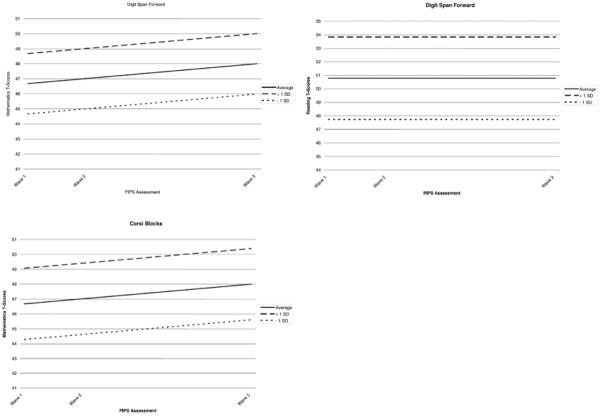
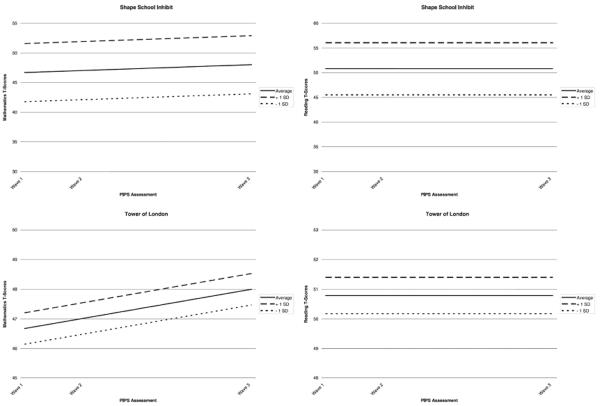
This study examined whether measures of short-term memory, working memory, and executive functioning in preschool children predict later proficiency in academic achievement at 7 years of age (third year of primary school). Children were tested in preschool (M age = 4 years, 6 months) on a battery of cognitive measures, and mathematics and reading outcomes (from standardized, norm-referenced school-based assessments) were taken on entry to primary school, and at the end of the first and third year of primary school. Growth curve analyses examined predictors of math and reading achievement across the duration of the study and revealed that better digit span and executive function skills provided children with an immediate head start in math and reading that they maintained throughout the first three years of primary school. Visual-spatial short-term memory span was found to be a predictor specifically of math ability. Correlational and regression analyses revealed that visual short-term and working memory were found to specifically predict math achievement at each time point, while executive function skills predicted learning in general rather than learning in one specific domain. The implications of the findings are discussed in relation to further understanding the role of cognitive skills in different mathematical tasks, and in relation to the impact of limited cognitive skills in the classroom environment.
Figures
References
-
- Alloway TP. Working memory, reading, and mathematical skills in children with developmental coordination disorder. Journal of Experimental Child Psychology. 2007;96:20–36. - PubMed
-
- Baddeley AD. Exploring the central executive. Quarterly Journal of Experimental Psychology. 1996;49A:5–28.
-
- Baddeley AD. The episodic buffer: A new component of working memory? Trends in Cognitive Sciences. 2000;4:417–423. - PubMed
-
- Baddeley AD, Hitch GJ. Working memory. In: Bower GH, editor. The psychology of learning and motivation: Advances in research and theory. vol. 8. Academic Press; New York: 1974. pp. 47–90.
-
- Blair C, Razza RP. Relating effortful control, executive function, and false belief understanding to emerging math and literacy ability in kindergarten. Child Development. 2007;78:647–663. - PubMed
Publication types
MeSH terms
Grants and funding
LinkOut - more resources
Full Text Sources
