


The impact of obesity on cardiovascular disease risk factors and subclinical vascular disease: the Multi-Ethnic Study of Atherosclerosis
- PMID: 18474756
- PMCID: PMC2931579
- DOI: 10.1001/archinte.168.9.928
The impact of obesity on cardiovascular disease risk factors and subclinical vascular disease: the Multi-Ethnic Study of Atherosclerosis
Abstract
Background: To assess the importance of the obesity epidemic on cardiovascular disease (CVD) risk, we determined the prevalence of obesity and the relationship of obesity to CVD risk factors and subclinical vascular disease.
Methods: The Multi-Ethnic Study of Atherosclerosis is an observational cohort study involving 6814 persons aged 45 to 84 years who were free of clinical CVD at baseline (2000-2002). The study assessed the association between body size and CVD risk factors, medication use, and subclinical vascular disease (coronary artery calcium, carotid artery intimal medial thickness, and left ventricular mass).
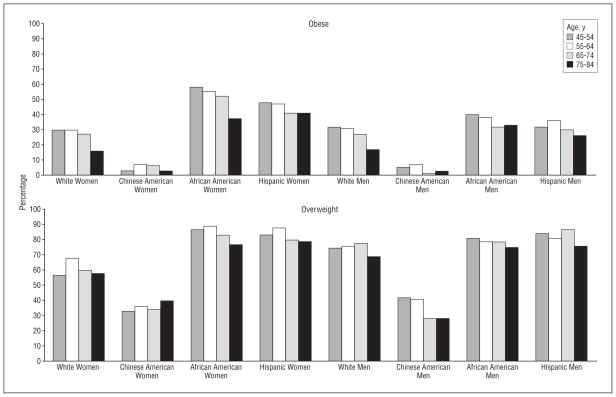
Results: A large proportion of white, African American, and Hispanic participants were overweight (60% to 85%) and obese (30% to 50%), while fewer Chinese American participants were overweight (33%) or obese (5%). Hypertension and diabetes were more prevalent in obese participants despite a much higher use of antihypertensive and/or antidiabetic medications. Obesity was associated with a greater risk of coronary artery calcium (17%), internal carotid artery intimal medial thickness greater than 80th percentile (32%), common carotid artery intimal medial thickness greater than 80th percentile (45%), and left ventricular mass greater than 80th percentile (2.7-fold greater) compared with normal body size. These associations persisted after adjustment for traditional CVD risk factors.
Conclusions: These data confirm the epidemic of obesity in most but not all racial and ethnic groups. The observed low prevalence of obesity in Chinese American participants indicates that high rates of obesity should not be considered inevitable. These findings may be viewed as indicators of potential future increases in vascular disease burden and health care costs associated with the obesity epidemic.
Figures
References
-
- Mokdad AH, Ford ES, Bowman BA, et al. Prevalence of obesity, diabetes, and obesity-related health risk factors, 2001. JAMA. 2003;289(1):76–79. - PubMed
-
- Freedman DS, Khan LK, Serdula MK, Galuska DA, Dietz WH. Trends and correlates of class 3 obesity in the United States from 1990 through 2000. JAMA. 2002;288(14):1758–1761. - PubMed
-
- Skyler JS, Oddo C. Diabetes trends in the USA. Diabetes Metab Res Rev. 2002;18(suppl 3):S21–S26. - PubMed
-
- Gregg EW, Cheng YJ, Cadwell BL, et al. Secular trends in cardiovascular disease risk factors according to body mass index in US adults. JAMA. 2005;293(15):1868–1874. - PubMed
Publication types
MeSH terms
Substances
Grants and funding
- N01-HC-95162/HC/NHLBI NIH HHS/United States
- N01 HC095169/HL/NHLBI NIH HHS/United States
- N01-HC-951660/HC/NHLBI NIH HHS/United States
- N01-HC-95163/HC/NHLBI NIH HHS/United States
- N01-HC-95159/HC/NHLBI NIH HHS/United States
- N01 HC095159/HL/NHLBI NIH HHS/United States
- N01-HC-95161/HC/NHLBI NIH HHS/United States
- N01 HC095166/HL/NHLBI NIH HHS/United States
- N01-HC-95166/HC/NHLBI NIH HHS/United States
- N01-HC-95165/HC/NHLBI NIH HHS/United States
- M01-RR07122/RR/NCRR NIH HHS/United States
- N01-HC-95169/HC/NHLBI NIH HHS/United States
- N01-HC-95164/HC/NHLBI NIH HHS/United States
- M01 RR007122/RR/NCRR NIH HHS/United States
- N01 HC095165/HC/NHLBI NIH HHS/United States
LinkOut - more resources
Full Text Sources
Medical
Molecular Biology Databases
