Understanding concordance in patient-physician relationships: personal and ethnic dimensions of shared identity
- PMID: 18474881
- PMCID: PMC2384992
- DOI: 10.1370/afm.821
Understanding concordance in patient-physician relationships: personal and ethnic dimensions of shared identity
Abstract
Purpose: Although concordance by race and sex in physician-patient relationships has been associated with patient ratings of better care, mechanisms through which concordance leads to better outcomes remains unknown. This investigation examined (1) whether patients' perceptions of similarity to their physicians predicted their ratings of quality of care and (2) whether perceived similarity was influenced by racial and sexual concordance and the physician's communication.
Methods: The research design was a cross-sectional study with 214 patients and 29 primary care physicians from 10 private and public outpatient clinics. Measures included postvisit patient ratings of similarity to the physician; satisfaction, trust, and intent to adhere; and audiotape analysis of patient involvement and physicians' patient-centered communication.
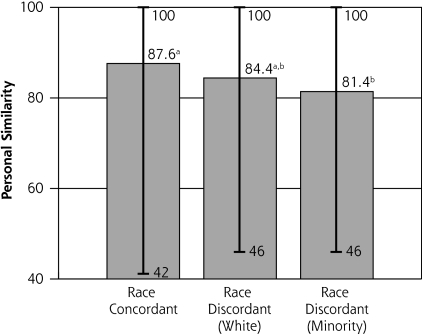
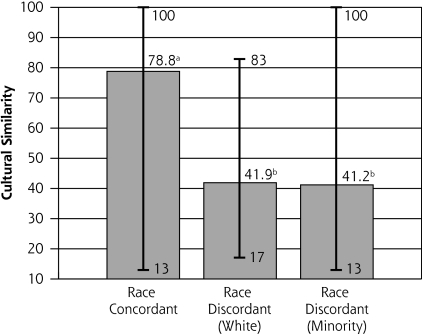
Results: Factor analysis revealed 2 dimensions of similarity, personal (in beliefs, values) and ethnic (in race, community). Black and white patients in racially concordant interactions reported more personal and ethnic similarity (mean score, 87.6 and 78.8, respectively, on a 100-point scale) to their physicians than did minority patients (mean score, 81.4 and 41.2, respectively) and white patients (mean score, 84.4 and 41.9, respectively) in racially discordant encounters. In multivariable models, perceived personal similarity was predicted by the patient's age, education, and physicians' patient-centered communication, but not by racial or sexual concordance. Perceived personal similarity and physicians' patient-centered communication predicted patients' trust, satisfaction, and intent to adhere.
Conclusions: The physician-patient relationship is strengthened when patients see themselves as similar to their physicians in personal beliefs, values, and communication. Perceived personal similarity is associated with higher ratings of trust, satisfaction, and intention to adhere. Race concordance is the primary predictor of perceived ethnic similarity, but several factors affect perceived personal similarity, including physicians' use of patient-centered communication.
Figures
References
-
- Institute of Medicine. Unequal Treatment: Confronting Racial and Ethnic Disparities in Health Care. Washington, DC: National Academy Press; 2002.
-
- Fiscella K, Meldrum S, Franks P, et al. Patient trust: Is it related to patient-centered behavior of primary care physicians? Med Care. 2004; 42(11):1049–1055. - PubMed
-
- Thom DH, Ribisl KM, Stewart AL, Luke DA. Further validation and reliability testing of the Trust in Physician Scale. The Stanford Trust Study Physicians. Med Care. 1999; 37(5):510–517. - PubMed
-
- Cabana MD, Jee SH. Does continuity of care improve patient outcomes? J Fam Pract. 2004; 53(12):974–980. - PubMed
-
- Williams GC, McGregor HA, King D, Nelson CC, Glasgow RE. Variation in perceived competence, glycemic control, and patient satisfaction: relationship to autonomy support from physicians. Patient Educ Couns. 2005; 57(1):39–45. - PubMed
Publication types
MeSH terms
Grants and funding
LinkOut - more resources
Full Text Sources
Medical