


A secondary gate as a mechanism for inhibition of the M2 proton channel by amantadine
- PMID: 18476738
- PMCID: PMC3801206
- DOI: 10.1021/jp800171m
A secondary gate as a mechanism for inhibition of the M2 proton channel by amantadine
Abstract
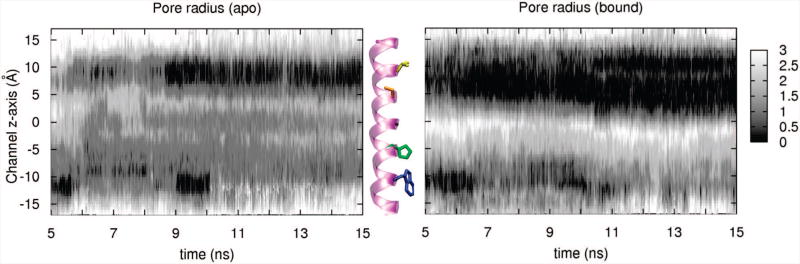
The mechanism of inhibition of the influenza A virus M2 proton channel by the antiviral drug amantadine has been under intense investigation. The importance of a mechanistic understanding is heightened by the prevalence of amantadine-resistant mutations. To gain mechanistic insight at the molecular level, we carried out extensive molecular dynamics simulations of the tetrameric M2 proton channel in both apo and amantadine-bound forms in a lipid bilayer. The simulation of the apo form revealed that Val27 from the four M2 subunits can form a secondary gate near the channel entrance and break the water wire in the channel pore. This gate arises from physical occlusion and the elimination of hydrogen-bonding partners for water molecules. In the presence of amantadine, the secondary gate formed by Val27 and the drug molecule lying just below form an extended blockage, which breaks the water wire throughout the simulation. The location and orientation of amantadine inside of the channel pore as found in our simulation are supported by a host of experimental observations. Our study suggests a novel role for Val27 in the inhibition of the M2 proton channel by amantadine.
Figures

References
Publication types
MeSH terms
Substances
Grants and funding
LinkOut - more resources
Full Text Sources
Other Literature Sources
