Effect of clopidogrel on early failure of arteriovenous fistulas for hemodialysis: a randomized controlled trial
- PMID: 18477783
- PMCID: PMC4943222
- DOI: 10.1001/jama.299.18.2164
Effect of clopidogrel on early failure of arteriovenous fistulas for hemodialysis: a randomized controlled trial
Abstract
Context: The arteriovenous fistula is the preferred type of vascular access for hemodialysis because of lower thrombosis and infection rates and lower health care expenditures compared with synthetic grafts or central venous catheters. Early failure of fistulas due to thrombosis or inadequate maturation is a barrier to increasing the prevalence of fistulas among patients treated with hemodialysis. Small, inconclusive trials have suggested that antiplatelet agents may reduce thrombosis of new fistulas.
Objective: To determine whether clopidogrel reduces early failure of hemodialysis fistulas.
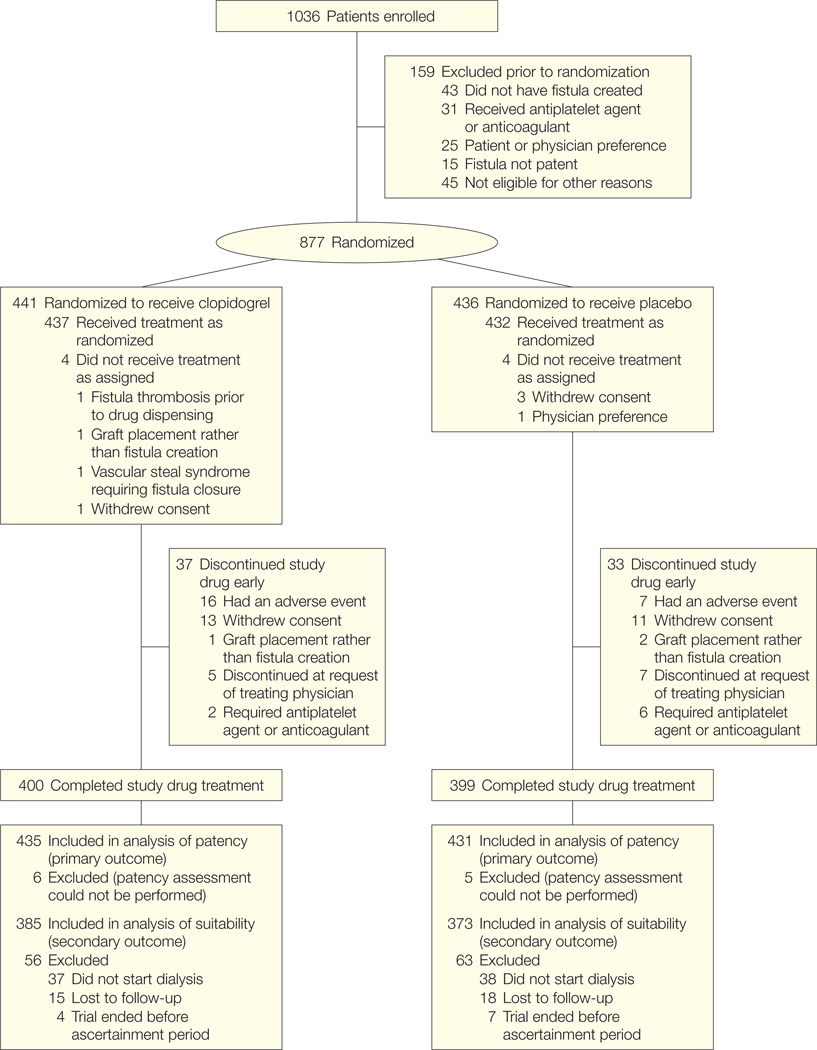
Design, setting, and participants: Randomized, double-blind, placebo-controlled trial conducted at 9 US centers composed of academic and community nephrology practices in 2003-2007. Eight hundred seventy-seven participants with end-stage renal disease or advanced chronic kidney disease were followed up until 150 to 180 days after fistula creation or 30 days after initiation of dialysis, whichever occurred later.
Intervention: Participants were randomly assigned to receive clopidogrel (300-mg loading dose followed by daily dose of 75 mg; n = 441) or placebo (n = 436) for 6 weeks starting within 1 day after fistula creation.
Main outcome measures: The primary outcome was fistula thrombosis, determined by physical examination at 6 weeks. The secondary outcome was failure of the fistula to become suitable for dialysis. Suitability was defined as use of the fistula at a dialysis machine blood pump rate of 300 mL/min or more during 8 of 12 dialysis sessions.
Results: Enrollment was stopped after 877 participants were randomized based on a stopping rule for intervention efficacy. Fistula thrombosis occurred in 53 (12.2%) participants assigned to clopidogrel compared with 84 (19.5%) participants assigned to placebo (relative risk, 0.63; 95% confidence interval, 0.46-0.97; P = .018). Failure to attain suitability for dialysis did not differ between the clopidogrel and placebo groups (61.8% vs 59.5%, respectively; relative risk, 1.05; 95% confidence interval, 0.94-1.17; P = .40).
Conclusion: Clopidogrel reduces the frequency of early thrombosis of new arteriovenous fistulas but does not increase the proportion of fistulas that become suitable for dialysis. Trial Registration clinicaltrials.gov Identifier: NCT00067119.
Comment in
-
Randomized trials in hemodialysis patients: time to step up to the plate.JAMA. 2008 May 14;299(18):2205-7. doi: 10.1001/jama.299.18.2205. JAMA. 2008. PMID: 18477790 No abstract available.
-
Clopidogrel decreases arteriovenous fistula thrombosis but does not improve fistula maturation.Nat Clin Pract Nephrol. 2008 Sep;4(9):476-7. doi: 10.1038/ncpneph0908. Epub 2008 Jul 29. Nat Clin Pract Nephrol. 2008. PMID: 18665140
-
Effect of clopidogrel on arteriovenous fistulas for dialysis.JAMA. 2008 Oct 8;300(14):1647-8; author reply 1648-9. doi: 10.1001/jama.300.14.1647-b. JAMA. 2008. PMID: 18840830 No abstract available.
-
Effect of clopidogrel on arteriovenous fistulas for dialysis.JAMA. 2008 Oct 8;300(14):1647; author reply 1648-9. doi: 10.1001/jama.300.14.1647-a. JAMA. 2008. PMID: 18840831 No abstract available.
-
Effect of clopidogrel on arteriovenous fistulas for dialysis.JAMA. 2008 Oct 8;300(14):1648; author reply 1648-9. doi: 10.1001/jama.300.14.1648-a. JAMA. 2008. PMID: 18840832 No abstract available.
-
More than reducing early fistula thrombosis is required: lessons from the Dialysis Access Consortium clopidogrel fistula study.Am J Kidney Dis. 2008 Nov;52(5):834-8. doi: 10.1053/j.ajkd.2008.09.005. Am J Kidney Dis. 2008. PMID: 18971012 No abstract available.
References
-
- US Renal Data System. 2007 Annual Data Report: Atlas of Chronic Kidney Disease and End-Stage Renal Disease in the United States. Bethesda, MD: National Institute of Diabetes and Digestive and Kidney Diseases; 2007.
-
- Feldman HI, Kobrin S, Wasserstein A. Hemodialysis vascular access morbidity. J Am Soc Nephrol. 1996;7(4):523–535. - PubMed
-
- US Renal Data System. 2005 Annual Data Report: Atlas of End-Stage Renal Disease in the United States. Bethesda, MD: National Institute of Diabetes and Digestive and Kidney Diseases; 2005.
-
- Vascular Access 2006 Work Group. NKF-KDOQI clinical practice guidelines for vascular access, update 2006. Am J Kidney Dis. 2006;48(suppl 1):S176–S276. - PubMed
-
- Ohira S, Naito H, Amano I, et al. 2005 Japanese Society for Dialysis Therapy guidelines for vascular access construction and repair for chronic hemodialysis. Ther Apher Dial. 2006;10(5):449–462. - PubMed
Publication types
MeSH terms
Substances
Associated data
Grants and funding
- U01 DK058982/DK/NIDDK NIH HHS/United States
- U01 DK058986/DK/NIDDK NIH HHS/United States
- U01DK058978/DK/NIDDK NIH HHS/United States
- U01DK058985/DK/NIDDK NIH HHS/United States
- U01DK058986/DK/NIDDK NIH HHS/United States
- U01 DK058973/DK/NIDDK NIH HHS/United States
- U01DK058966/DK/NIDDK NIH HHS/United States
- U01 DK058966/DK/NIDDK NIH HHS/United States
- U01 DK058981/DK/NIDDK NIH HHS/United States
- U01DK058982/DK/NIDDK NIH HHS/United States
- U01 DK058968/DK/NIDDK NIH HHS/United States
- U01DK058973/DK/NIDDK NIH HHS/United States
- U01 DK058978/DK/NIDDK NIH HHS/United States
- U01DK058981/DK/NIDDK NIH HHS/United States
- U01 DK058985/DK/NIDDK NIH HHS/United States
- U01DK058968/DK/NIDDK NIH HHS/United States
LinkOut - more resources
Full Text Sources
Other Literature Sources
Medical