Review
. 2008 Jul;466(7):1528-38.
doi: 10.1007/s11999-008-0286-4. Epub 2008 May 14.

The basic science of tendinopathy

Affiliations
Review

The basic science of tendinopathy

Yinghua Xu et al. Clin Orthop Relat Res. 2008 Jul.

Abstract

Tendinopathy is a common clinical problem with athletes and in many occupational settings. Tendinopathy can occur in any tendon, often near its insertion or enthesis where there is an area of stress concentration, and is directly related to the volume of repetitive load to which the tendon is exposed. Recent studies indicate tendinopathy is more likely to occur in situations that increase the "dose" of load to the tendon enthesis - including increased activity, weight, advancing age, and genetic factors. The cells in tendinopathic tendon are rounder, more numerous, and show evidence of oxidative damage and more apoptosis. These cells also produce a matrix that is thicker and weaker with more water, more immature and cartilage-like matrix proteins, and less organization. There is now evidence of a population of regenerating stem cells within tendon. These studies suggest prevention of tendinopathy should be directed at reducing the volume of repetitive loads to below that which induces oxidative-induced apoptosis and cartilage-like genes. The management strategies might involve agents or cells that induce tendon stem cell proliferation, repair and restoration of matrix integrity.


Figures
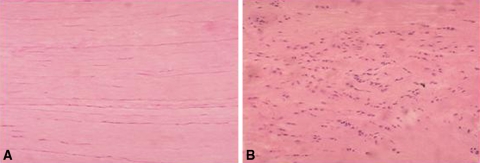
Fig. 1A–B
Fig. 1A–B
The normal tendon and tendinopathy tendon is shown. (A) Normal tendon has parallel, longitudinal architecture with scattered elongated tenocytes. (B) Tendinopathy tendon shows disorganized collagen architecture, high cellularity of rounded tenocytes. (This figure was published in Soslowsky LJ, Thomopoulos S, Tun S, Flanagan CL, Keefer CC, Mastaw J, Carpenter JE. Neer Award 1999. Overuse activity injures the supraspinatus tendon in an animal model: a histologic and biomechanical study. J Shoulder Elbow Surg. 2000;9:79–84, © Elsevier 2000, with permission.)
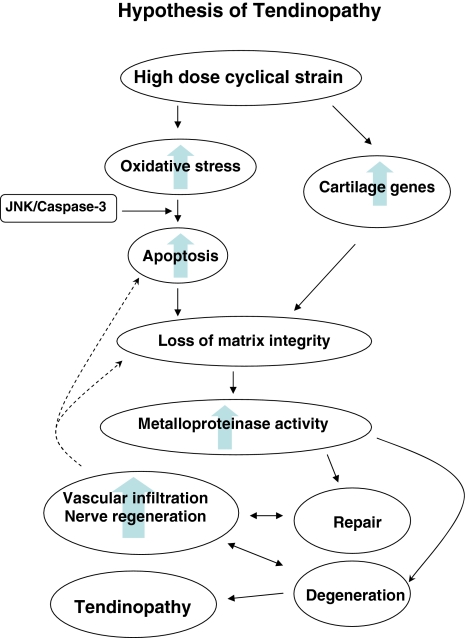
Fig. 2
Fig. 2
A conceptual diagram shows our current hypothesis on the pathogenesis of tendinopathy.

References

    1. {'text': '', 'ref_index': 1, 'ids': [{'type': 'DOI', 'value': '10.1111/j.1600-0838.2005.00466.x', 'is_inner': False, 'url': 'https://doi.org/10.1111/j.1600-0838.2005.00466.x'}, {'type': 'PubMed', 'value': '15998342', 'is_inner': True, 'url': 'https://pubmed.ncbi.nlm.nih.gov/15998342/'}]}
    2. Alfredson H. The chronic painful Achilles and patellar tendon: research on basic biology and treatment. Scand J Med Sci Sports. 2005;15:252–259. - PubMed
    1. {'text': '', 'ref_index': 1, 'ids': [{'type': 'DOI', 'value': '10.2174/1389450023348028', 'is_inner': False, 'url': 'https://doi.org/10.2174/1389450023348028'}, {'type': 'PubMed', 'value': '11899264', 'is_inner': True, 'url': 'https://pubmed.ncbi.nlm.nih.gov/11899264/'}]}
    2. Alfredson H, Lorentzon R. Chronic tendon pain: no signs of chemical inflammation but high concentrations of the neurotransmitter glutamate. Implications for treatment? Curr Drug Targets. 2002;3:43–54. - PubMed
    1. {'text': '', 'ref_index': 1, 'ids': [{'type': 'DOI', 'value': '10.1007/s00167-004-0549-x', 'is_inner': False, 'url': 'https://doi.org/10.1007/s00167-004-0549-x'}, {'type': 'PubMed', 'value': '15756611', 'is_inner': True, 'url': 'https://pubmed.ncbi.nlm.nih.gov/15756611/'}]}
    2. Alfredson H, Ohberg L. Neovascularisation in chronic painful patellar tendinosis–promising results after sclerosing neovessels outside the tendon challenge the need for surgery. Knee Surg Sports Traumatol Arthrosc. 2005;13:74–80. - PubMed
    1. {'text': '', 'ref_index': 1, 'ids': [{'type': 'DOI', 'value': '10.1007/s00167-003-0391-6', 'is_inner': False, 'url': 'https://doi.org/10.1007/s00167-003-0391-6'}, {'type': 'PubMed', 'value': '14520512', 'is_inner': True, 'url': 'https://pubmed.ncbi.nlm.nih.gov/14520512/'}]}
    2. Alfredson H, Ohberg L, Forsgren S. Is vasculo-neural ingrowth the cause of pain in chronic Achilles tendinosis? An investigation using ultrasonography and colour Doppler, immunohistochemistry, and diagnostic injections. Knee Surg Sports Traumatol Arthrosc. 2003;11:334–338. - PubMed
    1. {'text': '', 'ref_index': 1, 'ids': [{'type': 'DOI', 'value': '10.1016/S0014-5793(00)01528-3', 'is_inner': False, 'url': 'https://doi.org/10.1016/s0014-5793(00)01528-3'}, {'type': 'PubMed', 'value': '10818225', 'is_inner': True, 'url': 'https://pubmed.ncbi.nlm.nih.gov/10818225/'}]}
    2. Amour A, Knight CG, Webster A, Slocombe PM, Stephens PE, Knauper V, Docherty AJ, Murphy G. The in vitro activity of ADAM-10 is inhibited by TIMP-1 and TIMP-3. FEBS Lett. 2000;473:275–279. - PubMed

Substances