. 2008 Jul;15(7):1115-23.
doi: 10.1128/CVI.00015-08. Epub 2008 May 14.

Immunogenicity of Bacillus anthracis protective antigen domains and efficacy of elicited antibody responses depend on host genetic background

Affiliations

Immunogenicity of Bacillus anthracis protective antigen domains and efficacy of elicited antibody responses depend on host genetic background

Nareen Abboud et al. Clin Vaccine Immunol. 2008 Jul.

Abstract

Neutralizing antibodies to Bacillus anthracis protective antigen (PA), a component of anthrax toxin, mediate protection against anthrax. PA is antigenically complex and can elicit protective and nonprotective antibodies. Furthermore, vaccinated individuals demonstrate considerable variability in their antibody responses to PA. To explore the relationship between PA structure and antigenicity, we produced Escherichia coli strains expressing full-length PA (PA1-4), domains 2 to 4 (PA2-4), domain 1, (PA1), and domain 4 (PA4) and evaluated the immunogenicities and protective efficacies of the protein fractions in four mouse strains (strains A/J, BALB/c, C57BL/6, and Swiss Webster). Immunization with PA1-4 resulted in significantly higher lethal toxin-neutralizing antibody titers than immunization with any recombinant protein (rPA) fraction of PA. The magnitude and neutralizing capacity of the antibody response to full-length PA and its fragments varied depending on the mouse strain. We found no correlation between the antibody titer and the neutralizing antibody titer for A/J and Swiss Webster mice. In C57BL/6 mice, antibody titers and neutralization capacity correlated for two of four rPA domain proteins tested, while BALB/c mice displayed a similar correlation with only one rPA. By correlating the reactivity of immune sera with solvent-exposed linear peptide segments of PA, we tentatively assign the presence of four new linear B-cell epitopes in PA amino acids 121 to 150, 143 to 158, 339 to 359, and 421 to 440. We conclude that the genetic background of the host determines the relative efficacy of the antitoxin response. The results suggest that the variability observed in vaccination studies with PA-derived vaccines is a result of host heterogeneity and implies a need to develop other antigens as vaccine candidates.


Figures
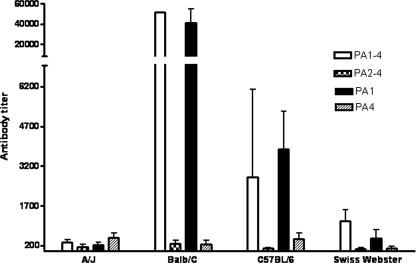
FIG. 1.
FIG. 1.
Antibody responses in vaccinated mice of different strains. Sera were collected from immunized mice 2 weeks after the second immunization with 1 μg of expressed rPA domain proteins and were tested by ELISA for the presence of PA-specific antibodies. The values represent the geometric means ± standard deviations from five mice per treatment group.
FIG. 2.
FIG. 2.
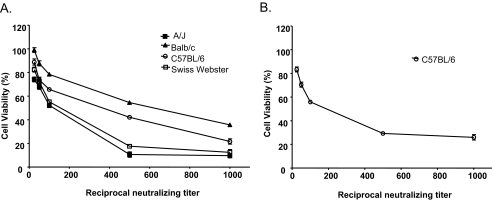
Neutralization of LeTx by sera from immunized mice. Dilutions of sera from individual mice vaccinated two times with expressed rPA domain proteins were incubated with J774 cells and LeTx for 4 h, and cell viability was measured by the MTT assay. All mouse strains immunized with PA1-4 (A) and C57BL/6 mice immunized with PA1 (B) produced antibodies that neutralized LeTx-mediated cytotoxicity. Data are represented as the geometric means ± standard deviations from five mice per treatment group. MTT assays were done twice, with similar results obtained each time. Sera collected prior to any mouse injections or immunization of the mice with the other rPA domain proteins conferred no protection (data not shown).
FIG. 3.
FIG. 3.
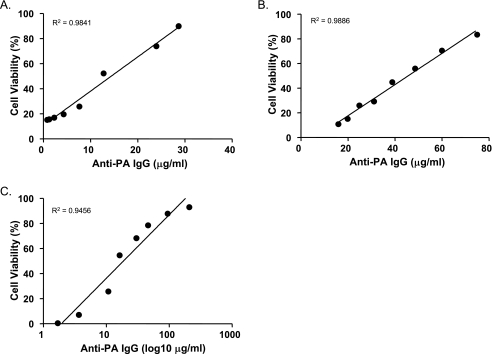
Correlation between anti-PA IgG levels and protection against LeTx-mediated cytotoxicity. The viability of J774 cells was plotted against the IgG antibody titer to PA (μg/ml) in sera from C57BL/6 mice vaccinated two times with PA1-4 (A) or PA1 (B) or in sera from BALB/c mice vaccinated with PA1-4 (C), as described in the legend to Fig. 2. Each point represents the average for five mice per treatment group. Regression lines and correlation coefficients (R2 values) are included for each plot.
FIG. 4.
FIG. 4.
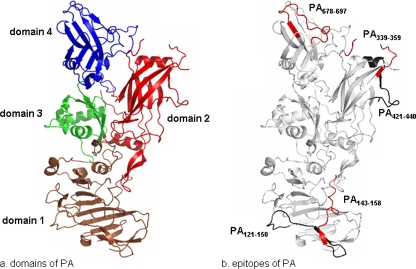
PA structure and locations of epitopes. The crystal structure of PA was created with the PyMOL program by using Protein Data Bank file 1ACC and shows the four domains of PA (a) and the locations of the epitopes (listed in Table 3) recognized by immune sera (b). Note that peptide PA143-158 overlaps with PA121-150.
FIG. 5.
FIG. 5.
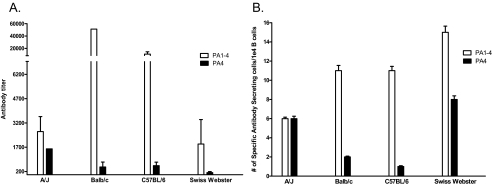
PA-specific ASCs in spleens of immunized mice. (A) Sera were collected from mice 2 weeks after the third immunization with 10 μg of PA1-4 or PA4 and were tested by ELISA for the presence of PA-specific antibodies. The values represent the geometric means ± standard deviations from five mice per treatment group. (B) Spleen leukocytes were harvested from immunized mice, and the frequency of PA-specific ASCs was determined by the spot ELISA. The data shown are a compilation of quadruplet replicates with geometric means ± standard deviations from five mice per treatment group.

References

    1. Benson, E. L., P. D. Huynh, A. Finkelstein, and R. J. Collier. 1998. Identification of residues lining the anthrax protective antigen channel. Biochemistry 37:3941-3948. - PubMed
    1. Blaustein, R. O., T. M. Koehler, R. J. Collier, and A. Finkelstein. 1989. Anthrax toxin: channel-forming activity of protective antigen in planar phospholipid bilayers. Proc. Natl. Acad. Sci. USA 86:2209-2213. - PMC - PubMed
    1. Brossier, F., M. Levy, A. Landier, P. Lafaye, and M. Mock. 2004. Functional analysis of Bacillus anthracis protective antigen by using neutralizing monoclonal antibodies. Infect. Immun. 72:6313-6317. - PMC - PubMed
    1. Brossier, F., M. Weber-Levy, M. Mock, and J. C. Sirard. 2000. Role of toxin functional domains in anthrax pathogenesis. Infect. Immun. 68:1781-1786. - PMC - PubMed
    1. Burnett, J. C., E. A. Henchal, A. L. Schmaljohn, and S. Bavari. 2005. The evolving field of biodefence: therapeutic developments and diagnostics. Nat. Rev. Drug Discov. 4:281-297. - PMC - PubMed

Publication types

MeSH terms