


Hypercontractility and impaired sildenafil relaxations in the BKCa channel deletion model of erectile dysfunction
- PMID: 18480246
- PMCID: PMC2494801
- DOI: 10.1152/ajpregu.00173.2008
Hypercontractility and impaired sildenafil relaxations in the BKCa channel deletion model of erectile dysfunction
Abstract
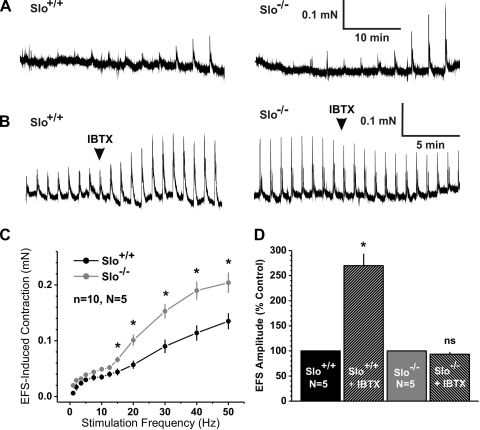
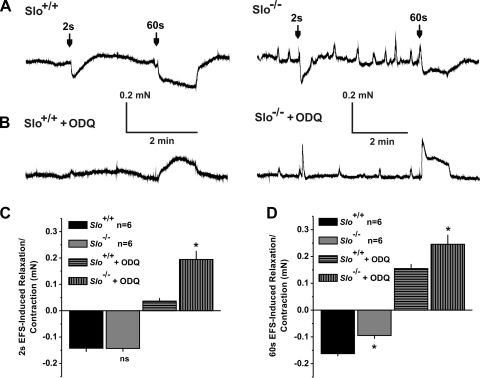
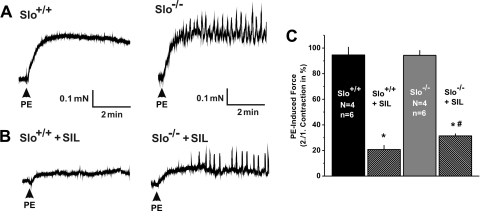
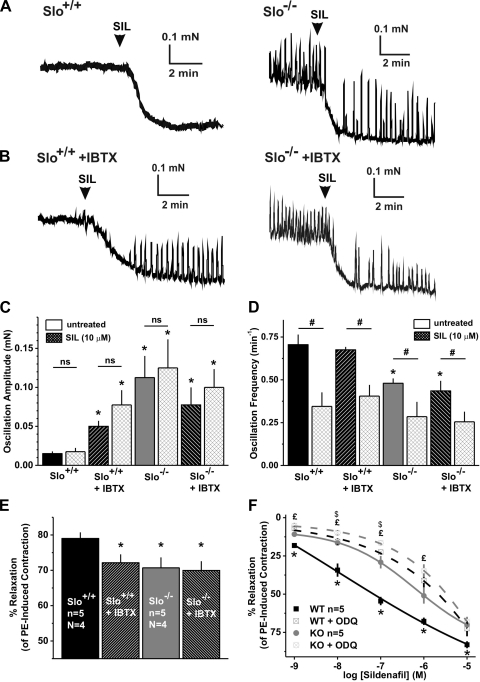
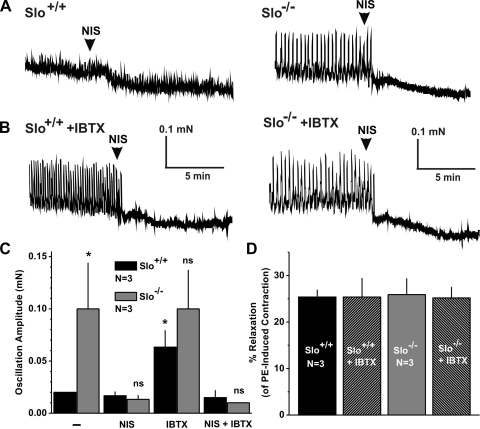
Erectile dysfunction (ED) can be elicited by a variety of pathogenic factors, particularly impaired formation of and responsiveness to nitric oxide (NO) and the downstream effectors soluble guanylate cyclase (sGC) and cGMP-dependent protein kinase I (PKGI). One important target of PKGI in smooth muscle is the large-conductance, Ca2+ -activated potassium (BKCa) channel. In our previous report (42), we demonstrated that deletion of the BKCa channel in mice induced force oscillations and led to reduced nerve-evoked relaxations and ED. In the current study, we used this ED model to explore the role of the BKCa channel in the NO/sGC/PKGI pathway. Electrical field stimulation (EFS)-induced contractions of corpus cavernosum smooth muscle strips were significantly enhanced in the absence of BKCa channel function. In strips precontracted with phenylephrine, EFS-induced relaxations were converted to contractions by inhibition of sGC, and this was further enhanced by loss of BK channel function. Sildenafil-induced relaxations were decreased to a similar extent by inhibition of sGC or BKCa channels. At concentrations >1 microM, sildenafil caused relaxations independent of inhibition of sGC or BKCa channels. Sildenafil did not affect the enhanced force oscillations that were induced by the loss of BKCa channel function. Yet, these oscillations could be completely eliminated by blocking L-type voltage-dependent Ca2+ channels (VDCCs). These results suggest that therapeutically relevant concentrations of sildenafil act through cGMP and BKCa channels, and loss of BKCa channel function leads to hypercontractility, which depends on VDCCs and cannot be modified by the cGMP pathway.
Figures
References
-
- Alioua A, Tanaka Y, Wallner M, Hofmann F, Ruth P, Meera P, Toro L. The large conductance, voltage-dependent, and calcium-sensitive K+ channel, Hslo, is a target of cGMP-dependent protein kinase phosphorylation in vivo. J Biol Chem 273: 32950–32956, 1998. - PubMed
-
- Andersson KE, Wagner G. Physiology of penile erection. Physiol Rev 75: 191–236, 1995. - PubMed
-
- Archer SL Potassium channels and erectile dysfunction. Vascul Pharmacol 38: 61–71, 2002. - PubMed
-
- Behr-Roussel D, Gorny D, Mevel K, Compagnie S, Kern P, Sivan V, Bernabe J, Bedigian MP, Alexandre L, Giuliano F. Erectile dysfunction: an early marker for hypertension? A longitudinal study in spontaneously hypertensive rats. Am J Physiol Regul Integr Comp Physiol 288: R276–R283, 2005. - PubMed
-
- Benet AE, Melman A. The epidemiology of erectile dysfunction. Urol Clin North Am 22: 699–709, 1995. - PubMed
Publication types
MeSH terms
Substances
Grants and funding
LinkOut - more resources
Full Text Sources
Medical
Molecular Biology Databases
Miscellaneous
