


Persistent human papillomavirus infection and cervical neoplasia: a systematic review and meta-analysis
- PMID: 18483125
- PMCID: PMC2878094
- DOI: 10.1093/aje/kwn036
Persistent human papillomavirus infection and cervical neoplasia: a systematic review and meta-analysis
Abstract
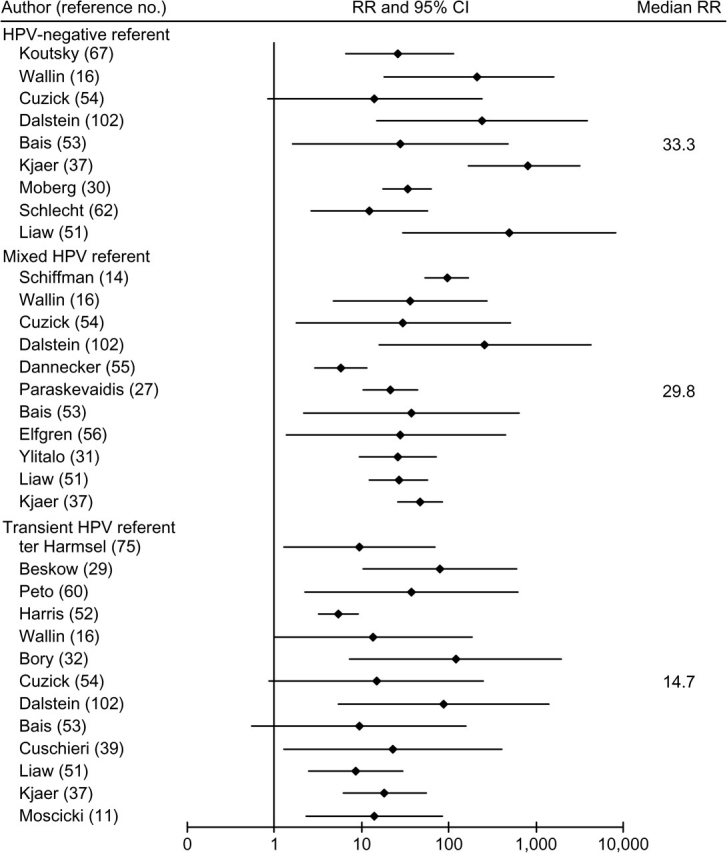
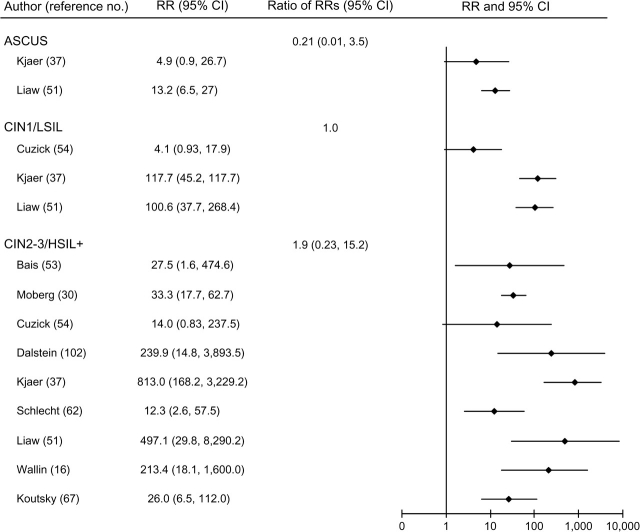
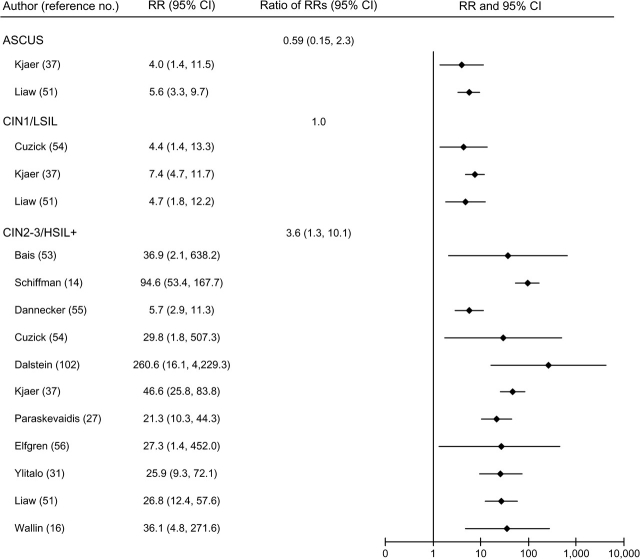
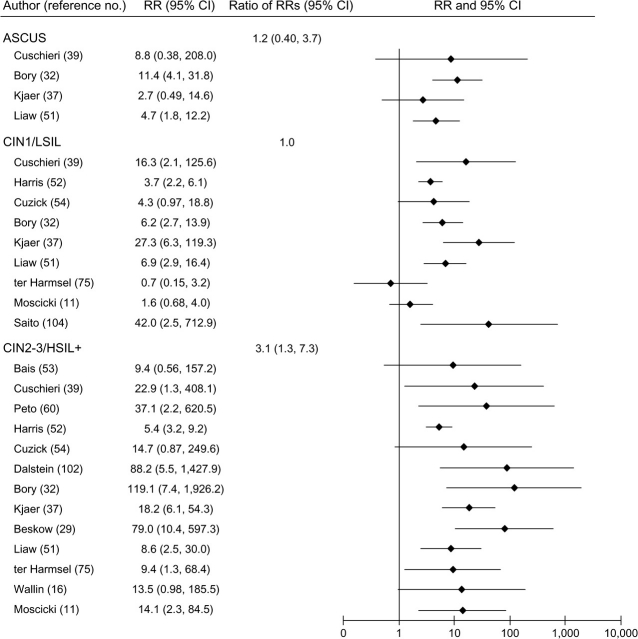
Detection of persistent cervical carcinogenic human papillomavirus (HPV) DNA is used as a marker for cervical cancer risk in clinical trials. The authors performed a systematic review and meta-analysis of the association between persistent HPV DNA and high-grade cervical intraepithelial neoplasia (CIN2-3), high-grade squamous intraepithelial lesions (HSIL), and invasive cervical cancer (together designated CIN2-3/HSIL+) to evaluate the robustness of HPV persistence for clinical use. MEDLINE and Current Contents were searched through January 30, 2006. Relative risks (RRs) were stratified by HPV comparison group. Of 2,035 abstracts, 41 studies were eligible for inclusion in the meta-analysis. Over 22,500 women were included in calculation of RRs for persistent HPV DNA detection and cervical neoplasia. RRs ranged from 1.3 (95% confidence interval: 1.1, 1.5) to 813.0 (95% confidence interval: 168.2, 3,229.2) for CIN2-3/HSIL+ versus <CIN2-3/HSIL+; 92% of RRs were above 3.0. Longer durations of infection (>12 months), wider testing intervals, CIN2-3/HSIL+, and use of an HPV-negative reference group were consistently associated with higher RRs. Thus, HPV persistence was consistently and strongly associated with CIN2-3/HSIL+, despite wide variation in definitions and study methods. The magnitude of association varied by duration of persistence and testing interval. Precise definition and standardization of HPV testing, sampling procedure, and test interval are needed for reliable clinical testing. These findings validate HPV persistence as a clinical marker and endpoint.
Figures
Comment in
-
Invited commentary: is monitoring of human papillomavirus infection for viral persistence ready for use in cervical cancer screening?Am J Epidemiol. 2008 Jul 15;168(2):138-44; discussion 145-8. doi: 10.1093/aje/kwn037. Epub 2008 May 15. Am J Epidemiol. 2008. PMID: 18483124 Free PMC article.
References
-
- International Agency for Research on Cancer. Lyon, France: International Agency for Research on Cancer; 2007. Human papillomaviruses. (IARC monographs on the evaluation of carcinogenic risks to humans, vol 90)
-
- Muñoz N. Human papillomavirus and cancer: the epidemiological evidence. J Clin Virol. 2000;19:1–5. - PubMed
-
- Ferlay J, Bray F, Pisani P, et al. GLOBOCAN 2002. Lyon, France: International Agency for Research on Cancer; 2004. cancer incidence, mortality and prevalence worldwide, version 2.0. (IARC CancerBase no. 5)
-
- Muñoz N, Bosch FX, de Sanjosé S, et al. Epidemiologic classification of human papillomavirus types associated with cervical cancer. N Engl J Med. 2003;348:518–27. - PubMed
