. 2008 Jul;295(1):G78-G87.
doi: 10.1152/ajpgi.90285.2008. Epub 2008 May 15.

Cannabinoid CB2 receptors in the enteric nervous system modulate gastrointestinal contractility in lipopolysaccharide-treated rats

Affiliations

Cannabinoid CB2 receptors in the enteric nervous system modulate gastrointestinal contractility in lipopolysaccharide-treated rats

Marnie Duncan et al. Am J Physiol Gastrointest Liver Physiol. 2008 Jul.

Abstract

Enhanced intestinal transit due to lipopolysaccharide (LPS) is reversed by cannabinoid (CB)2 receptor agonists in vivo, but the site and mechanism of action are unknown. We have tested the hypothesis that CB2 receptors are expressed in the enteric nervous system and are activated in pathophysiological conditions. Tissues from either saline- or LPS-treated (2 h; 65 microg/kg ip) rats were processed for RT-PCR, Western blotting, and immunohistochemistry or were mounted in organ baths where electrical field stimulation was applied in the presence or absence of CB receptor agonists. Whereas the CB2 receptor agonist JWH133 did not affect the electrically evoked twitch response of the ileum under basal conditions, in the LPS-treated tissues JWH133 was able to reduce the enhanced contractile response in a concentration-dependent manner. Rat ileum expressed CB2 receptor mRNA and protein under physiological conditions, and this expression was not affected by LPS treatment. In the myenteric plexus, CB2 receptors were expressed on the majority of neurons, although not on those expressing nitric oxide synthase. LPS did not alter the distribution of CB2 receptor expression in the myenteric plexus. In vivo LPS treatment significantly increased Fos expression in both enteric glia and neurons. This enhanced expression was significantly attenuated by JWH133, whose action was reversed by the CB2 receptor antagonist AM630. Taking these facts together, we conclude that activation of CB2 receptors in the enteric nervous system of the gastrointestinal tract dampens endotoxin-induced enhanced intestinal contractility.


Figures
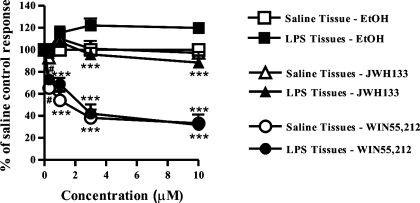
Fig. 1.
Fig. 1.
Ileal contractility in response to electrical field stimulation (EFS) in rat ileum. In each tissue, the control responses of EFS were recorded prior to addition of drugs (300 nM–10 μM). In tissues taken from rats given intraperitoneal saline 2 h earlier, the CB2 receptor agonist JWH133 had no effect on the contractile response, whereas in tissues taken from rats given LPS (65 μg/kg) 2 h previously the amplitude of the contractile response was attenuated at concentrations above 3 μM. The mixed CB1/CB2 receptor agonist WIN55,212-2 reduced the contractile responses in a concentration-dependent manner in tissues from both saline- and LPS-treated rats. EtOH, ethanol. Statistically significant differences compared with the relevant saline-treated rats: #P < 0.05, ***P < 0.001.
Fig. 2.
Fig. 2.
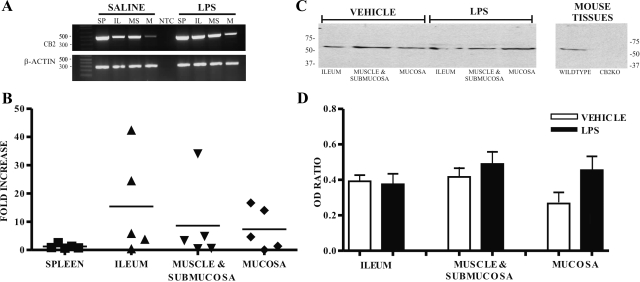
CB2 receptor mRNA and protein in the rat gastrointestinal tract. A: RNA was isolated from the spleen (SP), full-thickness ileum (IL), muscle and submucosa (MS), and mucosa (M). RT-PCR was performed using primers for cannabinoid CB2 receptor (CB2) or β-actin and the expected amplicons were 472 and 277 bp, respectively. NTC, no-template control. B: using quantitative real-time RT-PCR, we determined that CB2 mRNA was not significantly upregulated in the LPS-treated tissues (n = 5/group). C: protein homogenates were isolated from the full-thickness ileum, muscle and submucosal layers, and mucosa of rats treated 2 h earlier with either saline or LPS. Western blotting was performed with an antibody directed against the COOH terminus of the CB2 receptor (Alpha Diagnostics) and a band was observed at ∼60 kDa. A similar band was present in mouse ileum, and this band was absent in tissues from CB2−/− mice. D: semiquantitative densitometric measurement, expressed as a ratio of β-actin content in each sample, indicated that CB2 receptor mRNA was not upregulated by LPS treatment.
Fig. 3.
Fig. 3.
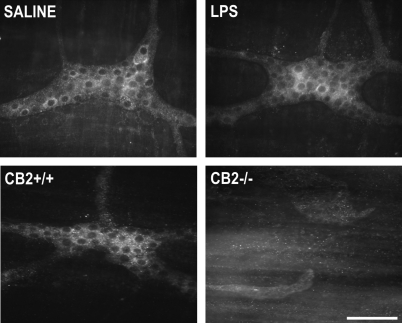
CB2 receptor immunoreactivity in the myenteric plexus of the rat ileum. CB2 receptor immunoreactivity is present in enteric cell bodies and fibers in the myenteric plexus of the rat ileum in saline-treated animals; no difference in staining was observed in the myenteric plexus of rats treated with LPS. The antibody also displayed similar staining in mouse myenteric plexus from wild-type animals, and staining was abolished in CB2−/− mice, indicating antibody specificity. Scale bar: 100 μm.
Fig. 4.
Fig. 4.
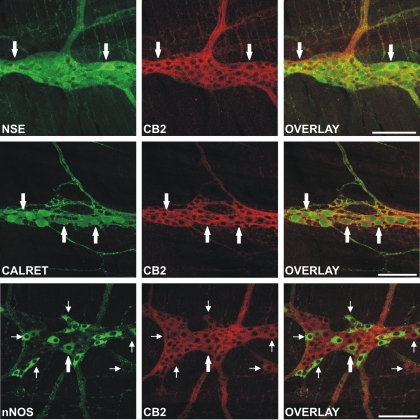
Confocal fluorescence micrographs of CB2 receptor immunoreactivity double labeled with enteric neuronal markers in whole-mount preparations of rat ileal myenteric plexus. Single labels for neuron specific enolase (NSE; top row), calretinin (calret; middle row) and neuronal nitric oxide synthase (nNOS; bottom row) are in the first column. CB2 receptor immunoreactivity is shown in the second column, and the overlay image is shown in the third column. Examples of colocalization are shown by thick arrows. The majority of NSE and calretinin-positive cells colocalize with CB2 receptor immunoreactivity. There is very little colocalization between neurons expressing nNOS and CB2 receptor immunoreactivity, shown by thin arrows. Scale bar: 100 μm.
Fig. 5.
Fig. 5.
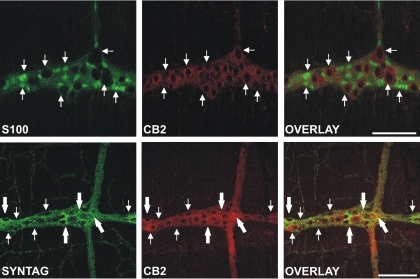
Confocal fluorescence micrographs of CB2 receptor immunoreactivity in whole-mount preparations of the rat myenteric plexus double-labeled with enteric glial and synaptic vesicle markers. Single labels for S100 (top row) and synaptotagmin (bottom row) are in the first column. CB2 receptor immunoreactivity is shown in the second column and the overlay double-labeled image is shown in the third column. There is no colocalization between S100 and CB2 receptor immunoreactivity; the distinct cell populations are shown by thin arrows. There is some degree of colocalization with CB2 receptor immunoreactivity and synaptotagmin; double labeling is shown by thick arrows, and no colocalization is shown by thin arrows. Scale bar: 100 μm.
Fig. 6.
Fig. 6.
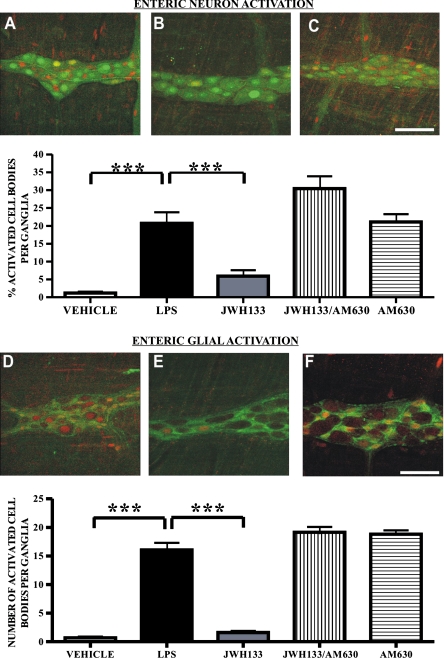
Fos expression in the rat myenteric plexus after LPS treatment. In vivo LPS-treatment (65 μg/kg ip; 2 h) induces Fos expression in both enteric neurons (A, red nuclei) and glia (D, red nuclei) compared with saline controls. Administration of the CB2 receptor agonist JWH133 in LPS-treated rats attenuates Fos expression in enteric neurons (B, green, labeled with NSE) and glia (E, green, labeled with S-100), which can be reversed by coadministration of the CB2 receptor antagonist AM630 (C, F), which has no effect alone on LPS-induced Fos expression. ***P < 0.001. Scale bar: 100 μm.

References

    1. Begg M, Molleman A, Parsons M. Modulation of the release of endogenous gamma-aminobutyric acid by cannabinoids in the guinea pig ileum. Eur J Pharmacol 434: 87–94, 2002. - PubMed
    1. Beltramo M, Bernardini N, Bertorelli R, Campanella M, Nicolussi E, Fredduzzi S, Reggiani A. CB2 receptor-mediated antihyperalgesia: possible direct involvement of neural mechanisms. Eur J Neurosci 23: 1530–1538, 2006. - PubMed
    1. Benito C, Nunez E, Tolon RM, Carrier EJ, Rabano A, Hillard CJ, Romero J. Cannabinoid CB2 receptors and fatty acid amide hydrolase are selectively overexpressed in neuritic plaque-associated glia in Alzheimer's disease brains. J Neurosci 23: 11136–11141, 2003. - PMC - PubMed
    1. Borrelli F, Capasso R, Pinto A, Izzo AA. Inhibitory effect of ginger (Zingiber officinale) on rat ileal motility in vitro. Life Sci 74: 2889–2896, 2004. - PubMed
    1. Buckley NE, McCoy KL, Mezey E, Bonner T, Zimmer A, Felder CC, Glass M, Zimmer A. Immunomodulation by cannabinoids is absent in mice deficient for the cannabinoid CB(2) receptor. Eur J Pharmacol 396: 141–149, 2000. - PubMed

Publication types

MeSH terms

LinkOut - more resources