. 2008 May 15;68(10):3584-90.
doi: 10.1158/0008-5472.CAN-07-6154.

Characterization of TMPRSS2-ETS gene aberrations in androgen-independent metastatic prostate cancer

Affiliations

Characterization of TMPRSS2-ETS gene aberrations in androgen-independent metastatic prostate cancer

Rohit Mehra et al. Cancer Res. .

Abstract

Recurrent gene fusions between the androgen-regulated gene TMPRSS2 and the ETS transcription factor family members ERG, ETV1, and ETV4 have been identified as a critical event in prostate cancer development. In this study, we characterized the prevalence and diversity of these rearrangements in hormone-refractory metastatic prostate cancer. We used a fluorescence in situ hybridization (FISH) split probe strategy to comprehensively evaluate TMPRSS2-ETS aberrations across 97 nonosseous metastatic sites of prostate cancer from 30 rapid autopsies of men who died of androgen-independent disease. Tissue microarrays were constructed representing multiple metastatic sites from each patient, and split signal FISH probes for TMPRSS2, ERG, ETV1, and ETV4 were used to assess for TMPRSS2-ETS rearrangements. In patients exhibiting these aberrations, multiple sites from an individual case harbored the same gene fusion molecular subtype suggesting clonal expansion of disease. The most common prostate cancer gene fusion, TMPRSS2-ERG, can be generated by the mechanism of interstitial deletion (Edel) about 39% to 60% of the time in clinically localized disease. Interestingly, we observed that all of the androgen-independent metastatic prostate cancer sites harboring TMPRSS2-ERG were associated with Edel. These findings suggest that TMPRSS2-ERG with Edel is an aggressive and, in this study, uniformly lethal molecular subtype of prostate cancer associated with androgen-independent disease.


Figures

Figure 1
Figure 1. FISH probe design and representative TMPRSS2-ETS chromosomal aberrations detected in androgen independent metastatic prostate cancer
A, For all assays, the chromosomal location of the gene is indicated (boxes), with the direction of transcription indicated by the arrow. The 5’ and 3’ BACs are indicated in ovals, with the number identifying each respective BAC and the color indicating the probe color in the accompanying images. B, Representative FISH images of the various TMPRSS2-ETS aberrations observed in this study. Green and red arrows show individual signals, and yellow arrows indicate colocalized signals in 4’6-diamidino-2-phenylindole (DAPI) stained nuclei. B1, Colocalized signals in metastatic prostate cancer cells in a case lacking TMPRSS2 rearrangement. B2, TMPRSS2 rearrangement positive case without Edel, as indicated by split 5’ and 3’ signals. B3, TMPRSS2 rearrangement positive case with Edel, as indicated by one pair of co-localized signals (yellow arrow) and the loss of one red labeled probe 3’ to TMPRSS2. B4, Co-localized signals (yellow arrows) in a representative case lacking ERG rearrangement. B5, An ERG rearrangement positive case with Edel showing loss of one red labeled probe 5’ to ERG. B6, ETV1 rearrangement positive case without deletion, as indicated by split 5’ and 3’ signals (green and red arrows). B7, ETV1 rearrangement positive case with deletion exhibiting loss of one red labeled probe 5’ to ETV1. B8, ETV1 amplification shown by multiple (–9) copies of co-localized signals in case 30 B9, A case showing rearrangement of ETV4, as indicated by break apart probes. Numbered BACs are as follows: 1= RP11-35C4 (5’ to TMPRSS2) and 2= RP11-120C17 (3’ to 18 TMPRSS2), 3= RP11-95I21 (5’ to ERG) and 4= RP11-476D17(3’ to ERG), 5= RP11- 661L15 (5’ to ETV1) and 6= RP11-124L22(3’ to ETV1) and 7= RP11-100E5 (5’ to ETV4) and 8= RP11-436J4 (3’ to ETV4).
Figure 2
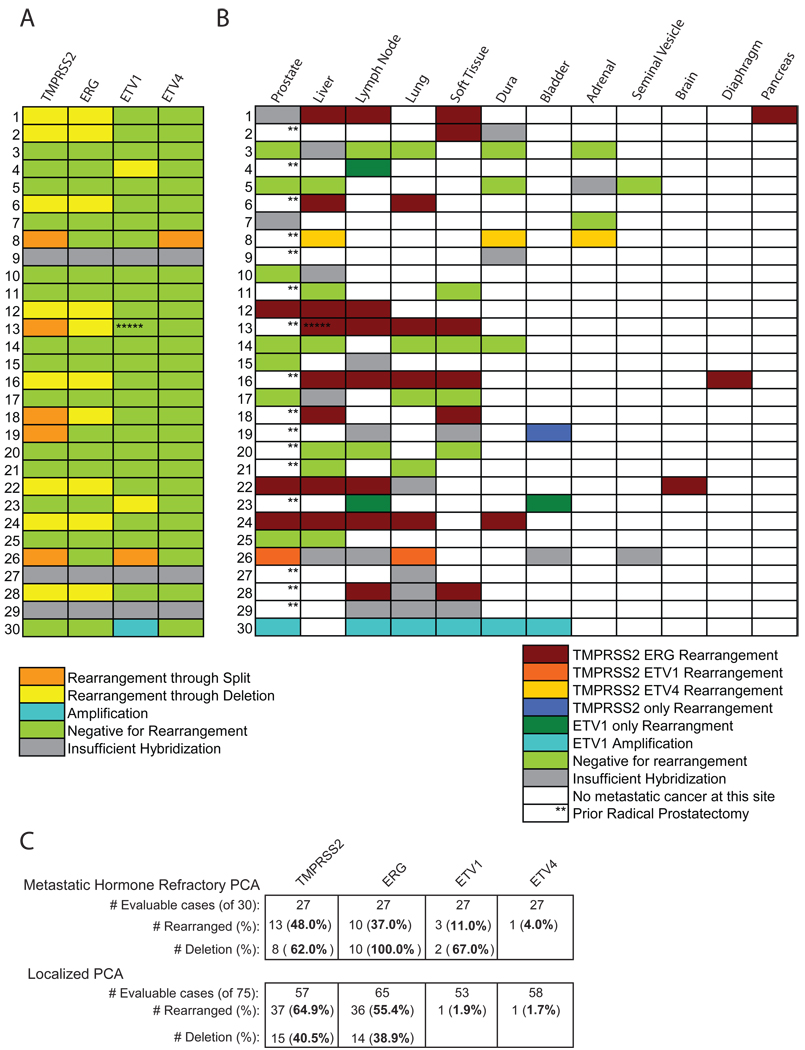
Figure 2. Diversity of TMPRSS2 and ETS rearrangements in androgen-independent metastatic prostate cancer
A, Heat map representation of the TMPRSS2 and ETS aberrations in metastatic prostate cancers characterized in each subject. B, Heat map representation of TMPRSS2 and ETS rearrangement status of the metastatic sites and residual tumor in the prostate (when present) as evaluated in this cohort. **Prostate cancer tissues could not be procured at the time of autopsy because of previous radical prostatectomy and hence were not available for evaluation. No cancer focus was hybridizable for FISH probes in cases 9, 27 and 29.*****Case 13 which harbored a TMPRSS2:ERG rearrangement at metastatic foci within liver, lung, dura and soft tissue liver also showed a deletion of 5’ end of ETV1 in metastatic tumor within liver (presumably a non-specific secondary aberration). Color legend signifies respective aberrations. C. Table of results for rearrangements in TMPRSS2, ERG, ETV1 and ETV4 as detected by the assays shown in Figure 1. In this cohort, 27 of 30 cases were evaluable for at least one assay in various metastatic prostate cancer sites in this cohort, and the number of evaluable cases for each assay is indicated. The percentage (of evaluable cases for that assay) and number of cases with rearrangements for each assay is listed. For TMPRSS2, ERG, ETV1 and ETV4, the percentage (of rearrangement positive cases) and number of cases with assays consistent with intrachromosomal deletion between TMPRSS2 and ERG are given. The bottom panel contains a comparison of similar assays in a clinically localized prostate cancer cohort we previously evaluated (1). The number and percentage of cases with rearrangements for each assay is given, as well as the number and percentage of TMPRSS2 and ERG rearrangement positive cases with intrachromosomal deletion.
Figure 3
Figure 3. The clonal nature of TMPRSS2-ETS aberrations in the spread of metastatic prostate cancer
A, Representative Case 24 of metastatic prostate cancer highlighting the clonal nature of cells harboring TMPRSS2-ETS gene fusions. In this case, the subject harbored TMPRSS-ERG with Edel in the prostate and metastatic sites in the liver, lung, dura, and lymph node (representative FISH images from each site are shown- using the multicolor FISH probe strategy a nucleus with an ERG deletion shows replacement of one juxtaposed red and green signal pair with a single green signal representing loss of the 5’ end (red probe)). B, This schematic depicts that while multi-focal prostate cancer might harbor TMPRSS-ETS gene fusion positive nodes and negative nodes, only one “clone” or molecular subtype will progress and result in androgen-independent metastatic disease.

References

    1. Mehra R, Tomlins SA, Shen R, et al. Comprehensive assessment of TMPRSS2 and ETS family gene aberrations in clinically localized prostate cancer. Mod Pathol. 2007;20:538–544. - PubMed
    1. Perner S, Demichelis F, Beroukhim R, et al. TMPRSS2:ERG Fusion-Associated Deletions Provide Insight into the Heterogeneity of Prostate Cancer. Cancer Res. 2006;66:8337–8341. - PubMed
    1. Taichman RS, Loberg RD, Mehra R, Pienta KJ. The evolving biology and treatment of prostate cancer. J Clin Invest. 2007;117:2351–2361. - PMC - PubMed
    1. Rubin MA, Putzi M, Mucci N, et al. Rapid ("warm") autopsy study for procurement of metastatic prostate cancer. Clin Cancer Res. 2000;6:1038–1045. - PubMed
    1. Shah RB, Mehra R, Chinnaiyan AM, et al. Androgen-independent prostate cancer is a heterogeneous group of diseases: lessons from a rapid autopsy program. Cancer Res. 2004;64:9209–9216. - PubMed

Publication types