Eye movement statistics in humans are consistent with an optimal search strategy
- PMID: 18484810
- PMCID: PMC2868380
- DOI: 10.1167/8.3.4
Eye movement statistics in humans are consistent with an optimal search strategy
Abstract
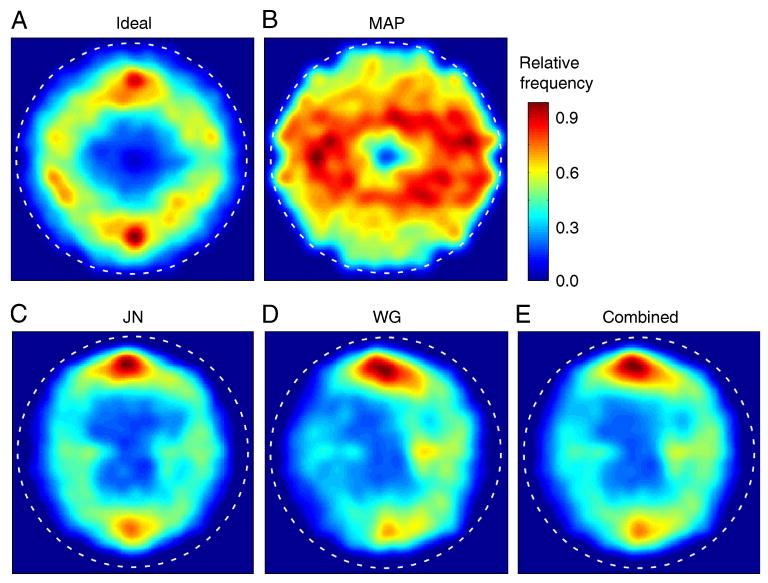
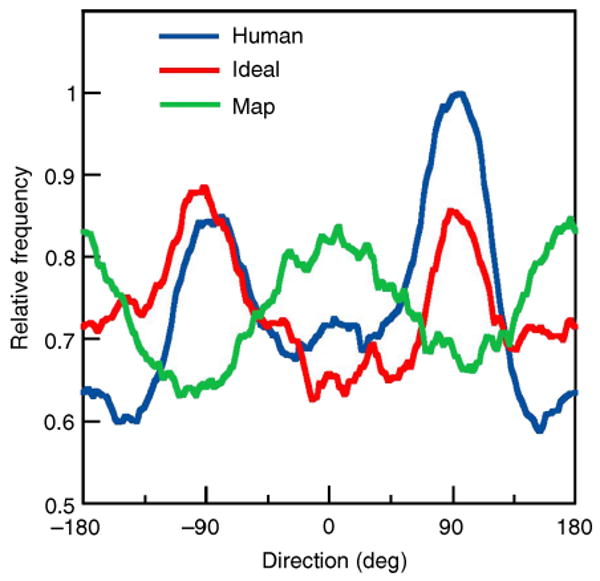
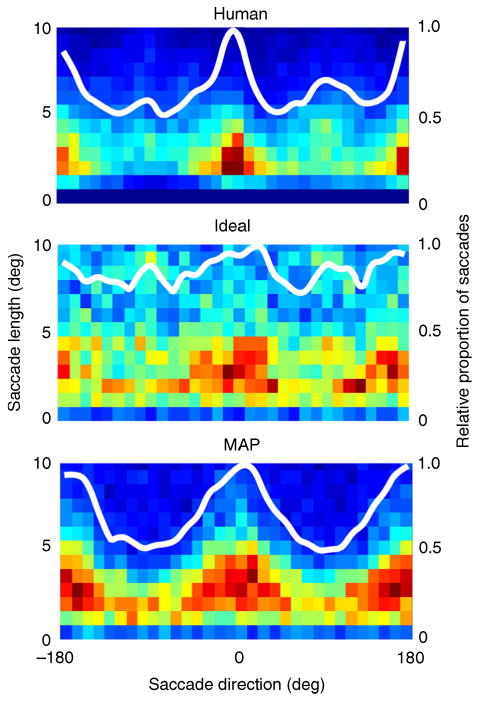
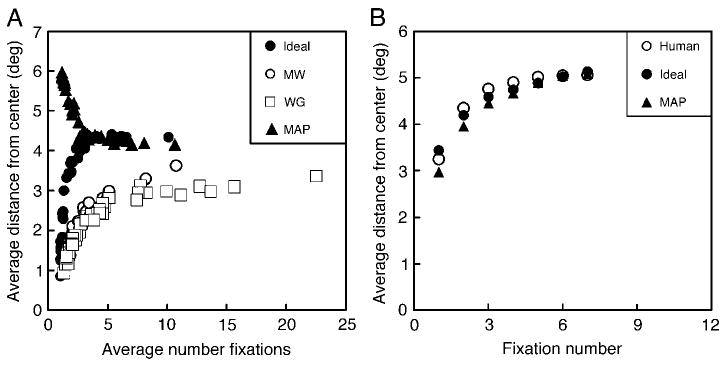
Most models of visual search are based on the intuition that humans choose fixation locations containing features that best match the features of the target. The optimal version of this feature-based strategy is what we term "maximum a posteriori (MAP) search." Alternatively, humans could choose fixations that maximize information gained about the target's location. We term this information-based strategy "ideal search." Here we compare eye movements of human, MAP, and ideal searchers in tasks where known targets are embedded at unknown locations within random backgrounds having the spectral characteristics of natural scenes. We find that both human and ideal searchers preferentially fixate locations in a donut-shaped region around the center of the circular search area, with a high density of fixations at top and bottom, while MAP searchers distribute their fixations more uniformly, with low density at top and bottom. Our results argue for a sophisticated search mechanism that maximizes the information collected across fixations.
Figures
References
-
- Aivar MP, Hayhoe MM, Chizk CL, Mruczek RE. Spatial memory and saccadic targeting in a natural task. Journal of Vision. 2005. pp. 177–193. 3. http://journalofvision.org/5/3/3/ - DOI - PubMed
-
- Burgess AE, Ghandeharian H. Visual signal detection. II. Signal-location identification. Journal of the Optical Society of America A, Optics and Image Science. 1984;1:906–910. - PubMed
-
- Carr JC, Fright WR, Beatson RK. Surface interpolation with radial basis functions for medical imaging. IEEE Transactions on Medical Imaging. 1997;16:96–107. - PubMed
-
- Carrasco M, Evert DL, Chang I, Katz SM. The eccentricity effect: Target eccentricity affects performance on conjunction searches. Perception & Psychophysics. 1995;57:1241–1261. - PubMed
-
- Carrasco M, Frieder KS. Cortical magnification neutralizes the eccentricity effect in visual search. Vision Research. 1997;37:63–82. - PubMed
Publication types
MeSH terms
Grants and funding
LinkOut - more resources
Full Text Sources
Other Literature Sources