Case Reports
. 2008 Jun;82(6):1334-41.
doi: 10.1016/j.ajhg.2008.04.014. Epub 2008 May 15.

Mutations in the MESP2 gene cause spondylothoracic dysostosis/Jarcho-Levin syndrome

Affiliations
Case Reports

Mutations in the MESP2 gene cause spondylothoracic dysostosis/Jarcho-Levin syndrome

Alberto S Cornier et al. Am J Hum Genet. 2008 Jun.

Abstract

Spondylothoracic dysostosis (STD), also known as Jarcho-Levin syndrome (JLS), is an autosomal-recessive disorder characterized by abnormal vertebral segmentation and defects affecting spine formation, with complete bilateral fusion of the ribs at the costovertebral junction producing a "crab-like" configuration of the thorax. The shortened spine and trunk can severely affect respiratory function during early childhood. The condition is prevalent in the Puerto Rican population, although it is a panethnic disorder. By sequencing a set of candidate genes involved in mouse segmentation, we identified a recessive E103X nonsense mutation in the mesoderm posterior 2 homolog (MESP2) gene in a patient, of Puerto Rican origin and from the Boston area, who had been diagnosed with STD/JLS. We then analyzed 12 Puerto Rican families with STD probands for the MESP2 E103X mutation. Ten patients were homozygous for the E103X mutation, three patients were compound heterozygous for a second nonsense mutation, E230X, or a missense mutation, L125V, which affects a conserved leucine residue within the bHLH region. Thus, all affected probands harbored the E103X mutation. Our findings suggest a founder-effect mutation in the MESP2 gene as a major cause of the classical Puerto Rican form of STD/JLS.


Figures
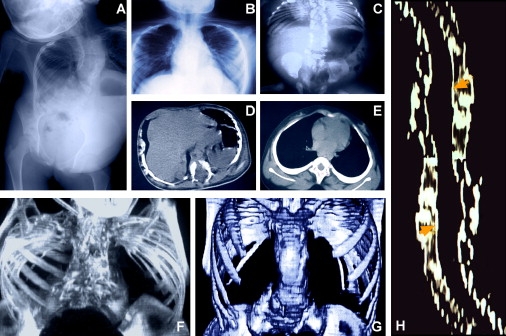
Figure 1
Figure 1
Rib and Vertebral Defects in Patients with Spondylothoracic Dysostosis (A) Antero-posterior (AP) chest radiograph of patient 01-022 showing the shortened vertebral column characteristic of patients with spondylothoracic dysostosis (STD), also known as Jarcho-Levin syndrome (JLS). This patient is from the Boston area but is of Puerto Rican origin. (B) AP chest radiograph demonstrating bilateral rib fusion at the costovertebral junction with the ribs' “crab-like” appearance as they fan out from their origins. (C) Thoraco-abdominal radiograph characteristic of a patient with STD. The spine is short but straight (AP projection), and multiple segmentation abnormalities are evident. The pedicles of the vertebrae are prominent (“tramline sign”). The ribs are fused posteriorly at the costovertebral junctions and fan out, showing a “crab-like” appearance. (D and E) Thoracic reconstructive CT scans. (D) Axial view of a thoracic vertebra shows both anterior and posterior cleft defects. (E) Vertebrae without clefts present an increased coronal diameter with a decreased sagittal diameter (sickle-shape vertebra). (F) Patient with STD homozygous for the E103X mutation shows a thoracic spine measurement of 4.2 cm. (G) Patient with STD heterozygous for the E103X mutation shows a spine measurement of 7.7 cm. (H) Reconstructive image of the spinal canal of a patient with STD. Arrowheads indicate the measurement points at the thoracic and lumbar levels, demonstrating a spinal-canal width of 34.0 mm versus an expected 27.1 mm (patient genotype E103X/E103X). Panels B–H are films from patients of Puerto Rican origin.
Figure 2
Figure 2
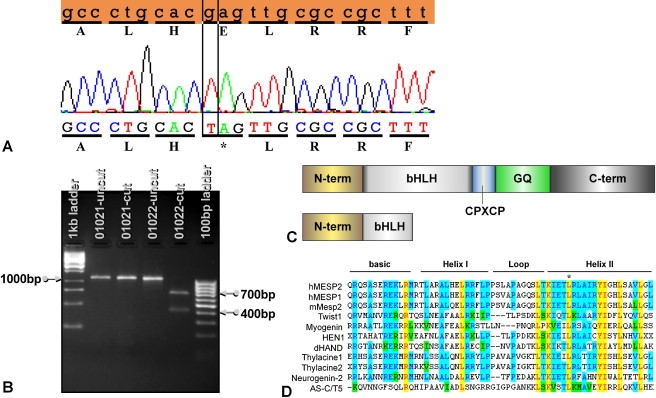
Detection of the E103X Mutation by DNA Sequencing and Restriction Fragment Length Polymorphism (RFLP) Analysis (A) The amino acid and DNA sequences (top, orange) of MESP2 from GenBank are compared with the sequences from the patient with STD/JLS. The single-base-pair substitution mutation (c.307G→T) is indicated by a vertical box. The asterisk indicates the stop codon. (B) The c.307G→T mutation results in the addition of an SpeI site, which can be detected as an RFLP. Sample no. 01021 is from a control patient who does not have the E103X mutation. Sample no. 01022 is from a patient who is homozygous for the E103X mutation. (C) Comparison of MESP2 full-length protein versus truncated protein caused by the E103X mutation. The full-length MESP2 protein (top) has an N-terminal (N-term) domain followed by a basic helix-loop-helix domain (bHLH), a region rich in glycine and glutamine residues (GQ repeats), and a c-terminal (c-term) region. Between the bHLH domain and the GQ repeats is a conserved CPXCP motif. The predicted protein resulting from the E103X mutation (bottom) has a short, truncated bHLH domain and is missing the other domains. (D) Sequence comparison of the bHLH domain of MESP2 to other bHLH proteins. The asterisk indicates the L125V mutation in patient 0600905-01. Identical residues are highlighted in yellow, conserved residues are highlighted in blue, and blocks of similar residues are highlighted in green. Swiss-Prot accession numbers for the sequences are: human MESP2, Q0VG99; human MESP1, Q9BRJ9; mouse Mesp2, O08574; human Twist1, Q15672; human Myogenin, P15173; human HEN1, Q02575; mouse dHAND, Q9EPN2; Xenopus Thylacine1, O73623; Xenopus Thylacine2, O73624; mouse Neurogenin-2, P70447; and Drosophila AS-C/T5, P10083.
Figure 3
Figure 3
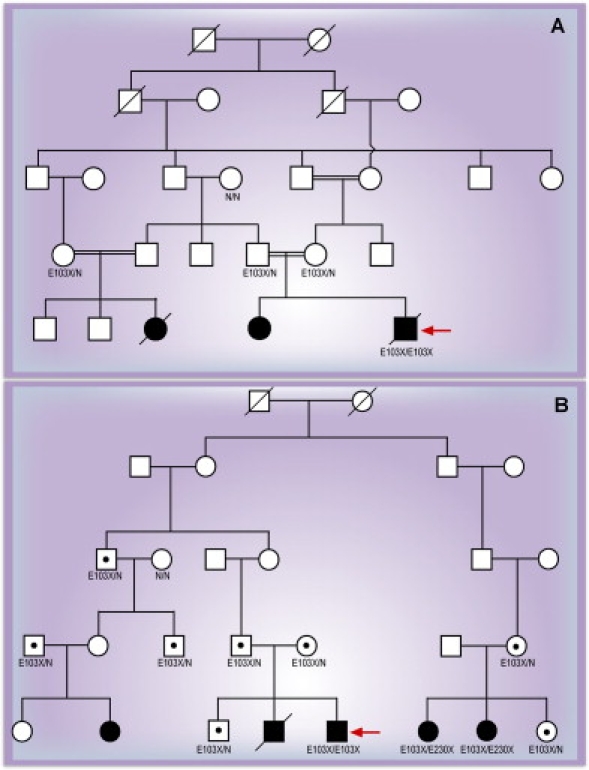
Confirmation of Homozygosity for the MESP2 E103X Mutation as the Cause of STD in Two Families of Puerto Rican Origin (A) Confirmation of homozygosity for the MESP2 E103X mutation as the cause of STD in a family of Puerto Rican origin. Black circles and square represent affected individuals. (B) Confirmation of homozygosity for the MESP2 E103X mutation as the cause of STD in a family of Puerto Rican origin and of heterozygosity for the E103X and E230X mutations. Black circles and squares represent affected individuals. Black dots represent unaffected carriers, and the red arrow in each panel indicates the proband.
Figure 4
Figure 4
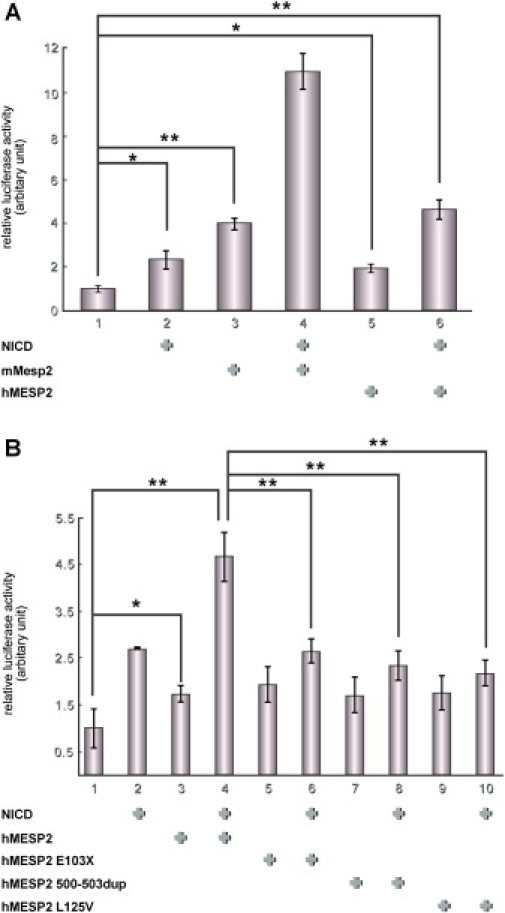
Luciferase Reporter Assay Indicating that Human MESP2 Mutants Lack Transactivation Activities (A) The activity of MESP2 was compared between mouse (mMesp2) and human (hMESP2) with the use of a reporter construct containing luciferase driven by a mouse Lfng enhancer. Cotransfection of MESP2 with the notch intracellular domain (NICD) results in synergistic activation of the reporter (indicated by + at the bottom of each panel). Similar activation was observed in hMESP2 and NICD. (B) The relative activities of hMESP2 and the variants. Three mutant MESP2 variants show reduced activities. The relative activities are expressed as means + SDs of three different experiments. indicates p < 0.05. ∗∗ indicates p < 0.01.

References

    1. Turnpenny P.D., Alman B., Cornier A.S., Giampietro P.F., Offiah A., Tassy O., Pourquie O., Kusumi K., Dunwoodie S. Abnormal vertebral segmentation and the notch signaling pathway in man. Dev. Dyn. 2007;236:1456–1474. - PubMed
    1. Jarcho S., Levin P. Hereditary malformation of the vertebral bodies. Bull. Johns Hopkins Hosp. 1938;62:216–226.
    1. Cornier A.S., Ramirez N., Arroyo S., Acevedo J., Garcia L., Carlo S., Korf B. Phenotype characterization and natural history of spondylothoracic dysplasia syndrome: a series of 27 new cases. Am. J. Med. Genet. 2004;128:120–126. - PubMed
    1. Lavy N.W., Palmer C.G., Merritt A.D. A syndrome of bizarre vertebral anomalies. J. Pediatr. 1966;69:1121–1125. - PubMed
    1. Moseley J.E., Bonforte R.J. Spondylothoracic dysplasia–a syndrome of congenital anomalies. Am. J. Roentgenol. Radium Ther. Nucl. Med. 1969;106:166–169. - PubMed

Publication types

MeSH terms