


Genome-wide SNP typing reveals signatures of population history
- PMID: 18485661
- PMCID: PMC3421839
- DOI: 10.1016/j.ygeno.2008.03.005
Genome-wide SNP typing reveals signatures of population history
Abstract
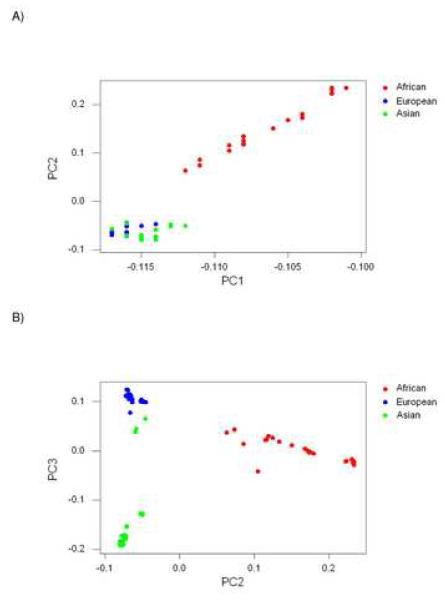
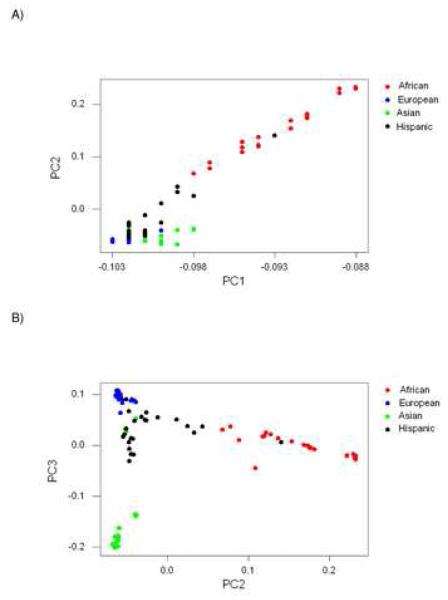
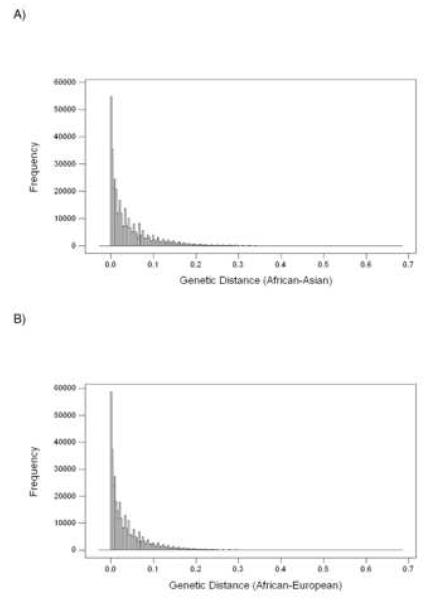
Single-nucleotide polymorphism (SNP) arrays have become a popular technology for disease-association studies, but they also have potential for studying the genetic differentiation of human populations. Application of the Affymetrix GeneChip Human Mapping 500K Array Set to a population of 102 individuals representing the major ethnic groups in the United States (African, Asian, European, and Hispanic) revealed patterns of gene diversity and genetic distance that reflected population history. We analyzed allelic frequencies at 388,654 autosomal SNP sites that showed some variation in our study population and 10% or fewer missing values. Despite the small size (23-31 individuals) of each subpopulation, there were no fixed differences at any site between any two subpopulations. As expected from the African origin of modern humans, greater gene diversity was seen in Africans than in either Asians or Europeans, and the genetic distance between the Asian and the European populations was significantly lower than that between either of these two populations and Africans. Principal components analysis applied to a correlation matrix among individuals was able to separate completely the major continental groups of humans (Africans, Asians, and Europeans), while Hispanics overlapped all three of these groups. Genes containing two or more markers with extraordinarily high genetic distance between subpopulations were identified as candidate genes for health differences between subpopulations. The results show that, even with modest sample sizes, genome-wide SNP genotyping technologies have great promise for capturing signatures of gene frequency difference between human subpopulations, with applications in areas as diverse as forensics and the study of ethnic health disparities.
Figures
References
-
- Lillie-Blanton M, Parsons PE, Gayle H, Dievler A. Racial differences in health: not just black and white, but shades of gray. Annu. Rev. Public Health. 1996;17:411–448. - PubMed
-
- Tishkoff SA, Williams SM. Genetic analysis of African populations: human evolution and complex disease. Nature Reviews Genetics. 2002;3:611–621. - PubMed
Publication types
MeSH terms
Grants and funding
LinkOut - more resources
Full Text Sources
Research Materials
