


The cannabinoid receptor agonist, WIN 55, 212-2, attenuates tumor-evoked hyperalgesia through peripheral mechanisms
- PMID: 18486111
- PMCID: PMC2678169
- DOI: 10.1016/j.brainres.2008.03.063
The cannabinoid receptor agonist, WIN 55, 212-2, attenuates tumor-evoked hyperalgesia through peripheral mechanisms
Abstract
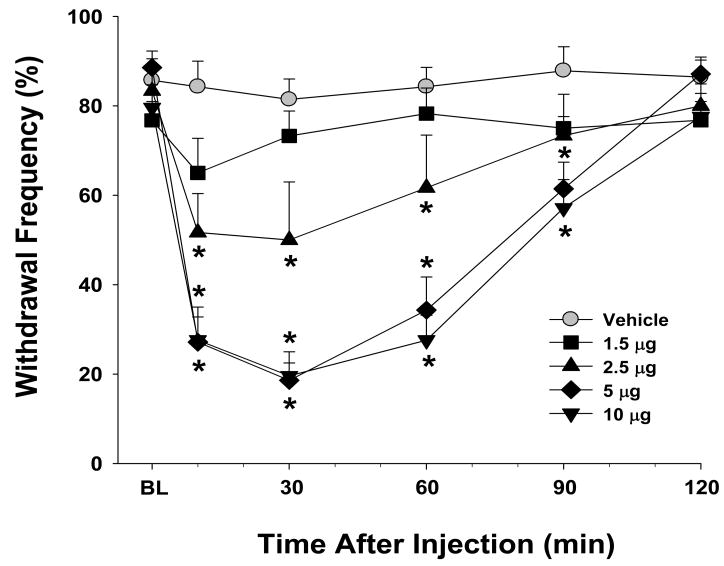
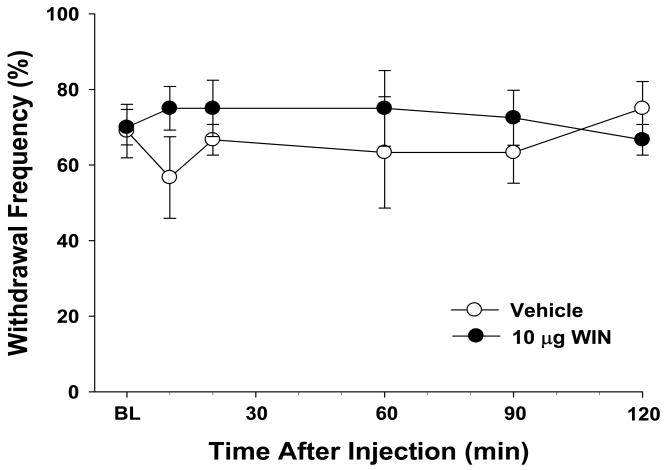
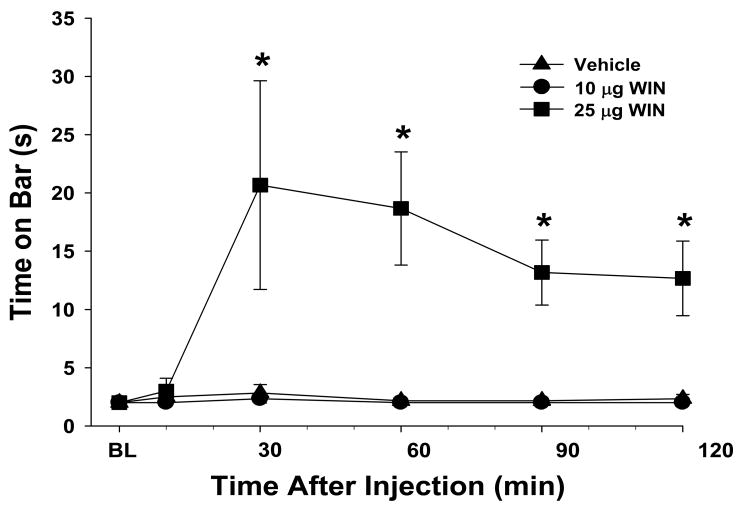
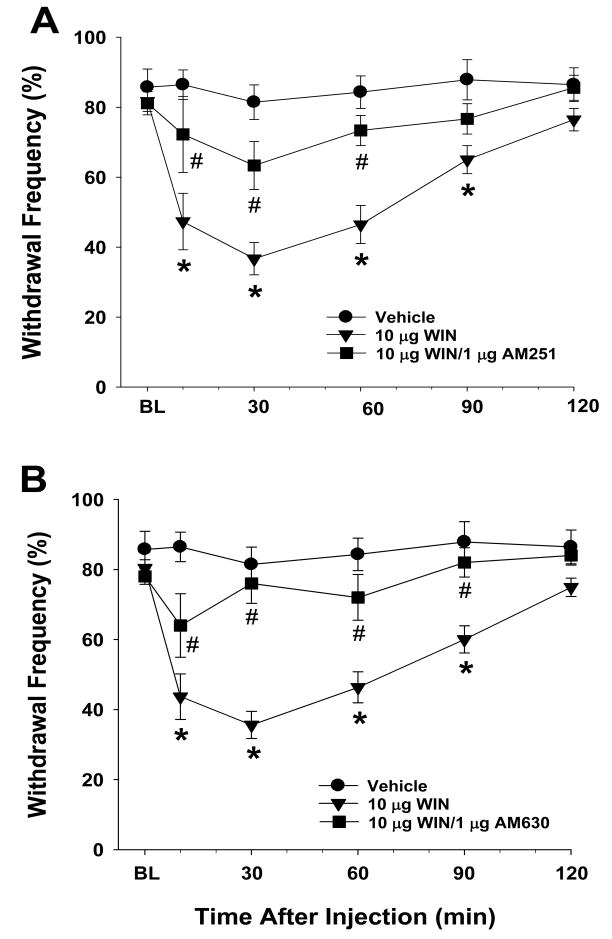
Several lines of evidence suggest that cannabinoids can attenuate various types of pain and hyperalgesia through peripheral mechanisms. The development of rodent cancer pain models has provided the opportunity to investigate novel approaches to treat this common form of pain. In the present study, we examined the ability of peripherally administered cannabinoids to attenuate tumor-evoked mechanical hyperalgesia in a murine model of cancer pain. Unilateral injection of osteolytic fibrosarcoma cells into and around the calcaneus bone resulted in tumor formation and mechanical hyperalgesia in the injected hindpaw. Mechanical hyperalgesia was defined as an increase in the frequency of paw withdrawals to a suprathreshold von Frey filament (3.4 mN) applied to the plantar surface of the hindpaw. WIN 55, 212-2 (1.5 to 10 microg) injected subcutaneously into the tumor-bearing hindpaw produced a dose-dependent decrease in paw withdrawal frequencies to suprathreshold von Frey filament stimulation. Injection of WIN 55,212-2 (10 microg) into the contralateral hindpaw did not decrease paw withdrawal frequencies in the tumor-bearing hindpaw. Injection of the highest antihyperalgesic dose of WIN 55,212-2 (10 microg) did not produce catalepsy as determined by the bar test. Co-administration of WIN 55,212-2 with either cannabinoid 1 (AM251) or cannabinoid 2 (AM630) receptor antagonists attenuated the antihyperalgesic effects of WIN 55, 212-2. In conclusion, peripherally administered WIN 55,212-2 attenuated tumor-evoked mechanical hyperalgesia by activation of both peripheral cannabinoid 1 and cannabinoid 2 receptors. These results suggest that peripherally-administered cannabinoids may be effective in attenuating cancer pain.
Figures
References
-
- Agarwal N, Pacher P, Tegeder I, Amaya F, Constantin CE, Brenner GJ, Rubino T, Michalski CW, Marsicano G, Monory K, Mackie K, Marian C, Batkai S, Parolaro D, Fischer MJ, Reeh P, Kunos G, Kress M, Lutz B, Woolf CJ, Kuner R. Cannabinoids mediate analgesia largely via peripheral type 1 cannabinoid receptors in nociceptors. Nature Neuroscience. 2007;10:870–879. - PMC - PubMed
-
- Ahluwalia J, Urban L, Capogna M, Bevan S, Nagy I. Cannabinoid 1 receptors are expressed in nociceptive primary afferent sensory neurons. Neuroscience. 2000;100:685–688. - PubMed
-
- Amaya F, Shimosato G, Kawasaki Y, Hashimoto S, Tanaka Y, Ji RR, Tanaka M. Induction of CB1 cannabinoid receptor by inflammation in primary afferent neurons facilitates antihyperalgesic effect of peripheral CB1 agonist. Pain. 2006;124:175–183. - PubMed
-
- Azevedo São Leão Ferreira K, Kimura M, Jacobsen Teixeira M. The WHO analgesic ladder for cancer pain control, twenty years of use. How much pain relief does one get from using it? Supportive Care in Cancer. 2006;14:1086–1093. - PubMed
-
- Baamonde A, Lastra A, Juárez L, García V, Hidalgo A, Menéndez L. Effects of the local administration of selective mu-, delta-and kappa-opioid receptor agonists on osteosarcoma-induced hyperalgesia. Naunyn-Schmiedeberg’s Archives of Pharmacology. 2005;372:213–219. - PubMed
Publication types
MeSH terms
Substances
Grants and funding
LinkOut - more resources
Full Text Sources
Miscellaneous
