Review
. 2008 Jun 30;60(10):1209-17.
doi: 10.1016/j.addr.2008.03.010. Epub 2008 Apr 6.

Ultrasound for drug and gene delivery to the brain

Affiliations
Review

Ultrasound for drug and gene delivery to the brain

Kullervo Hynynen. Adv Drug Deliv Rev. .

Abstract

Noninvasive, transient, and local image-guided blood-brain barrier disruption (BBBD) has been demonstrated with focused ultrasound exposure in animal models. Most studies have combined low pressure amplitude and low time average acoustic power burst sonications with intravascular injection of pre-formed micro-bubbles to produce BBBD without damage to the neurons. The BBB has been shown to be healed within a few hours after the exposure. The combination of focused ultrasound beams with MR image guidance allows precise anatomical targeting as demonstrated by the delivery of several marker molecules in different animal models. This method may in the future have a significant impact on the diagnosis and treatment of central nervous system (CNS) disorders. Most notably, the delivery of the chemotherapy agents (liposomal Doxorubicin and Herceptin) has been shown in a rat model.


Figures
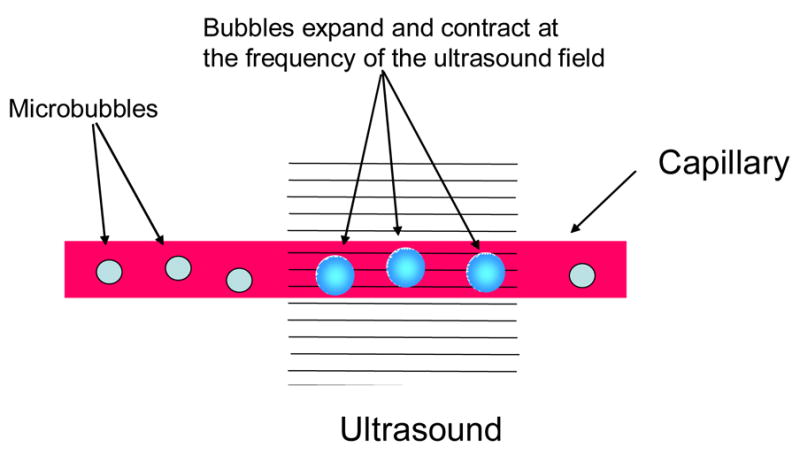
Figure 1
Figure 1
A diagram of the ultrasound induced BBBD.
Figure 2
Figure 2
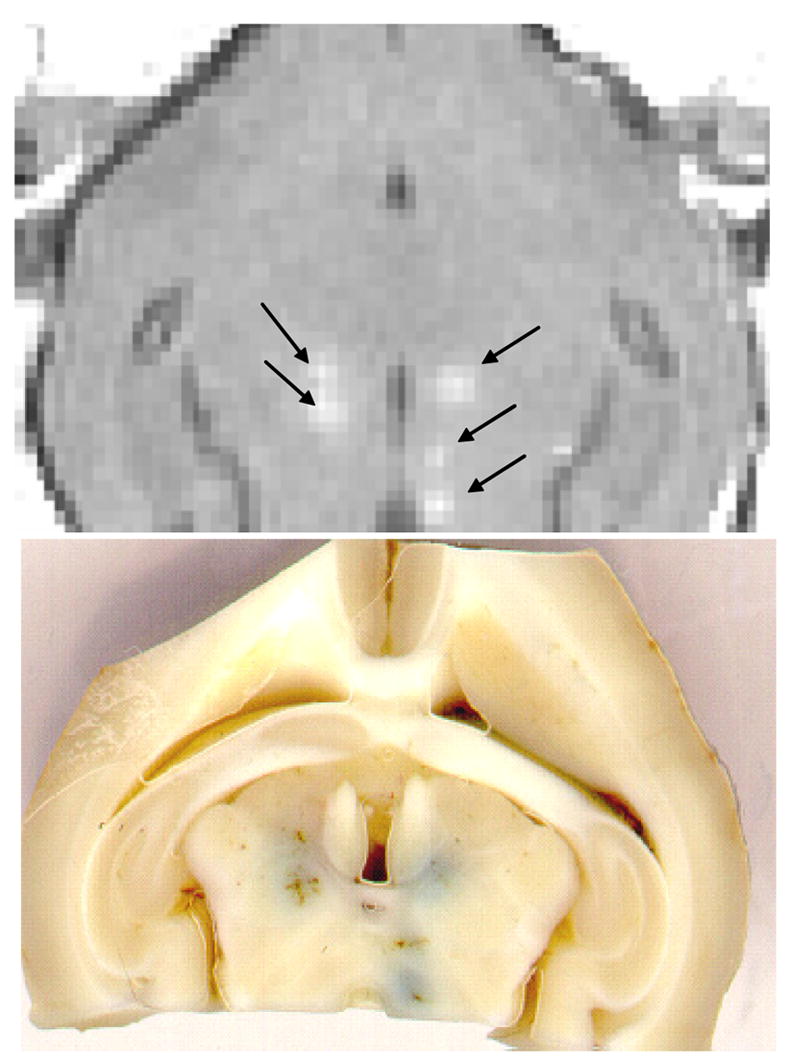
Top: An example of T1-weighted MR image of a rabbit brain obtained after five sonications (arrows) through a cranietomy and an injection of a bolus of gadolinium contrast agent. The image was acquired across the focus of the ultrasound beam and show local contrast enhancement at the sonicated locations. Bottom: The post mortem slice of the same brain showing trypan blue leakage at the sonicated location. The dye was injected a few minutes after the sonications.
Figure 3
Figure 3
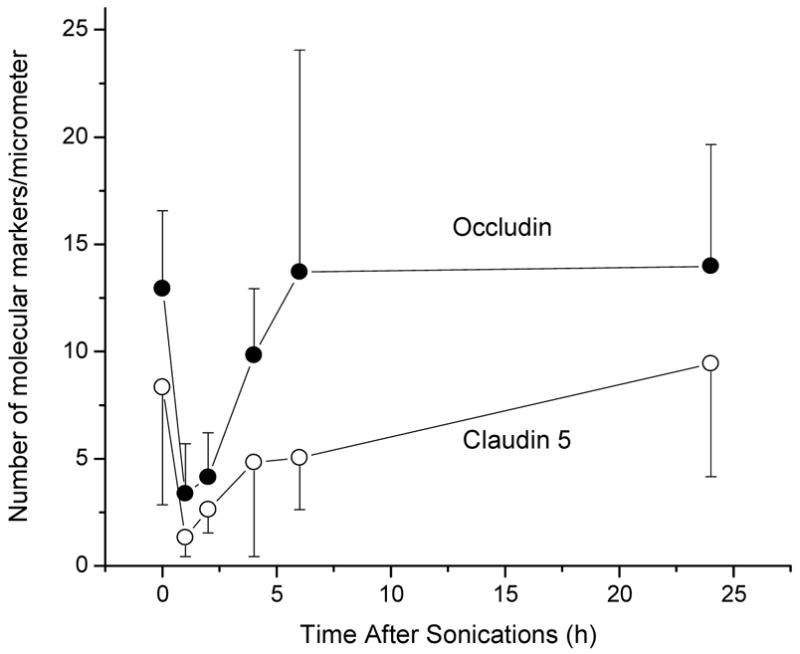
The number of TJ proteins Occludin and Claudin 5 as a function of time before and after sonications of rat brain through intact skull [43].
Figure 4
Figure 4
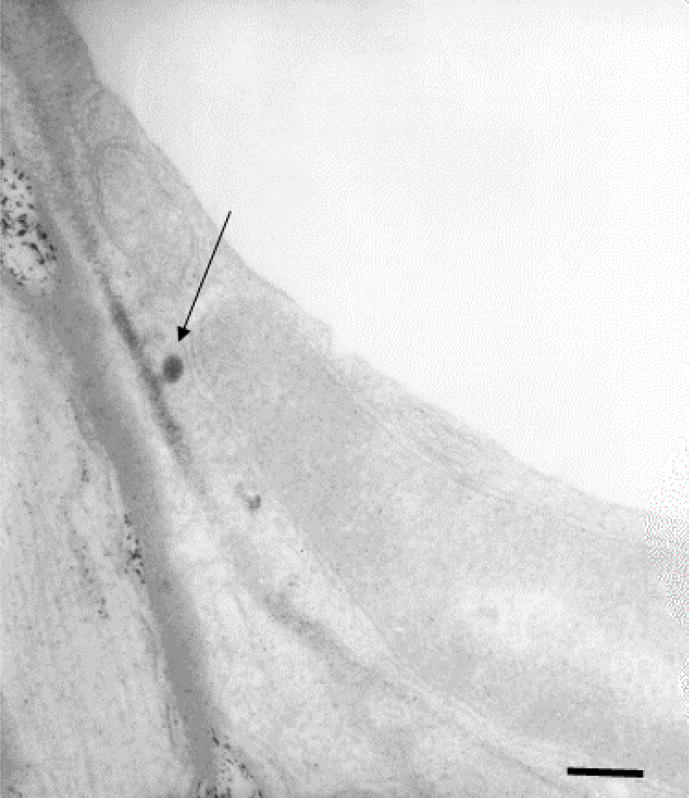
An electron microscopy image of horseradish peroxidase transport through the endothelium showing a vacuole emptying its content after transporting it through the endothelial cell [44]. These rat brain sonications were done through the intact skull.
Figure 5
Figure 5
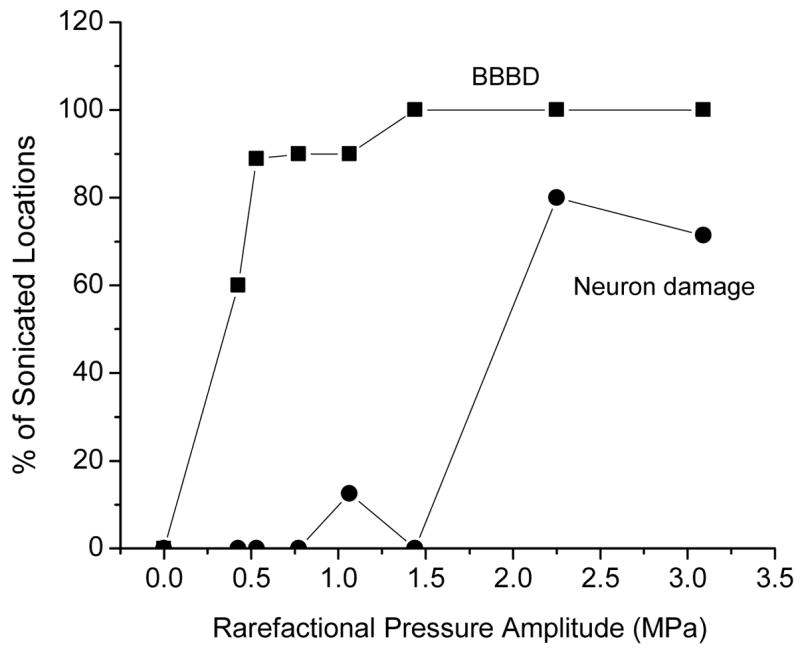
A. The percentage of sonicated locations in rabbit brain that showed contrast enhancement in T1-weighted MR images after sonication as a function the pressure amplitude during the 10 ms ultrasound bursts at the frequency of 0.68MHz. The sonications for this graph were done through a craniotomy window but the study demonstrated that equivalent response can be induced also through intact skull. The percentage of the locations that showed light microscopy evidence of neural damage is also plotted in the graph [42].
Figure 6
Figure 6
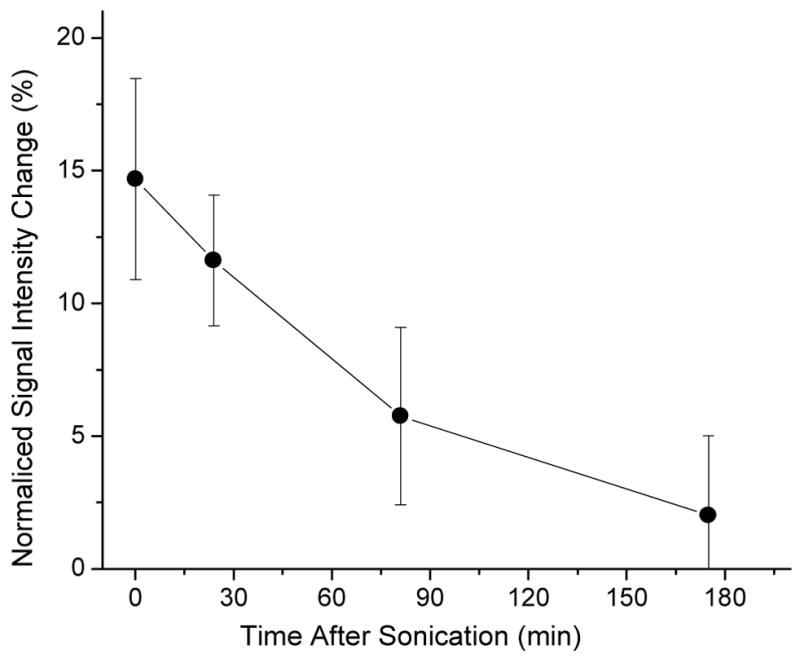
The normalized T1-signal intensity change after injection of gadopentetate dimeglumine contrast agent in rabbit brain as function of time after sonication when the contrast was injected demonstrating the healing of the BBBD [30]. The 10 ms burst sonications at the burst repetition frequency of 1 Hz and at a frequency of 0.26 MHz were done through intact skull.
Figure 7
Figure 7
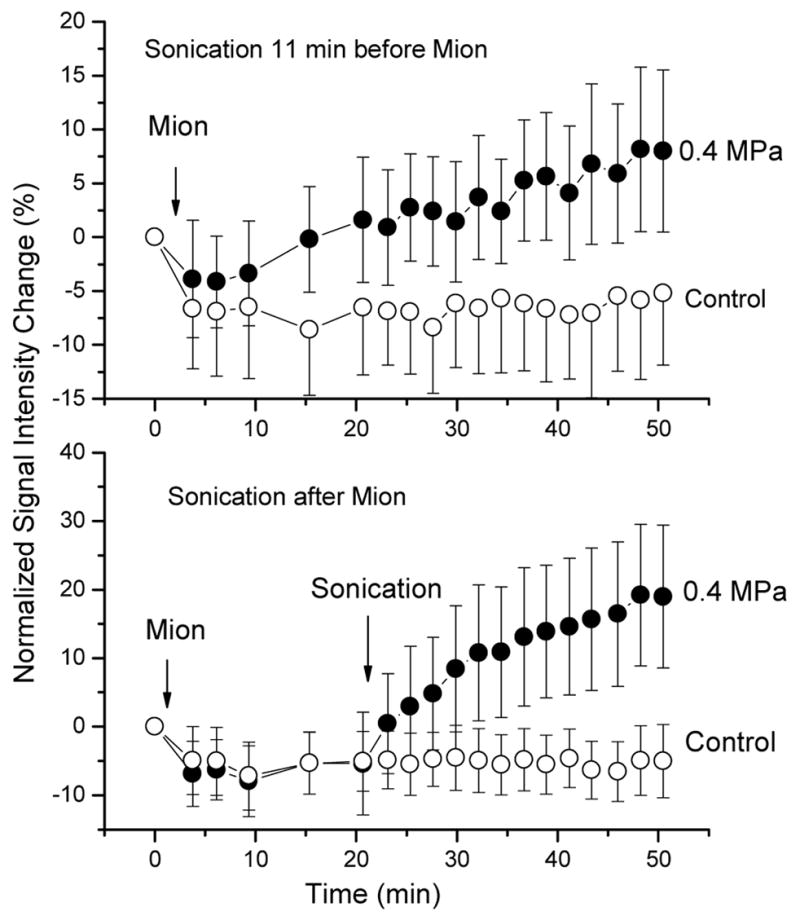
The signal intensity change in the sonicated and the unsonicated control brain locations as a function of time after sonication. The was sonication before (A) and after (B) the contrast agent (MION) injection.

References

    1. Abbott NJ, Romero IA. Transporting therapeutics across the blood-brain barrier. Mol Med Today. 1996;2:106–113. - PubMed
    1. Kroll RA, Neuwelt EA. Outwitting the blood-brain barrier for therapeutic purposes: osmotic opening and other means. Neurosurgery. 1998;42:1083–1099. - PubMed
    1. Johansson BB. The physiology of the blood-brain barrier. Adv Exp Med Biol. 1990;274:25–39. - PubMed
    1. Pardridge WM. Drug and gene delivery to the brain: the vascular route. Neuron. 2002;36:555–558. - PubMed
    1. Nag S. Morphology and molecular properties of cellular components of normal cerebral vessels. Methods Mol Med. 2003;89:3–36. - PubMed

Publication types

MeSH terms

Substances