


Comparative Study
doi: 10.1529/biophysj.107.119115.
Epub 2008 May 16.
Exploring the suitability of coarse-grained techniques for the representation of protein dynamics
Affiliations
- PMID: 18487297
- PMCID: PMC2517050
- DOI: 10.1529/biophysj.107.119115
Item in Clipboard
Comparative Study
Exploring the suitability of coarse-grained techniques for the representation of protein dynamics
Biophys J.
2008 Sep.
Abstract
A systematic study of two coarse-grained techniques for the description of protein dynamics is presented. The two techniques exploit either Brownian or discrete molecular dynamics algorithms applied in the context of simple C(alpha)-C(alpha) potentials, like those used in coarse-grained normal mode analysis. Coarse-grained simulations of the flexibility of protein metafolds are compared to those computed with fully atomistic molecular dynamics simulations using state-of-the-art physical potentials and explicit solvent. Both coarse-grained models efficiently capture critical features of the protein dynamics.
Figures

Total variances (in Å2) computed for the set of proteins using MD (dark gray), BD (gray), and DMD (light gray).

Entropies (in cal/molK) associated with the samplings obtained using MD (dark gray), BD (gray), and DMD (light gray).
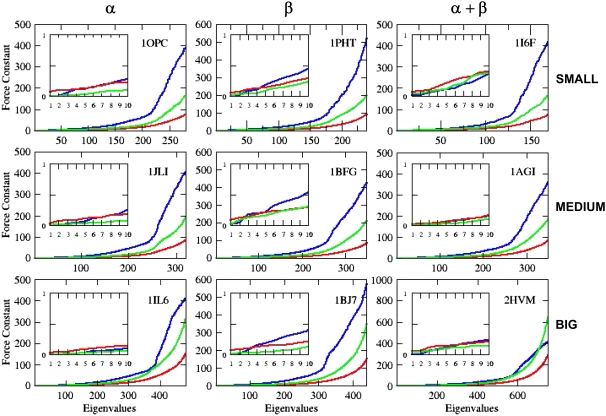
Harmonic force constants (kcal/mol Å2) associated with the deformation along eigenvectors derived from MD (blue), BD (red), and DMD (green) for representative proteins. The inset corresponds to values obtained for the first 10 eigenvectors.

Dimensionality (top) and number (bottom) of essential modes required to explain 90% of the variance for the set of proteins using MD (dark gray), BD (gray), and DMD (light gray).

Rank distance between the DMD (light gray) or BD (gray) eigenvectors (x axis) and the MD eigenvectors showing the best overlap for representative proteins.

Normalized spread (Eq. 21) of DMD (light gray) and BD (gray) eigenvectors in MD essential space.

Similarity index (γ; Eq. 19) between MD and coarse-grained important spaces in DMD (light gray) and BD (gray) simulations for the set of proteins. The important space is defined for each protein as (top) the minimum number of eigenvectors required to explain 90% of variance, and (bottom) the first 50 eigenvectors were selected for all proteins.

Z-scores (Eq. 20) associated with similarity indices (Eq. 19 and Fig. 7) between MD and coarse-grained models with DMD (light gray) and BD (gray). The important space is defined for each protein as (top) the minimum number of eigenvectors required to explain 90% of variance and (bottom) the first 50 eigenvectors.

α-Carbons B-factors (in Å2) computed from MD (blue), DMD (green), and BD (red) simulations for representative proteins.
References
-
- Daniel, R. M., R. V. Dumm, J. L. Finney, and C. J. Smith. 2003. The role of dynamics in enzyme activity. Annu. Rev. Biophys. Biomol. Struct. 32:69–92. - PubMed
-
- Eisenmesser, E. Z., D. A. Bosco, M. Akke, and D. Kern. 2002. Enzyme dynamics during catalysis. Science. 295:1520–1523. - PubMed
-
- Hinsen, K., A. Thomas, and M. J. Field. 1999. Analysis of domain motions in large proteins. Proteins. 34:369–382. - PubMed
Publication types
MeSH terms
LinkOut - more resources
Full Text Sources
Molecular Biology Databases
