. 2008 May;20(5):1316-29.
doi: 10.1105/tpc.107.057455. Epub 2008 May 16.

Mutation of a rice gene encoding a phenylalanine biosynthetic enzyme results in accumulation of phenylalanine and tryptophan

Affiliations

Mutation of a rice gene encoding a phenylalanine biosynthetic enzyme results in accumulation of phenylalanine and tryptophan

Tetsuya Yamada et al. Plant Cell. 2008 May.

Abstract

Two distinct biosynthetic pathways for Phe in plants have been proposed: conversion of prephenate to Phe via phenylpyruvate or arogenate. The reactions catalyzed by prephenate dehydratase (PDT) and arogenate dehydratase (ADT) contribute to these respective pathways. The Mtr1 mutant of rice (Oryza sativa) manifests accumulation of Phe, Trp, and several phenylpropanoids, suggesting a link between the synthesis of Phe and Trp. Here, we show that the Mtr1 mutant gene (mtr1-D) encodes a form of rice PDT with a point mutation in the putative allosteric regulatory region of the protein. Transformed callus lines expressing mtr1-D exhibited all the characteristics of Mtr1 callus tissue. Biochemical analysis revealed that rice PDT possesses both PDT and ADT activities, with a preference for arogenate as substrate, suggesting that it functions primarily as an ADT. The wild-type enzyme is feedback regulated by Phe, whereas the mutant enzyme showed a reduced feedback sensitivity, resulting in Phe accumulation. In addition, these observations indicate that rice PDT is critical for regulating the size of the Phe pool in plant cells. Feeding external Phe to wild-type callus tissue and seedlings resulted in Trp accumulation, demonstrating a connection between Phe accumulation and Trp pool size.


Figures

Figure 1.
Figure 1.
Schematic Diagram of Presumed Dual Pathways for Phe Synthesis from Chorismate. The enzymes that catalyze each conversion are shown in italics.
Figure 2.
Figure 2.
Characteristics of Mtr1. (A) Levels of Phe and Trp in calli of Norin 8 and Mtr1. Data are expressed as nanomoles of amino acid per gram of fresh weight (FW) and are means ± sd from three independent experiments. (B) Activity of AS in callus extracts of Norin 8 and Mtr1. Activity was measured in the presence of the indicated concentrations of Trp. Data are expressed as picomoles of anthranilate formed per minute per milligram of protein and are means ± sd from three independent experiments.
Figure 3.
Figure 3.
Metabolic Profiling of Calli of Norin 8 and Mtr1. The top two and bottom two chromatograms were obtained with detection at 280 and 254 nm, respectively. The peaks for Trp and Phe are indicated. Chemical structures were determined for the numbered peaks.
Figure 4.
Figure 4.
Chemical Structures of the Numbered Peaks in Figure 3. MW, molecular weight.
Figure 5.
Figure 5.
Genetic Map of mtr1-D and Alignment of Nucleotide and Predicted Amino Acid Sequences Surrounding the Mutation Site in a Candidate mtr1-D Gene of Rice. (A) RM420 and RM172 (SSR markers) as well as C213 (cleaved amplified polymorphic sequence marker) delineate the position of mtr1-D on the linkage and physical maps. P0034A01 and P0627E10 are PAC clones, and OSJNOa136M23 is a fosmid clone. Gray and black boxes indicate putative ORFs. cM, centimorgan. (B) Alignment of the nucleotide sequence surrounding a mutation site in the ORF of a putative PDT gene from Mtr1. The sequence derived from Mtr1 is compared with those of Norin 8 and Nipponbare. Asterisks indicate identical residues. Nucleotide numbers correspond to the cDNA sequence relative to the first ATG codon. (C) Domain organization of the 364–amino acid protein encoded by the putative PDT gene of rice. The protein contains a plastid-targeting signal peptide (TP, residues 1 to 42), a PDT domain (residues 78 to 256), and an ACT domain (residues 266 to 354). S298I indicates the Ser-to-Ile substitution at position 298 in the MTR1 protein. (D) Alignment of sequences of the ACT domain in P-proteins or PDTs from various species of plants and microorganisms. The amino acid sequence of Norin 8 was identical to that of Nipponbare (AK066428). Shaded regions indicate two highly conserved motifs, GALV and ESRP.
Figure 6.
Figure 6.
Expression of Mtr1 Characteristics in Transformed Callus Lines. (A) Growth of transformed callus lines on 2N6 medium containing 150 μM 5MT. Wild-type and mutant (M) lines are transformed callus lines of Nipponbare harboring wild-type (PDTWT) or mutant (PDTS298I) versions of the putative rice PDT gene, respectively. Each of the numbered quadrants contains three pieces of callus tissue from an independent line (lines numbered 1 to 4). (B) Levels of Phe in transformed callus lines. (C) Levels of Trp in transformed callus lines. Data in (B) and (C) are means ± sd from three independent experiments.
Figure 7.
Figure 7.
Metabolic Characteristics of Transformed Callus Lines. (A) Metabolic profiling of calli of Norin 8 and Mtr1 as well as of transformed callus lines expressing PDTWT (WT24) or PDTS298I (M47). The top four and bottom four chromatograms were obtained with detection at 280 and 254 nm, respectively. The peaks for Trp and Phe are indicated. The numbered peaks correspond to the compounds shown in Figure 4. (B) Content of 6′-malonylrosine (peak 8 in [A]) in transformed callus lines. Data are means ± sd from three independent experiments.
Figure 8.
Figure 8.
Chloroplast Import Assay of Rice PDT. The full-length (precursor) form of rice PDT was synthesized and labeled with 35S using a cell-free translation system. It was then subjected to a chloroplast import assay as described previously (Kasai et al., 2005). The reaction mixture was subsequently incubated in the absence (–) or presence (+) of thermolysin before analysis by SDS-PAGE and autoradiography.
Figure 9.
Figure 9.
Effects of Feeding with External Phe in Calli of Norin 8, Mtr1, or Nipponbare. (A) Growth of callus tissue of Mtr1 on 2N6 medium in the absence or presence of 100 μM 5MT or 300 μM Phe, as indicated. (B) Growth of callus tissue of Norin 8 on 2N6 medium in the absence or presence of 100 μM 5MT or 300 μM Phe, as indicated. Data in (A) and (B) are means ± sd from 24 pieces of callus. (C) Quantification of free Trp in the callus of Nipponbare grown on 2N6 medium in the absence or presence of 25 μM 5MT or 300 or 600 μM Phe, as indicated. Data are means ± sd from three independent experiments. (D) Effect of Phe on 5MT uptake into Nipponbare callus tissue. Calli were grown on 2N6 medium in the absence or presence of 300 or 600 μM Phe or 25 μM 5MT, as indicated. Data are means ± sd from three independent experiments.
Figure 10.
Figure 10.
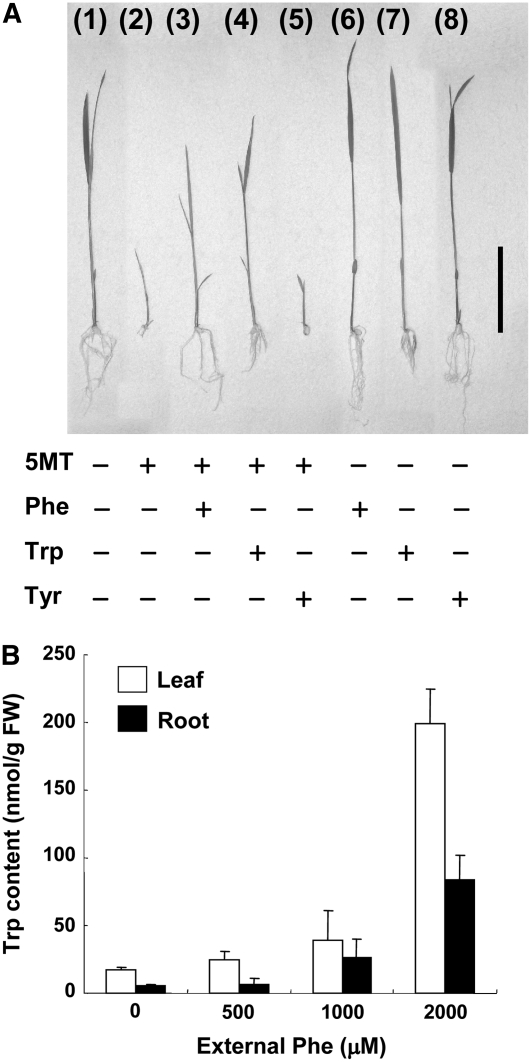
Effects of Feeding with External Phe on Seedlings of Nipponbare. (A) Effects of aromatic amino acids on the sensitivity of Nipponbare seedlings to 5MT. Seedlings (1) to (8) were cultured on MS medium in the absence or presence of 300 μM 5MT, 300 μM Phe, 300 μM Trp, or 300 μM Tyr, as indicated. Bar = 50 mm. (B) Quantification of free Trp in the leaves and roots of Nipponbare seedlings grown on MS medium containing 0, 500, 1000, or 2000 μM Phe. Data are means ± sd from three independent experiments.

References

    1. Achnine, L., Blancaflor, E.B., Rasmussen, S., and Dixon, R.A. (2004). Colocalization of L-phenylalanine ammonia-lyase and cinnamate 4-hydroxylase for metabolic channeling in phenylpropanoid biosynthesis. Plant Cell 16 3098–3109. - PMC - PubMed
    1. Ahmad, S., Weisburg, W.G., and Jensen, R.A. (1990). Evolution of aromatic amino acid biosynthesis and application to the fine-tuned phylogenetic positioning of enteric bacteria. J. Bacteriol. 172 1051–1061. - PMC - PubMed
    1. Bate, N.J., Orr, J., Ni, W., Meromi, A., Nadler-Hassar, T., Doerner, P.W., Dixon, R.A., Lamb, C.J., and Elkind, Y. (1994). Quantitative relationship between phenylalanine ammonia-lyase levels and phenylpropanoid accumulation in transgenic tobacco identifies a rate-determining step in natural product synthesis. Proc. Natl. Acad. Sci. USA 91 7608–7612. - PMC - PubMed
    1. Bongaerts, J., Kramer, M., Muller, U., Raeven, L., and Wubbolts, M. (2001). Metabolic engineering for microbial production of aromatic amino acids and derived compounds. Metab. Eng. 3 289–300. - PubMed
    1. Bonner, C., and Jensen, R. (1987). Prephenate aminotransferase. Methods Enzymol. 142 479–487. - PubMed

Publication types

MeSH terms

Associated data

LinkOut - more resources