Evaluation of adenovirus-delivered human CD59 as a potential therapy for AMD in a model of human membrane attack complex formation on murine RPE
- PMID: 18487376
- PMCID: PMC4139013
- DOI: 10.1167/iovs.08-2025
Evaluation of adenovirus-delivered human CD59 as a potential therapy for AMD in a model of human membrane attack complex formation on murine RPE
Abstract
Purpose: Complement-mediated damage to the retinal pigment epithelium (RPE), Bruch membrane, and choroid has been associated with pathogenesis in age-related macular degeneration (AMD). The terminal step of complement activation involves lysis of cells by the insertion of the membrane attack complex (MAC) in the plasma membrane. The hypothesis that local overexpression of human CD59 (hCD59) delivered by an adenovirus (Ad) vector to primary murine RPE cells in vitro, RPE in vivo, or cornea ex vivo protects those cells from human MAC deposition and lysis was tested.
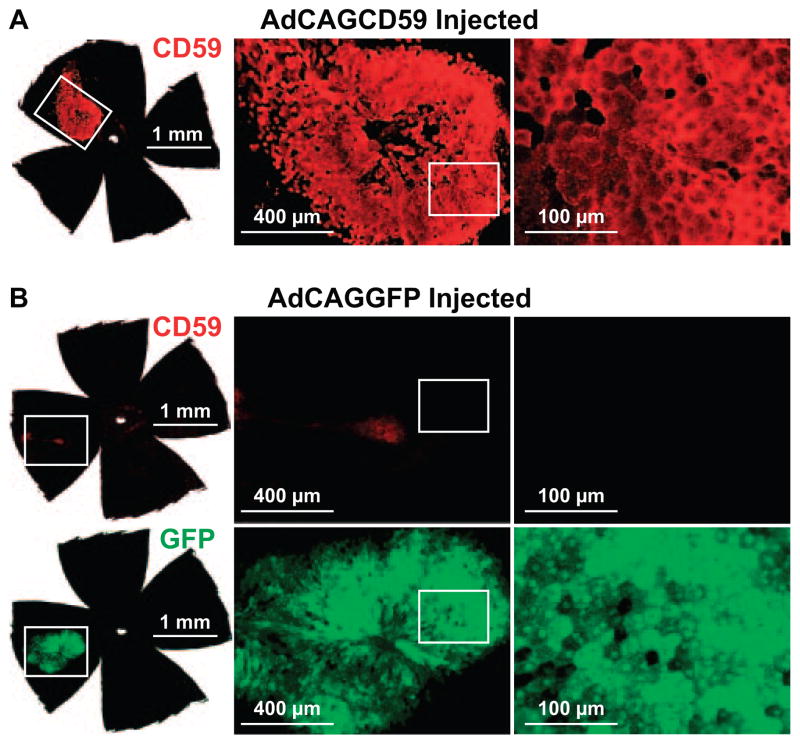
Methods: A humanized model of MAC deposition on murine cells and murine ocular tissues including RPE and cornea was developed to permit testing of human complement regulators in mice. A recombinant adenovirus-expressing hCD59 was generated, and this virus was injected into the subretinal space of adult mice. Subsequently, eyecups from these mice were exposed to human serum, and the levels of MAC deposition on the RPE were quantified. hCD59 was also expressed on murine cornea ex vivo and in murine hepatocytes, and primary RPE cells in vitro and levels of human MAC deposition and cell lysis were measured.
Results: Adenovirus-mediated delivery of hCD59 to the RPE, cornea, or cells in culture protects those cells from human MAC deposition and MAC-mediated damage and vesiculation.
Conclusions: The humanized model of MAC deposition on murine ocular tissues allows testing of human complement regulators that may have potential in the treatment of AMD or other diseases associated with complement activation.
Figures




References
-
- Klein R, Klein BE, Knudtson MD, Meuer SM, Swift M, Gangnon RE. Fifteen-year cumulative incidence of age-related macular degeneration: the Beaver Dam Eye Study. Ophthalmology. 2007;114:253–262. - PubMed
-
- van Leeuwen R, Klaver CC, Vingerling JR, Hofman A, de Jong PT. Epidemiology of age-related maculopathy: a review. Eur J Epidemiol. 2003;18:845–854. - PubMed
-
- Johnson LV, Ozaki S, Staples MK, Erickson PA, Anderson DH. A potential role for immune complex pathogenesis in drusen formation. Exp Eye Res. 2000;70:441–449. - PubMed
-
- Hageman GS, Luthert PJ, Victor Chong NH, Johnson LV, Anderson DH, Mullins RF. An integrated hypothesis that considers drusen as biomarkers of immune-mediated processes at the RPE-Bruch’s membrane interface in aging and age-related macular degeneration. Prog Retin Eye Res. 2001;20:705–732. - PubMed
-
- Johnson LV, Leitner WP, Staples MK, Anderson DH. Complement activation and inflammatory processes in drusen formation and age related macular degeneration. Exp Eye Res. 2001;73:887–896. - PubMed
Publication types
MeSH terms
Substances
Grants and funding
LinkOut - more resources
Full Text Sources
Other Literature Sources
Medical
Miscellaneous