


Rasagiline - a novel MAO B inhibitor in Parkinson's disease therapy
- PMID: 18488080
- PMCID: PMC2386362
Rasagiline - a novel MAO B inhibitor in Parkinson's disease therapy
Abstract
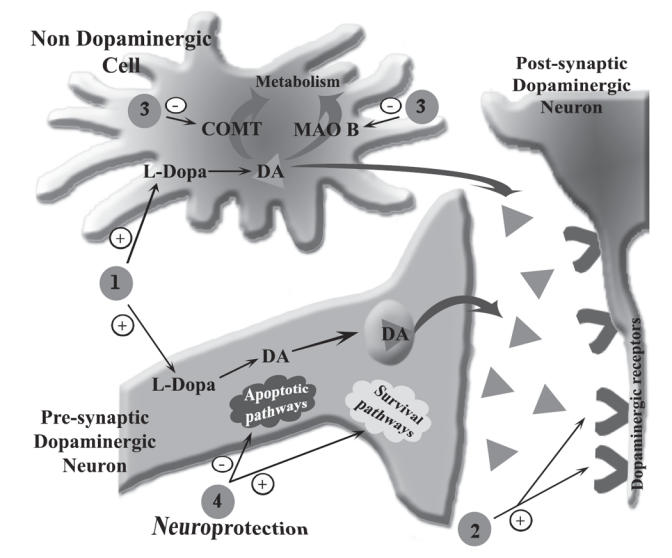
Parkinson's disease (PD) is a progressive neurodegenerative, dopamine deficiency disorder. The main therapeutic strategies for PD treatment relies on dopamine precursors (levodopa), inhibition of dopamine metabolism (monoamine oxidase [MAO] B and catechol-O-methyl transferase inhibitors), and dopamine receptor agonists. Recently, a novel selective and irreversible MAO B propargylamine inhibitor rasagiline (N-propargyl-1-R-aminoindan, Azilect((R))) was approved for PD therapy. In contrast to selegiline, the prototype of MAO B inhibitors, rasagiline is not metabolized to potentially toxic amphetamine metabolites. The oral bioavailability of rasagiline is 35%, it reaches T(max) after 0.5-1 hours and its half-life is 1.5-3.5 hours. Rasagiline undergoes extensive hepatic metabolism primarily by cytochrome P450 type 1A2 (CYP1A2). Rasagiline is initiated at 1 mg once-daily dosage as monotherapy in early PD patients and at 0.5-1 mg once-daily as adjunctive to levodopa in advanced PD patients. Rasagiline treatment was not associated with "cheese effect" and up to 20 mg per day was well tolerated. In PD patients with hepatic impairment, rasagiline dosage should be carefully adjusted. Rasagiline should not be administered with other MAO inhibitors and co-administration with certain antidepressants and opioids should be avoided. Although further clinical evidence is needed on the neuroprotective effects of rasagiline in PD patients, this drug provides an additional tool for PD therapy.
Keywords: MAO B inhibition; neuroprotection; rasagiline; safety; therapy.
Figures
References
-
- Abu-Raya S, Blaugrund E, Trembovler V, et al. Rasagiline, a novel MAO B inhibitor with neuroprotective effects under ischemic conditions in PC12 cells. Drug Dev Res. 2000;50:285–90.
-
- Abu-Raya S, Tabakman R, Blaugrund E, et al. Neuroprotective and neurotoxic effects of monoamine oxidase-B inhibitors and derived metabolites under ischemia in PC12 cells. Eur J Pharmacol. 2002;434:109–16. - PubMed
-
- Biglan KM, Schwid S, Eberly S, et al. Rasagiline improves quality of life in patients with early Parkinson’s disease. Mov Disord. 2006;21:616–23. - PubMed
-
- Bonuccelli U, Del Dotto P. New pharmacologic horizons in the treatment of Parkinson disease. Neurology. 2006;67:S30–8. - PubMed
-
- Braak H, Del Tredici K, Rub U, et al. Staging of brain pathology related to sporadic Parkinson’s disease. Neurobiol Aging. 2003;24:197–211. - PubMed
LinkOut - more resources
Full Text Sources
Other Literature Sources
