


Exercise blood pressure and the risk of incident cardiovascular disease (from the Framingham Heart Study)
- PMID: 18489939
- PMCID: PMC2953798
- DOI: 10.1016/j.amjcard.2008.01.046
Exercise blood pressure and the risk of incident cardiovascular disease (from the Framingham Heart Study)
Abstract
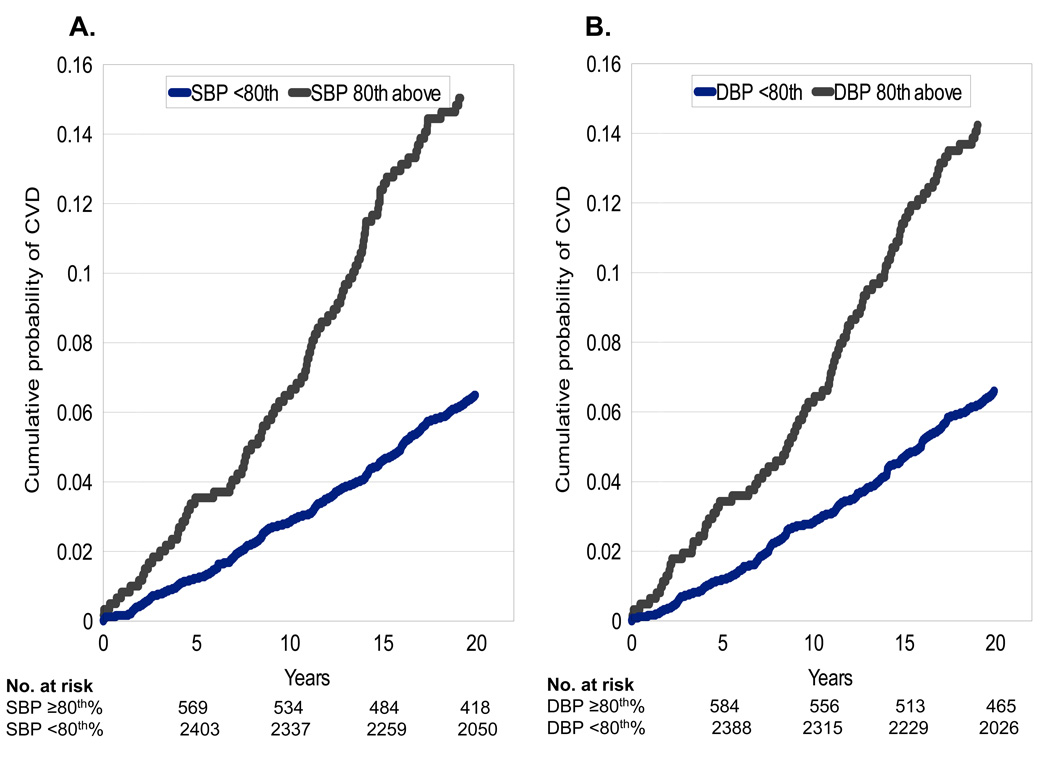
Exaggerated systolic blood pressure (BP) augmentation with exercise has been associated with impaired endothelial function and cardiovascular risk. However, previous studies were largely restricted to men, did not evaluate diastolic BP, and focused on peak exercise measures, which are influenced by effort and fitness level. The aim of this study was to determine the association of exercise BP responses with risk of incident cardiovascular disease (CVD). BP was assessed during stage 2 of the Bruce protocol and during recovery in 3,045 Framingham Study subjects (mean age 43 years; 53% women). The association between exercise BP and CVD events during 20 years of follow-up was examined using Cox proportional hazards models. In age- and sex-adjusted analyses, exercise systolic and diastolic BP were associated with incident CVD (adjusted hazard ratios [HRs] for top quintile 1.55, 95% confidence interval [CI] 1.18 to 2.04; and 1.77, 95% CI 1.35 to 2.31, respectively, relative to the lower 4 quintiles; p <0.005). After adjustment for BP at rest and conventional risk factors, exercise diastolic BP (HR 1.41, 95% CI 1.01 to 1.95, p = 0.04), but not exercise systolic BP (HR 0.97, 95% CI 0.68 to 1.38, p = 0.86), remained a significant predictor of CVD. Similarly, in recovery responses after exercise, only diastolic BP (HR 1.53, 95% CI 1.08 to 2.18, p = 0.02) predicted incident CVD in multivariable models. In conclusion, in middle-aged adults, diastolic BP during low-intensity exercise and recovery predicted incident CVD. Our findings support the concept that dynamic BP provides incremental information to BP at rest and suggest that exercise diastolic BP may be a better predictor than exercise systolic BP in this age group.
Figures


References
-
- Kannel WB, Feinleib M, McNamara PM, Garrison RJ, Castelli WP. An investigation of coronary heart disease in families. The Framingham offspring study. Am J Epidemiol. 1979;110:281–290. - PubMed
-
- Chobanian AV, Bakris GL, Black HR, Cushman WC, Green LA, Izzo JL, Jr, Jones DW, Materson BJ, Oparil S, Wright JT, Jr, Roccella EJ. The Seventh Report of the Joint National Committee on Prevention, Detection, Evaluation, and Treatment of High Blood Pressure: the JNC 7 report. Jama. 2003;289:2560–2572. - PubMed
-
- Bruce RA. Exercise testing of patients with coronary heart disease. Principles and normal standards for evaluation. Ann Clin Res. 1971;3:323–332. - PubMed
-
- The sixth report of the Joint National Committee on prevention, detection, evaluation, and treatment of high blood pressure. Arch Intern Med. 1997;157:2413–2446. - PubMed
