


Review
doi: 10.1016/j.cytogfr.2008.04.011.
Epub 2008 May 19.
microRNAs and death receptors
Affiliations
- PMID: 18490189
- PMCID: PMC2587095
- DOI: 10.1016/j.cytogfr.2008.04.011
Item in Clipboard
Review
microRNAs and death receptors
Cytokine Growth Factor Rev.
2008 Jun-Aug.
Abstract
Death receptors induce apoptosis through either the Type I or II pathway. In Type I cells, the initiator caspase-8 directly activates effector caspases such as caspase-3, whereas in Type II cells, the death signal is amplified through mitochondria thereby activating effector caspases causing cell death. Recently, there have been advances in elucidating the early events in the CD95 signaling pathways and how post-translational modifications regulate CD95 signaling. This review will focus on recent insights into the mechanisms of the two different types of CD95 signaling pathways, and will introduce miRNAs as regulators of death receptor signaling.
Figures
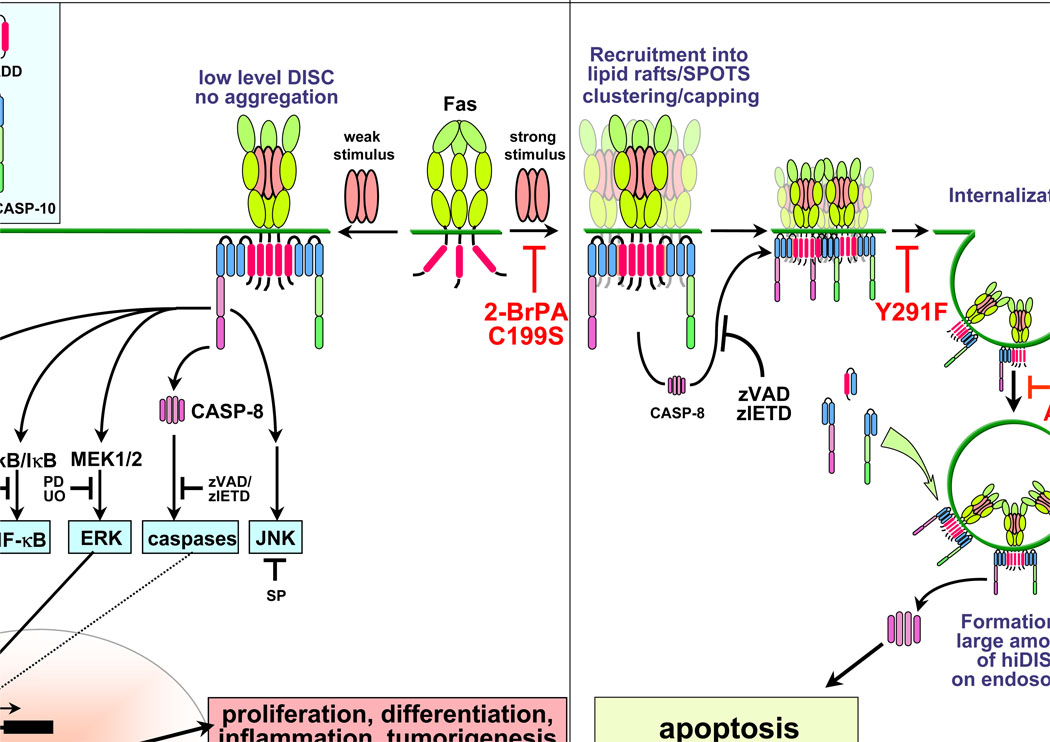
Signaling pathways of CD95. When CD95 is strongly activated in Type I cells, CD95 forms clusters and palmitoylation at C199 allows efficient recruitment of CD95 into lipid rafts. In the rafts, further receptor clustering or capping occurs and large lipid raft platforms are formed. CD95 is then internalized through clathrin-mediated endocytosis, which can be inhibited by siRNAs against the AP-2 adaptor complex or the clathrin heavy chain (CHC). In the endosomal compartment, large amounts of DISC are recruited to CD95, thereby inducing apoptosis. When CD95 is weakly activated, or when recruitment of CD95 to lipid rafts to form higher order CD95 oligomers is impaired by inhibition of palmitoylation, or when internalization is blocked, only a low level of DISC with markedly reduced receptor aggregation is formed. This formation allows efficient activation of nonapoptotic pathways such as NF-κB and members of the MAPK family without apoptosis induction. Lnt A, latrunculin A; 2-BrPA, 2-bromopalmitic acid; CHC, clathrin heavy chain; hiDISC, high-molecular weight DISC; SB, SB203580; PD, PD98059; UO, UO126; SP, SP600125.
References
-
- Hengartner MO. The biochemistry of apoptosis. Nature. 2000;407:770–776. - PubMed
-
- Li P, Nijhawan D, Budihardjo I, Srinivasula SM, Ahmad M, Alnemri ES, et al. Cytochrome c and dATP-dependent formation of Apaf-1/caspase-9 complex initiates an apoptotic protease cascade. Cell. 1997;91:479–489. - PubMed
-
- Susin SA, Lorenzo HK, Zamzami N, Marzo I, Snow BE, Brothers GM, et al. Molecular characterization of mitochondrial apoptosis-inducing factor. Nature. 1999;397:441–446. - PubMed
-
- Du C, Fang M, Li Y, Li L, Wang X. Smac, a mitochondrial protein that promotes cytochrome c-dependent caspase activation by eliminating IAP inhibition. Cell. 2000;102:33–42. - PubMed
-
- Verhagen AM, Ekert PG, Pakusch M, Silke J, Connolly LM, Reid GE, et al. Identification of DIABLO, a mammalian protein that promotes apoptosis by binding to and antagonizing IAP proteins. Cell. 2000;102:43–53. - PubMed
Publication types
MeSH terms
Substances
Grants and funding
LinkOut - more resources
Full Text Sources
Research Materials
