. 2008 Jun 9;205(6):1447-61.
doi: 10.1084/jem.20071450. Epub 2008 May 19.

Differential regulation of interleukin 12 and interleukin 23 production in human dendritic cells

Affiliations

Differential regulation of interleukin 12 and interleukin 23 production in human dendritic cells

Franca Gerosa et al. J Exp Med. .

Abstract

We analyzed interleukin (IL) 12 and IL-23 production by monocyte-derived dendritic cells (mono-DCs). Mycobacterium tuberculosis H37Rv and zymosan preferentially induced IL-23. IL-23 but not IL-12 was efficiently induced by the combination of nucleotide-binding oligodimerization domain and Toll-like receptor (TLR) 2 ligands, which mimics activation by M. tuberculosis, or by the human dectin-1 ligand beta-glucan alone or in combination with TLR2 ligands, mimicking induction by zymosan. TLR2 ligands inhibited IL-12 and increased IL-23 production. DC priming with interferon (IFN) gamma strongly increased IL-12 production, but was not required for IL-23 production and inhibited IL-23 production induced by beta-glucan. The pattern of IL-12 and IL-23 induction was reflected in accumulation of the IL-12p35 and IL-23p19 transcripts, respectively, but not IL-12/23p40. Although IL-23, transforming growth factor beta, and IL-6 contained in the supernatants of activated mono-DCs played a role in the induction of IL-17 by human CD4(+) T cells, IL-1beta, in combination with one or more of those factors, was required for IL-17 production, and its production determined the differential ability of the stimuli used to elicit mono-DCs to produce soluble factors directing IL-17 production. Thus, the differential ability of pathogens to induce antigen-presenting cells to produce cytokines regulates the immune response to infection.


Figures
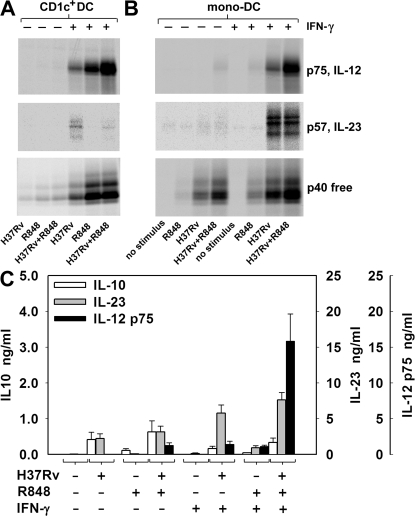
Figure 1.
Figure 1.
Differential regulation of IL-12 and IL-23 production in CD1c+ DCs and mono-DCs stimulated by H37Rv. CD1c+ DCs (A) and mono-DCs (B and C) were treated with IFN-γ or left untreated. Cells were labeled with [35S]methionine (A and B) or unlabeled (C) and stimulated with heat-killed H37Rv, alone or together with R848. After 18 h, supernatants were immunoprecipitated with anti–IL-12 p35, anti–IL-23 p19, or anti–IL-12/23 p40 mAbs and resolved by nonreducing SDS-PAGE (A and B) or tested for IL-12 p75, IL-23, and IL-10 production by ELISA (C). In A, supernatants were pooled from cells purified from three different donors. Results in B are representative of six independent experiments. Data in C are mean ± SE values for mono-DCs derived from 20 different donors.
Figure 2.
Figure 2.
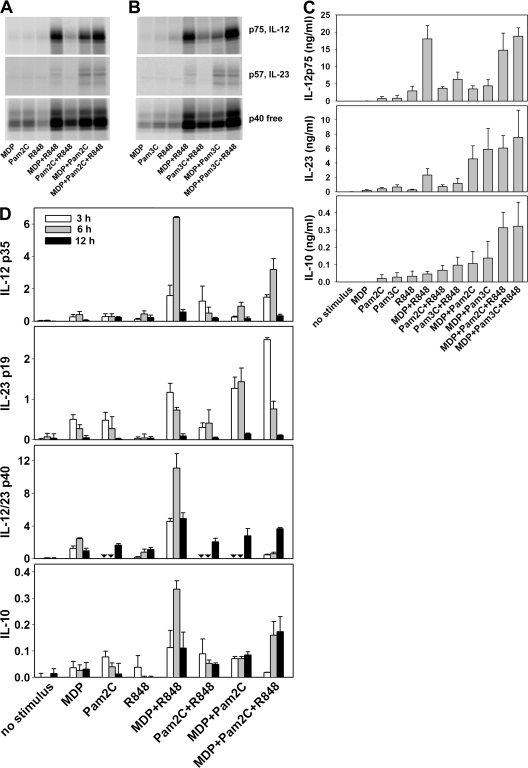
A combination of NOD2 and TLR2 ligands mimics IL-23 and IL-12 induction by M. tuberculosis. mono-DCs treated with IFN-γ were labeled with [35S]methionine (A and B) or unlabeled (C and D) and stimulated with different combinations of MDP, Pam2C, and Pam3C, with or without R848. After 18 h, supernatants were immunoprecipitated with anti–IL-12 p35, anti–IL-23 p19, or anti–IL-12/23 p40 mAbs and resolved in nonreducing SDS-PAGE (A and B), or were evaluated for IL-12 p75, IL-23, and IL-10 by ELISA (C). In D, cells were lysed at 3, 6, and 12 h, and mRNA accumulation was determined using the QuantiGene multiplex assay. Results in A and B are representative of those obtained in three independent experiments with cells derived from different donors. Data in C are mean ± SE values from mono-DCs derived from three different donors. Results in D were obtained with cells from two different donors and are expressed as the mean ± SD of triplicate cultures. Inverted triangles indicate not done.
Figure 3.
Figure 3.
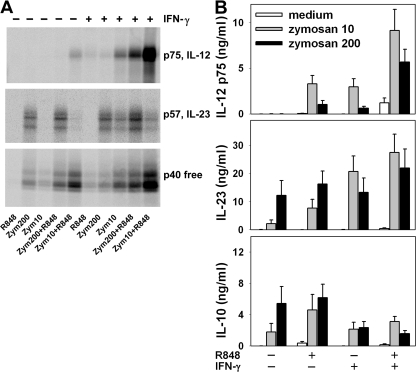
Differential regulation of IL-12 and IL-23 in mono-DCs stimulated by zymosan. mono-DCs treated with or without IFN-γ were labeled with [35S]methionine (A) or unlabeled (B) and stimulated with 10 or 200 μg/ml zymosan alone or associated with R848. After 18 h, supernatants were immunoprecipitated with anti–IL-12 p35, anti–IL-23 p19, or anti–IL-12/23 p40 mAbs and resolved in nonreducing SDS-PAGE (A) or were tested by ELISA (B) for IL-12 p75, IL-23, and IL-10. Results in A are representative of three independent experiments. Results in B are mean ± SE values from mono-DCs derived from 10 different donors.
Figure 4.
Figure 4.
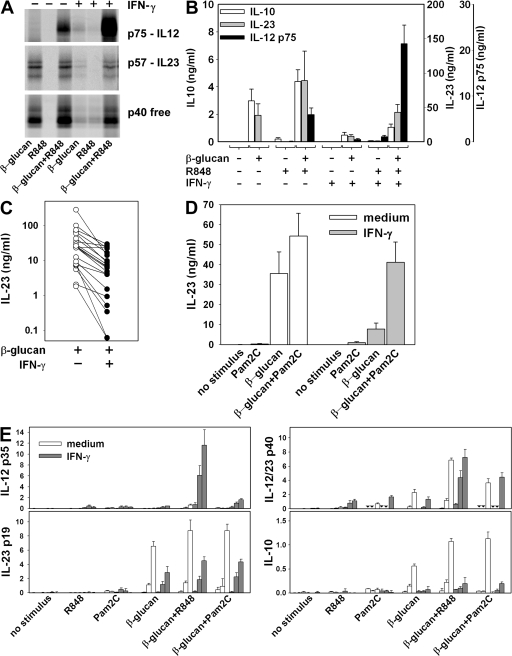
Role of dectin-1 and TLR2 in IL-12 and IL-23 production in mono-DCs. mono-DCs treated with IFN-γ or left untreated were labeled with [35S]methionine (A) or unlabeled (B–E) and stimulated with β-glucan or Pam2C, or with a combination of β-glucan+Pam2C, with or without R848. After 18 h, supernatants were immunoprecipitated with anti–IL-12 p35, anti–IL-23 p19, or anti–IL-12/23 p40 mAbs and resolved in nonreducing SDS-PAGE (A) and tested for IL-23, IL-12 p75, and IL-10 production by ELISA (B–D) and for mRNA accumulation using the QuantiGene multiplex assay (E). Results in A are representative of four independent experiments. Results in B are mean ± SE values from mono-DCs derived from 18 donors. Results in C represent individual IL-23 levels from mono-DCs derived from 21 different donors. Results in D are mean ± SE values from five experiments. Results in E are mean ± SD (n = 3) mRNA accumulation in cells derived from three separate donors and lysed at 3 h (right column of each triplet), 6 h (middle column of each triplet), and 12 h (right column of each triplet). Inverted triangles indicate not done.
Figure 5.
Figure 5.
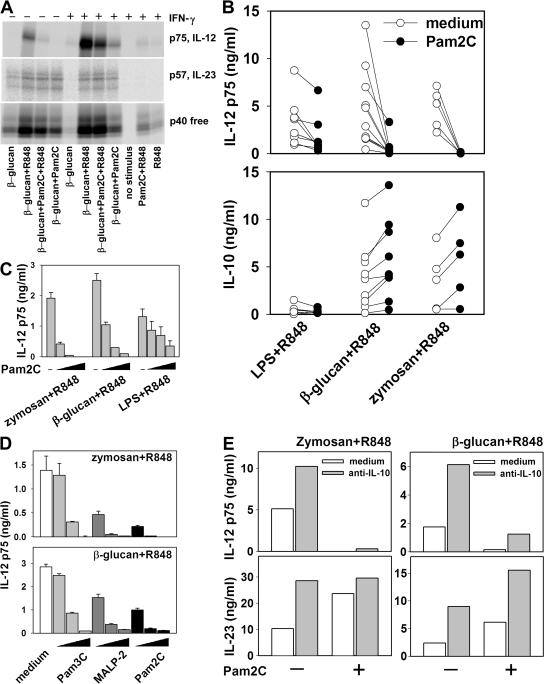
TLR2-mediated inhibition of IL-12 p75. (A) mono-DCs treated with IFN-γ or left untreated were labeled with [35S]methionine and stimulated with β-glucan, Pam2C, R848, and their combinations. After 18 h, supernatants were immunoprecipitated with anti–IL-12 p35, anti–IL-23 p19, or anti–IL-12/23 p40 mAbs and resolved in nonreducing SDS-PAGE. (B) Cytokine production was measured by ELISA in mono-DCs 18 h after stimulation with 10 ng/ml LPS+R848, 10 μg/ml β-glucan+R848, or 10 μg/ml zymosan+R848 in the presence or absence of 50 ng/ml Pam2C (each symbol represents a single donor). (C) mono-DCs were stimulated as indicated in B in the presence or absence of 0.5, 5, and 50 ng/ml Pam2C, and IL-12 p75 was measured by ELISA (mean ± SD from triplicate cultures). (D) IL-12 p75 production was assessed by ELISA (mean ± SD from triplicate cultures) in mono-DCs stimulated with 10 μg/ml zymosan+R848 or 10 μg/ml β-glucan+R848 without or with 2, 20, and 200 ng/ml Pam3C; 1, 10, and 100 ng/ml MALP-2; or 0.5, 5, and 50 ng/ml Pam2C. (E) mono-DCs were stimulated with10 μg/ml zymosan+R848 (left) or with 0.1 μg/ml β-glucan+R848 (right) in the absence (open column) or presence (gray column) of 30 μg/ml of the neutralizing anti–IL-10 mAb 19F1, with or without 50 ng/ml Pam2C. Cytokines were measured by ELISA (mean values from duplicate cultures in a representative experiment of six performed with similar results).
Figure 6.
Figure 6.
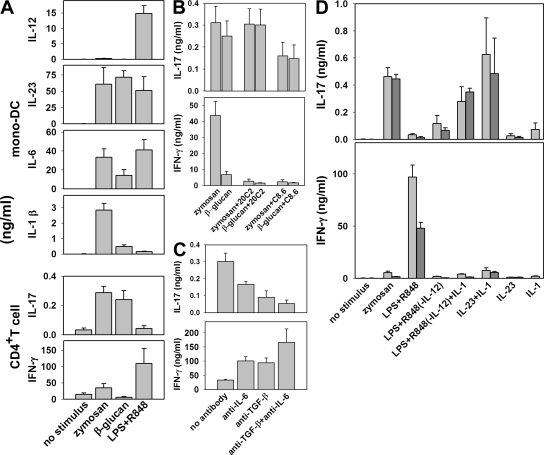
Induction of IL-17 and IFN-γ in human CD4+T cells by supernatants of stimulated mono-DCs. Supernatants from differently stimulated mono-DCs were used to induce IL-17 and IFN-γ production from human CD4+ CD45RO T lymphocytes stimulated with anti-CD3 and anti-CD28. (A) Supernatants from IFN-γ–primed mono-DCs stimulated with 200 μg/ml zymosan or 1 μg/ml LPS+R848, or from unprimed mono-DCs stimulated with 10 μg/ml β-glucan, were evaluated by ELISA for IL-12, IL23, IL-6, and IL-1β production and for the capacity to induce IL-17 and IFN-γ in naive CD4+ T cells (mean ± SE from 10 independent experiments). (B) IL-17 and IFN-γ production was determined by ELISA in naive T cell cultures in the presence of supernatants from zymosan- or β-glucan–stimulated mono-DCs, and in the presence or absence of neutralizing anti–IL-12 p75 (20C2) or anti-p40 (C8.6) mAbs (mean ± SE from seven independent experiments). (C) Effect of neutralizing anti–TGF-β or anti–IL-6, or a mixture of both mAbs on IL-17 and IFN-γ production measured by ELISA in naive T cells cultured in the presence of supernatants from zymosan-stimulated mono-DCs. (D) Effect of 10 ng/ml IL-1β on IL-17 and IFN-γ production, as determined by ELISA in naive T cells cultured in the presence of IL-23 or an IL-12–depleted supernatant from LPS+R848–stimulated mono-DCs. Supernatants were diluted to contain IL-23 at a final concentration of 15 or 1.5 ng/ml (light and dark gray, respectively). Recombinant IL-23 was used at 15 or 1.5 ng/ml (light and dark gray, respectively). C and D show the mean ± SD from triplicate cultures. Similar results were obtained in three independent experiments.

References

    1. Kobayashi, M., L. Fitz, M. Ryan, R.M. Hewick, S.C. Clark, S. Chan, R. Loudon, F. Sherman, B. Perussia, and G. Trinchieri. 1989. Identification and purification of natural killer cell stimulatory factor (NKSF), a cytokine with multiple biologic effects on human lymphocytes. J. Exp. Med. 170:827–846. - PMC - PubMed
    1. Oppmann, B., R. Lesley, B. Blom, J.C. Timans, Y. Xu, B. Hunte, F. Vega, N. Yu, J. Wang, K. Singh, et al. 2000. Novel p19 protein engages IL-12p40 to form a cytokine, IL-23, with biological activities similar as well as distinct from IL-12. Immunity. 13:715–725. - PubMed
    1. Cooper, A.M., and S.A. Khader. 2007. IL-12p40: an inherently agonistic cytokine. Trends Immunol. 28:33–38. - PubMed
    1. D'Andrea, A., M. Rengaraju, N.M. Valiante, J. Chehimi, M. Kubin, M. Aste, S.H. Chan, M. Kobayashi, D. Young, E. Nickbarg, et al. 1992. Production of natural killer cell stimulatory factor (interleukin 12) by peripheral blood mononuclear cells. J. Exp. Med. 176:1387–1398. - PMC - PubMed
    1. Trinchieri, G. 2003. Interleukin-12 and the regulation of innate resistance and adaptive immunity. Nat. Rev. Immunol. 3:133–146. - PubMed

Publication types

MeSH terms