


First molecular characterization of group B streptococci with reduced penicillin susceptibility
- PMID: 18490507
- PMCID: PMC2493108
- DOI: 10.1128/AAC.00185-08
First molecular characterization of group B streptococci with reduced penicillin susceptibility
Abstract
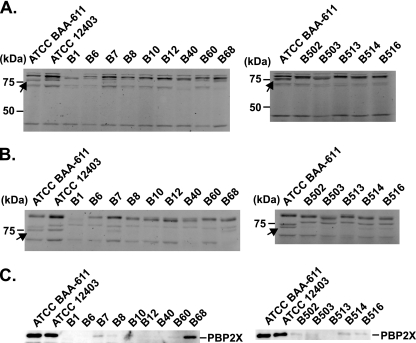
Group B streptococci (GBS; Streptococcus agalactiae) are the leading cause of neonatal invasive diseases and are also important pathogens for adults. Penicillins are the drugs of first choice for the treatment of GBS infections, since GBS have been regarded to be uniformly susceptible to penicillins so far. Here we characterize the first strains of GBS with reduced penicillin susceptibility (PRGBS) identified in Japan. Fourteen PRGBS strains were clinically isolated from the sputa of elderly patients from 1995 to 2005; and the MICs of penicillin, oxacillin, and ceftizoxime ranged from 0.25 to 1 microg/ml, 2 to 8 microg/ml, and 4 to 128 microg/ml, respectively. Moreover, some strains were also insusceptible to ampicillin, cefazolin, cefepime, and cefotaxime. All the PRGBS isolates tested possessed a few amino acid substitutions adjacent to the conserved SSN and KSG motifs (amino acids 402 to 404 and 552 to 554, respectively) of PBP 2X, and the amino acid substitutions could be classified into two types, Q557E and V405A. Western blotting analysis of the 14 clinical isolates with anti-PBP 2X-specific serum suggested that the amount of PBP 2X among the 14 PRGBS isolates was reduced, although the 2 ATCC strains produced a significant amount of PBP 2X. The introduction of PRGBS-derived PBP 2X genes into penicillin-susceptible strains through allelic exchange elevated their penicillin insusceptibility, suggesting that these altered PBP 2X genes are responsible for the penicillin insusceptibility in PRGBS strains. In this study, we characterized for the first time PRGBS strains on a molecular basis, although several reports have so far mentioned the existence of beta-lactam-insusceptible GBS from a phenotypic standpoint.
Figures


References
-
- American Academy of Pediatrics Committee on Infectious Disease, Committee on Fetus and Newborn. 1997. Revised guidelines for prevention of early-onset group B streptococcal (GBS) infection. Pediatrics 99:489-496. - PubMed
-
- Baker, C. J. 2000. Group B streptococcal infections, p. 222-237. In D. L. Stevens and E. L. Kaplan (ed.), Streptococcal infections. Clinical aspects, microbiology, and molecular pathogenesis. Oxford University Press, Oxford, England.
-
- Centers for Disease Control and Prevention. 2002. Prevention of perinatal group B streptococcal disease. MMWR Recommend. Rep. 51(RR-11):1-22.
Publication types
MeSH terms
Substances
Associated data
- Actions
- Actions
- Actions
- Actions
- Actions
- Actions
- Actions
- Actions
- Actions
- Actions
- Actions
- Actions
- Actions
- Actions
- Actions
- Actions
- Actions
- Actions
- Actions
- Actions
- Actions
- Actions
- Actions
- Actions
- Actions
- Actions
- Actions
- Actions
- Actions
- Actions
- Actions
- Actions
- Actions
- Actions
- Actions
- Actions
- Actions
- Actions
- Actions
- Actions
- Actions
- Actions
- Actions
- Actions
- Actions
- Actions
- Actions
- Actions
- Actions
- Actions
- Actions
- Actions
- Actions
- Actions
- Actions
- Actions
- Actions
- Actions
- Actions
- Actions
- Actions
- Actions
- Actions
- Actions
- Actions
- Actions
- Actions
- Actions
- Actions
- Actions
LinkOut - more resources
Full Text Sources
Molecular Biology Databases
Research Materials
Miscellaneous
