. 2008 May 20:8:79.
doi: 10.1186/1471-2180-8-79.

Human methanogen diversity and incidence in healthy and diseased colonic groups using mcrA gene analysis

Affiliations

Human methanogen diversity and incidence in healthy and diseased colonic groups using mcrA gene analysis

Pauline D Scanlan et al. BMC Microbiol. .

Abstract

Background: The incidence and diversity of human methanogens are insufficiently characterised in the gastrointestinal tract of both health and disease. A PCR and clone library methodology targeting the mcrA gene was adopted to facilitate the two-fold aim of surveying the relative incidence of methanogens in health and disease groups and also to provide an overview of methanogen diversity in the human gastrointestinal tract.

Results: DNA faecal extracts (207 in total) from a group of healthy controls and five gastrointestinal disease groups were investigated. Colorectal cancer, polypectomised, irritable bowel syndrome and the control group had largely equivalent numbers of individuals positive for methanogens (range 45-50%). Methanogen incidence in the inflammatory bowel disease groups was reduced, 24% for ulcerative colitis and 30% for Crohn's disease. Four unique mcrA gene restriction fragment length polymorphism profiles were identified and bioinformatic analyses revealed that the majority of all sequences (94%) retrieved from libraries were 100% identical to Methanobrevibacter smithii mcrA gene. In addition, mcrA gene sequences most closely related to Methanobrevibacter oralis and members of the order Methanosarcinales were also recovered.

Conclusion: The mcrA gene serves as a useful biomarker for methanogen detection in the human gut and the varying trends of methanogen incidence in the human gut could serve as important indicators of intestinal function. Although Methanobrevibacter smithii is the dominant methanogen in both the distal colon of individuals in health and disease, the diversity of methanogens is greater than previously reported. In conclusion, the low incidence of methanogens in Inflammatory Bowel Disease, the functionality of the methanogens and impact of methane production in addition to competitive interactions between methanogens and other microbial groups in the human gastrointestinal tract warrants further investigation.


Figures
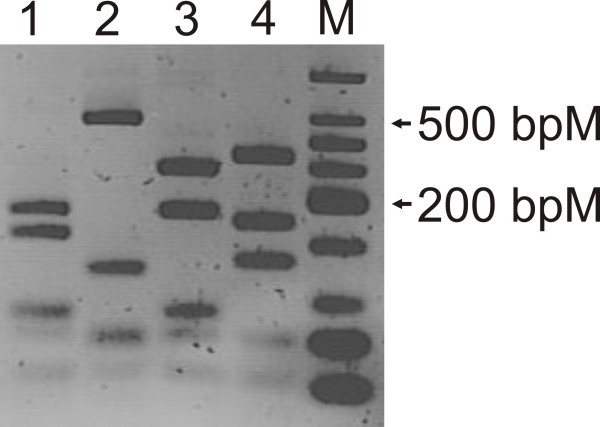
Figure 1
Figure 1
RFLP analysis of mcrA gene amplicons. 4% (w/v) agarose gel showing representatives of the four unique mcrA gene RFLP types identified in this study. Lane 1: RFLP profile of mcrA gene from Mbb. smithii PST (RFLP profile type A), Lane 2: RFLP profile identified in RFLP analysis of IBS clone library, sequence most closely related to Mbb. oralis and represented in Figure 2 by DC IBS-4, (RFLP profile Type B), Lane 3: RFLP profile generated from Ulcerative Colitis clone library analysis, most closely related to Mbb. smithii and represented in Figure 2 by clone DC UC-14, (RFLP profile Type C), Lane 4: RFLP profile Type D generated from Ulcerative Colitis clone library analysis and represented in Figure 2 by DC UC-6, uncultured methanogen clone, M: Low Weight Molecular DNA Ladder (Promega).
Figure 2
Figure 2
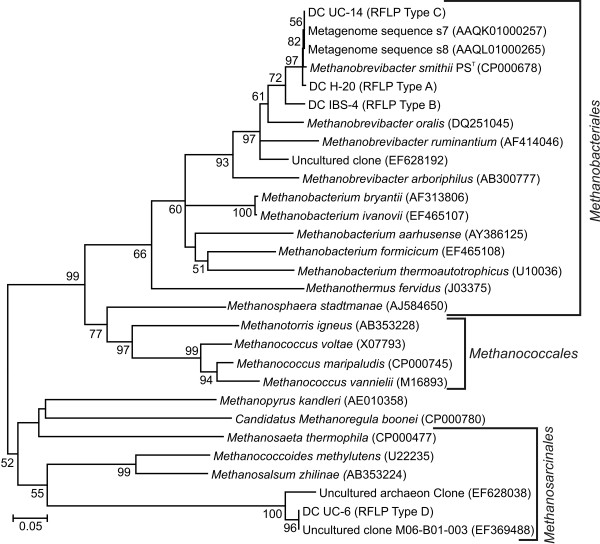
Evolutionary relationships mcrA gene clone generated from this study to mcrA genes of cultured and uncultured methanogens. The evolutionary history was inferred using the Neighbor-Joining method [49]. The bootstrap consensus tree inferred from 500 replicates [50] is taken to represent the evolutionary history of the taxa analyzed [50]. The percentage of replicate trees in which the associated taxa clustered together in the bootstrap test (500 replicates) are shown next to the branches [50] and any value below 50% was not shown. The tree is drawn to scale, with branch lengths in the same units as those of the evolutionary distances used to infer the phylogenetic tree. The evolutionary distances were computed using the Maximum Composite Likelihood method [51] and are in the units of the number of base substitutions per site. Codon positions included were 1st, 2nd, 3rd and noncoding. All positions containing gaps and missing data were eliminated from the dataset (Complete deletion option). There were a total of 348 positions in the final dataset. The accession numbers are included in parenthesis after each entry.

References

    1. Woese CR, Kandler O, Wheelis ML. Towards a natural system of organisms: Proposal for the domains Archaea, Bacteria, and Eucarya. Proc Natl Acad Sci USA. 1990;87:4576–4579. doi: 10.1073/pnas.87.12.4576. - DOI - PMC - PubMed
    1. Miller TL, Wolin MJ. Enumeration of Methanobrevibacter smithii in human feces. Arch Microbiol. 1982;131:14–18. doi: 10.1007/BF00451492. - DOI - PubMed
    1. Morvan B, Bonnemoy F, Fonty G, Gouet P. Quantitative determination of H2-utilizing acetogenic and sulfate-reducing bacteria and methanogenic archaea from digestive tract of different mammals. Curr Microbiol. 1996;32:129–133. doi: 10.1007/s002849900023. - DOI - PubMed
    1. Ohkuma M, Noda S, Kudo T. Phylogenetic relationships of symbiotic methanogens in diverse termites. FEMS Microbiol Lett. 1999;171:147–153. doi: 10.1111/j.1574-6968.1999.tb13425.x. - DOI - PubMed
    1. Miller TL, Wolin MJ, de Macario EC, Macario AJ. Isolation of Methanobrevibacter smithii from human feces. Appl Environ Microbiol. 1982;43:227–232. - PMC - PubMed

Publication types

MeSH terms

LinkOut - more resources