


Bioactive dietary long-chain fatty acids: emerging mechanisms of action
- PMID: 18492298
- PMCID: PMC2648819
- DOI: 10.1017/S0007114508992576
Bioactive dietary long-chain fatty acids: emerging mechanisms of action
Abstract
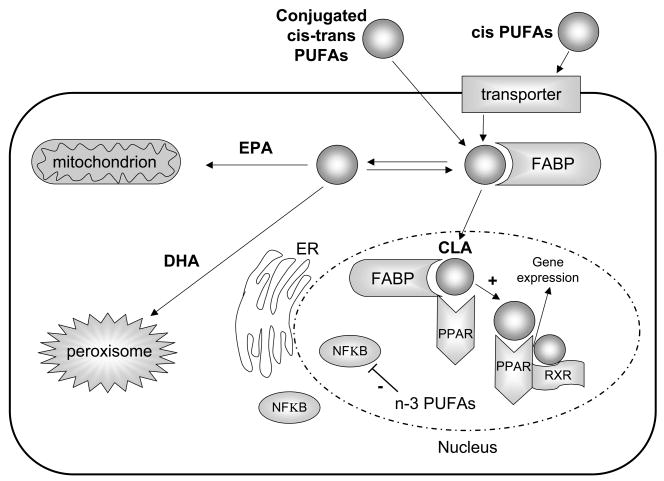
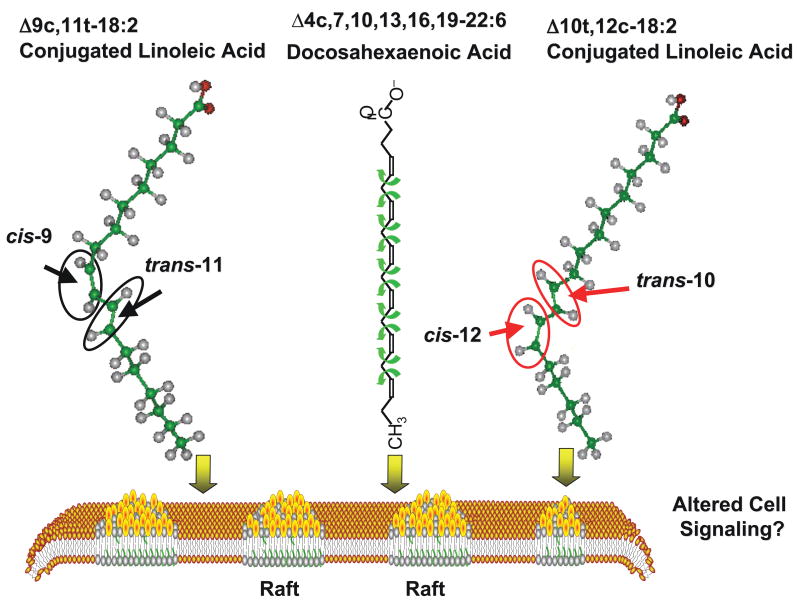
The plasma membranes of all eukaryotic cells contain heterogeneous self-organising intrinsically unstable liquid ordered domains or lipid assemblies in which key signal transduction proteins are localised. These assemblies are classified as 'lipid rafts' (10-200 nm), which are composed mostly of cholesterol and sphingolipid microdomains and therefore do not integrate well into the fluid phospholipid bilayers. In addition, caveolae represent a subtype of lipid raft macrodomain that form flask-shaped membrane invaginations containing structural proteins, i.e. caveolins. With respect to the diverse biological effects of long-chain PUFA, increasing evidence suggests that n-3 PUFA and perhaps conjugated fatty acids uniquely alter the basic properties of cell membranes. Because of its polyunsaturation, DHA and possibly conjugated linoleic acid are sterically incompatible with sphingolipid and cholesterol and, therefore, appear to alter lipid raft behaviour and protein function. The present review examines the evidence indicating that dietary sources of n-3 PUFA can profoundly alter the biochemical make up of lipid rafts/caveolae microdomains, thereby influencing cell signalling, protein trafficking and cell cytokinetics.
Figures
References
-
- Karin M. Nuclear factor-kB in cancer development and progression. Nature. 2006;441:431–436. - PubMed
-
- Rollins BJ. Inflammatory chemokines in cancer growth and progression. Eur J Cancer. 2006;42:760–767. - PubMed
-
- Hong MY, Lupton JR, Morris JS, et al. Dietary fish oil reduces O6-methylguanine DNA adduct levels in rat colon in part by increasing apoptosis during tumor initiation. Cancer Epidemiol Biomarkers & Prev. 2000;9:819–826. - PubMed
-
- Chapkin RS, McMurray DN, Lupton JR. Colon cancer, fatty acids and anti-inflammatory compounds. Curr Opin Gastroenterol. 2007;23:48–54. - PubMed
-
- Fowler KH, Chapkin RS, McMurray DN. Effects of purified dietary n-3 ethyl esters on murine T-lymphocyte function. J Immunol. 1993;151:5186–5197. - PubMed
Publication types
MeSH terms
Substances
Grants and funding
LinkOut - more resources
Full Text Sources
