


Cost effectiveness analysis of population-based serology screening and (13)C-Urea breath test for Helicobacter pylori to prevent gastric cancer: a markov model
- PMID: 18494053
- PMCID: PMC2712169
- DOI: 10.3748/wjg.14.3021
Cost effectiveness analysis of population-based serology screening and (13)C-Urea breath test for Helicobacter pylori to prevent gastric cancer: a markov model
Abstract
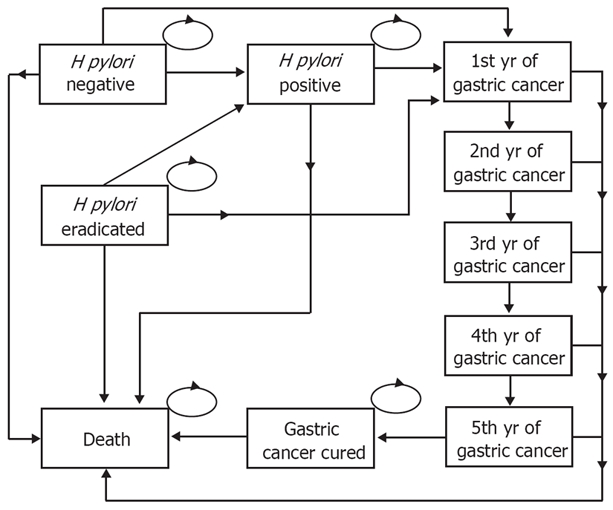
Aim: To compare the costs and effectiveness of no screening and no eradication therapy, the population-based Helicobacter pylori (H pylori) serology screening with eradication therapy and (13)C-Urea breath test (UBT) with eradication therapy.
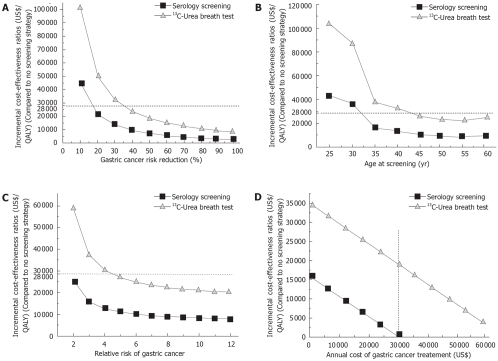
Methods: A Markov model simulation was carried out in all 237900 Chinese males with age between 35 and 44 from the perspective of the public healthcare provider in Singapore. The main outcome measures were the costs, number of gastric cancer cases prevented, life years saved, and quality-adjusted life years (QALYs) gained from screening age to death. The uncertainty surrounding the cost-effectiveness ratio was addressed by one-way sensitivity analyses.
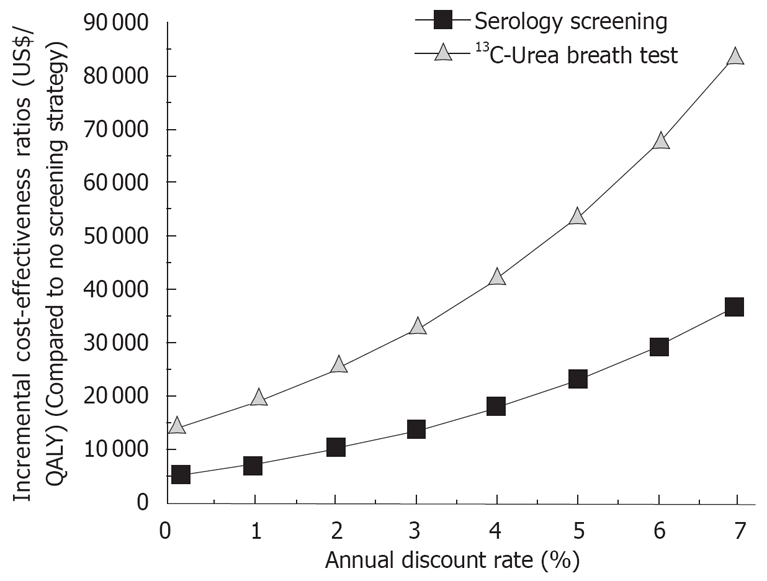
Results: Compared to no screening, the incremental cost-effectiveness ratio (ICER) was $16166 per life year saved or $13571 per QALY gained for the serology screening, and $38792 per life year saved and $32525 per QALY gained for the UBT. The ICER was $477079 per life year saved or $390337 per QALY gained for the UBT compared to the serology screening. The cost-effectiveness of serology screening over the UBT was robust to most parameters in the model.
Conclusion: The population-based serology screening for H pylori was more cost-effective than the UBT in prevention of gastric cancer in Singapore Chinese males.
Figures
References
-
- Kelley JR, Duggan JM. Gastric cancer epidemiology and risk factors. J Clin Epidemiol. 2003;56:1–9. - PubMed
-
- Parsonnet J, Friedman GD, Vandersteen DP, Chang Y, Vogelman JH, Orentreich N, Sibley RK. Helicobacter pylori infection and the risk of gastric carcinoma. N Engl J Med. 1991;325:1127–1131. - PubMed
-
- An international association between Helicobacter pylori infection and gastric cancer. The EUROGAST Study Group. Lancet. 1993;341:1359–1362. - PubMed
Publication types
MeSH terms
Substances
LinkOut - more resources
Full Text Sources
Medical
