. 2008 Jun;12(3):975-86.
doi: 10.1111/j.1582-4934.2008.00161.x.

Thrombin bound to a fibrin clot confers angiogenic and haemostatic properties on endothelial progenitor cells

Affiliations

Thrombin bound to a fibrin clot confers angiogenic and haemostatic properties on endothelial progenitor cells

David M Smadja et al. J Cell Mol Med. 2008 Jun.

Abstract

Recent data suggest that endothelial progenitor cells (EPCs) are involved in recanalizing venous thrombi. We examined the impact of a fibrin network, and particularly of adsorbed thrombin, on EPCs derived from cord blood CD34(+) cells. Fibrin networks generated in microplates by adding CaCl(2) to platelet-depleted plasma retained adsorbed thrombin at the average concentration of 4.2 nM per well. EPCs expressed high levels of endothelial cell protein C receptor and thrombomodulin, allowing the generation of activated protein C on the fibrin matrix in the presence of exogenous human protein C. The fibrin matrix induced significant EPC proliferation and, when placed in the lower chamber of a Boyden device, strongly enhanced EPC migration. These effects were partly inhibited by hirudin by 41% and 66%, respectively), which suggests that fibrin-adsorbed thrombin interacts with EPCs via the thrombin receptor PAR-1. Finally, spontaneous lysis of the fibrin network, studied by measuring D-dimer release into the supernatant, was inhibited by EPCs but not by control mononuclear cells. Such an effect was associated with a 10-fold increase in plasminogen activator inhibitor-1 (PAI-1) secretion by EPCs cultivated in fibrin matrix. Overall, our data show that EPCs, in addition to their angiogenic potential, have both anticoagulant and antifibrinolytic properties. Thrombin may modulate these properties and contribute to thrombus recanalization by EPCs.


Figures

1
1
Characterization of EPCs derived from human cord blood (A). Representative flow cytometric histograms of detached EPCs after immunolabelling with a control antibody (black line) and specific antibodies (blue line) to endothelial markers (CD146, CD31), haematopoietic markers (CD34 and CD133), leucocyte markers (CD14 and CD45), thrombin receptors (PAR-1 and CD141 = thrombomodulin) and endothelial protein C receptor (EPCR). (B). Immunofluorescence was performed on unpermeabilized EPCs, with anti-EPCR antibodies. Bar = 50 μm (magnification × 40)
2
2
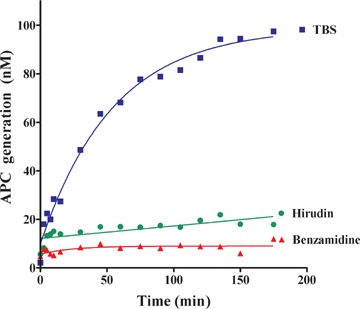
Protein C activation by EPCs on a fibrin clot, in the presence of exogenous protein C. Monolayer cultures of EPCs grown to confluence on a fibrin network in 96-well microtitre plates were overlaid with 50 μl of 50 mM Tris/150 mM NaCl2 (TBS) containing 5 mM calcium and 0.2% bovine serum albumin. Then, 64 nM human protein C (PC) was added with 30 mM benzamidine, 100 nM hirudin, or TBS, for 0 to 180 min. at 37°C. Twenty microlitres of supernatant was added to 80 μl of 100 nM hirudin solution to stop activated protein C (APC) generation, and APC was quantified by measuring the kinetics of hydrolysis of 500 μM S-2366 substrate at 405 nm.
3
3
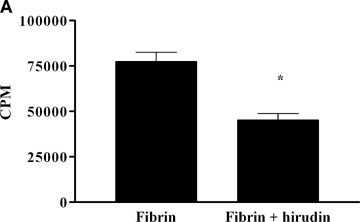
Impact of thrombin bound to a fibrin clot on EPC proliferation and migration (A) EPCs plated at a density of 5 × 10⁴/well were cultured for 24 hrs on a fibrin network (pre-treated or not with hirudin for 30 min. in unsupple-mented EBM-2 medium. The cells were then washed twice in ice-cold PBS and lysed overnight at 4°C in 1 N NaOH. DNA synthesis was determined by measuring the incorporation of 5′-[3H]-thymidine for 4 hrs with a Betamatic counter. Results are expressed as mean ± SEM of at least three separate experiments.*P < 0.05.(B) EPC migration was measured in modified Boyden chambers with 8-μm pore-size filters. EPCs were seeded at a density of 5 × 10⁴ per well in 200 μl of EBM-2 medium/1% SVF and were allowed to migrate for 5 hrs at 37°C toward a fibrin matrix placed in the lower chamber. Fibrin networks were pre-treated with 100 nM hirudin for 30 min. Results are expressed as mean ± SEM of at least three separate experiments.*P < 0.05
4
4
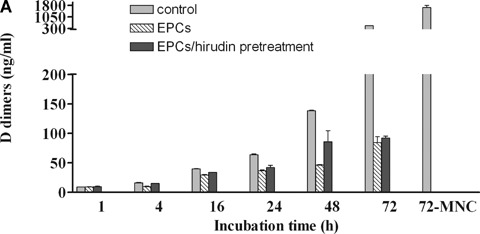
Fibrin network lysis by EPCs.(A) D-dimer release by EPCs and mononuclear cells (MNCs) cultured on fibrin matrices for 72 hrs. The control corresponds to spontaneous clot lysis in the absence of cells (EBM-2 medium). Closed histograms show the results of fibrin network pre-treatment with 100 nM hirudin for 30 min. before adding EPCs. Results are expressed as mean ± SEM of at least three separate experiments.*P < 0.05.(B) PAI-1 levels in supernatants of EPCs and MNCs placed on fibrin clots for 72 hrs. The control corresponds to basal levels of PAI-1 in the supernatant of the clot in the absence of cells (EBM-2 medium). When indicated, thrombin was inhibited by pre-treating the fibrin network with 100 nM hirudin for 30 min. Results are expressed as mean ±SEM of at least three separate experiments.*P < 0.05.

References

    1. McGuinness CL, Humphries J, Waltham M, Burnand KG, Collins M, Smith A. Recruitment of labelled monocytes by experimental venous thrombi. Thromb Haemost. 2001;6:1018–24. - PubMed
    1. Wakefield TW, Linn MJ, Henke PK, Kadell AM, Wilke CA, Wrobleski SK, Sarkar M, Burdick MD, Myers DD, Strieter RM. Neovascularization during venous thrombosis organization:a preliminary study. J Vasc Surg. 1999;5:885–92. - PubMed
    1. Modarai B, Burnand KG, Sawyer B, Smith A. Endothelial progenitor cells are recruited into resolving venous thrombi. Circulation. 2005;20:2645–53. - PubMed
    1. Waltham M, Burnand KG, Collins M, McGuinness CL, Singh I, Smith A. Vascular endothelial growth factor enhances venous thrombus recanalisation and organisation. Thromb Haemost. 2003;1:169–76. - PubMed
    1. Smadja DM, Cornet A, Emmerich J, Aiach M, Gaussem P. Endothelial progenitor cells: Characterization, in vitro expansion, and prospects for autologous cell therapy. Cell Biol Toxicol. 2007;4:223–39. - PubMed

Publication types