. 2008 May 21:8:156.
doi: 10.1186/1471-2148-8-156.

Nucleotide diversity in the mitochondrial and nuclear compartments of Chlamydomonas reinhardtii: investigating the origins of genome architecture

Affiliations

Nucleotide diversity in the mitochondrial and nuclear compartments of Chlamydomonas reinhardtii: investigating the origins of genome architecture

David Roy Smith et al. BMC Evol Biol. .

Abstract

Background: The magnitude of intronic and intergenic DNA can vary substantially both within and among evolutionary lineages; however, the forces responsible for this disparity in genome compactness are conjectural. One explanation, termed the mutational-burden hypothesis, posits that genome compactness is primarily driven by two nonadaptive processes: mutation and random genetic drift - the effects of which can be discerned by measuring the nucleotide diversity at silent sites (pisilent), defined as noncoding sites and the synonymous sites of protein-coding regions. The mutational-burden hypothesis holds that pisilent is negatively correlated to genome compactness. We used the model organism Chlamydomonas reinhardtii, which has a streamlined, coding-dense mitochondrial genome and an noncompact, intron-rich nuclear genome, to investigate the mutational-burden hypothesis. For measuring pisilent we sequenced the complete mitochondrial genome and portions of 7 nuclear genes from 7 geographical isolates of C. reinhardtii.

Results: We found significantly more nucleotide diversity in the nuclear compartment of C. reinhardtii than in the mitochondrial compartment: net values of pisilent for the nuclear and mitochondrial genomes were 32 x 10-3 and 8.5 x 10⁻³, respectively; and when insertions and deletions (indels) are factored in, these values become 49 x 10-3 for the nuclear DNA and 11 x 10-3 for the mitochondrial DNA (mtDNA). Furthermore, our investigations of C. reinhardtii revealed 4 previously undiscovered mitochondrial introns, one of which contains a fragment of the large-subunit (LSU) rRNA gene and another of which is found in a region of the LSU-rRNA gene not previously reported (for any taxon) to contain introns.

Conclusion: At first glance our results are in opposition to the mutational-burden hypothesis: pisilent was approximately 4 times greater in the nuclear compartment of C. reinhardtii relative to the mitochondrial compartment. However, when we consider the encumbrance of noncoding DNA in each of these C. reinhardtii compartments, we conclude that introns in the mtDNA impose a greater burden than those in the nuclear DNA and suggest that the same may be true for the intergenic regions. Overall, we cannot reject the mutational-burden hypothesis and feel that more data on nucleotide diversity from green algae and other protists are needed.


Figures
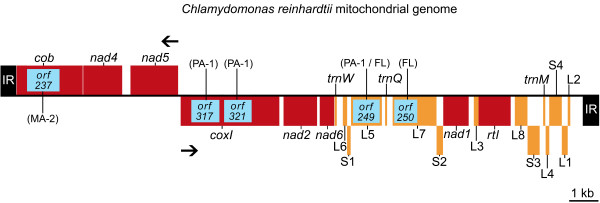
Figure 1
Figure 1
Genetic map of the Chlamydomonas reinhardtii mitochondrial genome, including all currently identified optional introns. Protein-coding regions and regions encoding structural RNAs are red and orange, respectively. S1–S4 represent the small-subunit rRNA-coding modules; L1–L8 represent the large-subunit rRNA-coding modules. The terminal inverted repeats (IR) are black. Intronic regions and their open reading frames are boxed in blue inside their associated genes. The C. reinhardtii strains (Table 1) in which the different introns occur are labelled in parentheses. Solid arrows denote the transcriptional polarities. Note: due to the presence/absence of introns among the different strains, the size of the C. reinhardtii mitochondrial genome can vary from 15,782 nt to 18,990 nt.
Figure 2
Figure 2
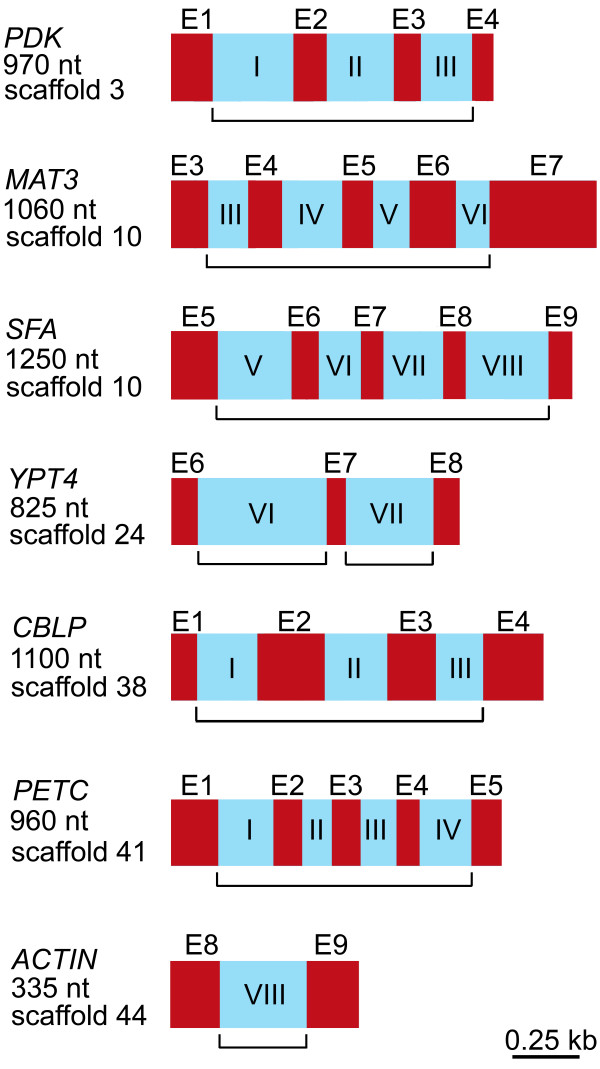
Partial genetic maps of the 7 Chlamydomonas reinhardtii nuclear-encoded genes employed in the analysis. The bracketed segment beneath each map represents the region that was PCR amplified. Left of each map is the name of the gene, the approximate size of the region that was PCR amplified, and the location of the gene within the C. reinhardtii nuclear genome – locations are based on the C. reinhardtii draft nuclear genome sequence version 3.0 [8]. Exons are red; they are labelled with an "E" and a number denoting their position within the gene. Introns are blue and are labelled with a roman numeral denoting their location within the gene. Note: each of these genes is present only once in the C. reinhardtii nuclear genome.
Figure 3
Figure 3
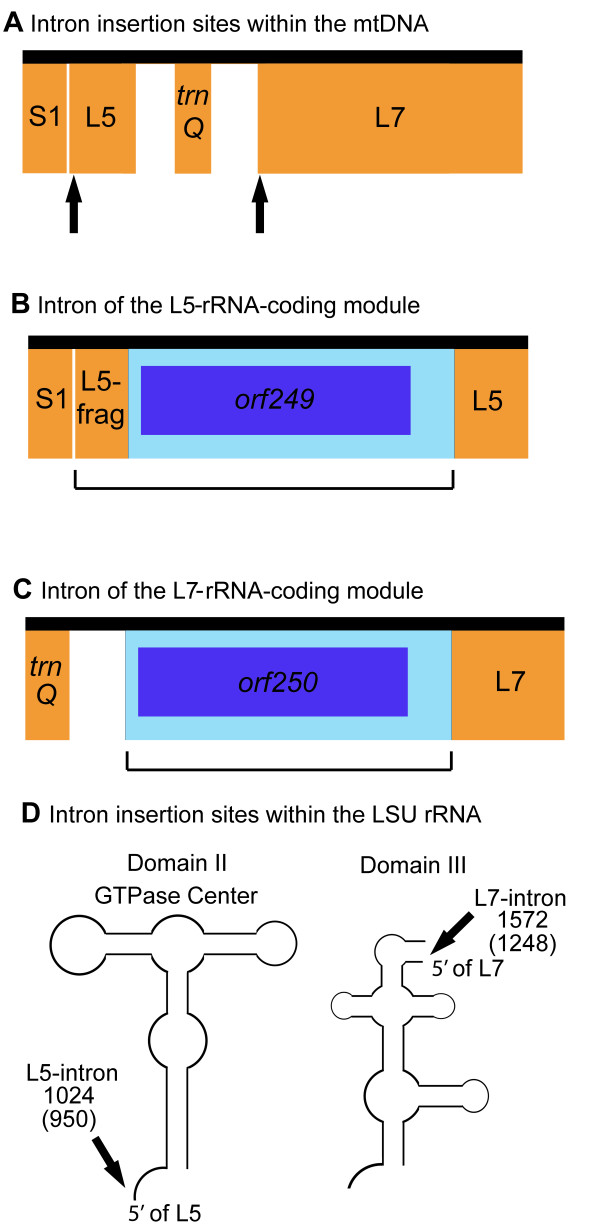
Schema of the introns in the L5- and L7-rRNA-coding modules. The vertical arrows in A show the intron insertion sites within the C. reinhardtii mtDNA. B and C depict the introns in the L5- and L7-rRNA-coding modules, respectively; rRNA-coding regions are orange; introns are light blue; intronic open reading frames are boxed in dark blue within their respective introns; L5-frag refers to a duplicated segment of the L5-rRNA-coding module (the first 35 nt of the module are duplicated); bracketed portions of the map represent regions that were shown to be spliced-out in mature transcripts. D depicts the intron insertion sites in the context of the large subunit (LSU) ribosomal RNA sequence of C. reinhardtii; arrows point to the region where the introns are inserted; numbers above the arrows denote the position of the residue that immediately precedes the insertion site: un-bracketed numbers correspond to the residue in the 23S rRNA gene of Escherichia coli [44] and bracketed numbers correspond to the residue in the LSU-rRNA secondary-structure model of Boer and Gray [21]. Note: the C. reinhardtii strains in which these introns occur are shown in Figure 1.

References

    1. Lynch M, Conery JS. The origins of genome complexity. Science. 2003;302:1401–1404. doi: 10.1126/science.1089370. - DOI - PubMed
    1. Lynch M. Streamlining and simplification of microbial genome architecture. Annu Rev Microbiol. 2006;60:327–349. doi: 10.1146/annurev.micro.60.080805.142300. - DOI - PubMed
    1. Lynch M, Koskella B, Schaack S. Mutation pressure and the evolution of organelle genomic architecture. Science. 2006;311:1727–1730. doi: 10.1126/science.1118884. - DOI - PubMed
    1. Lynch M. The Origins of Genome Architecture. Sunderland: Sinauer Associates, Inc; 2007.
    1. Birky CW Jr, Fuerst P, Maryama T. Organelle gene diversity under migration, mutation, and drift: equilibrium expectations, approach to equilibrium, effect of heteroplasmic cells, and comparison to nuclear genes. Genetics. 1989;121:613–627. - PMC - PubMed

Publication types

Substances

LinkOut - more resources