. 2008 May 21:9:14.
doi: 10.1186/1471-2091-9-14.

Isolation, characterization and molecular cloning of duplex-specific nuclease from the hepatopancreas of the Kamchatka crab

Affiliations

Isolation, characterization and molecular cloning of duplex-specific nuclease from the hepatopancreas of the Kamchatka crab

Veronika E Anisimova et al. BMC Biochem. .

Abstract

Background: Nucleases, which are key components of biologically diverse processes such as DNA replication, repair and recombination, antiviral defense, apoptosis and digestion, have revolutionized the field of molecular biology. Indeed many standard molecular strategies, including molecular cloning, studies of DNA-protein interactions, and analysis of nucleic acid structures, would be virtually impossible without these versatile enzymes. The discovery of nucleases with unique properties has often served as the basis for the development of modern molecular biology methods. Thus, the search for novel nucleases with potentially exploitable functions remains an important scientific undertaking.

Results: Using degenerative primers and the rapid amplification of cDNA ends (RACE) procedure, we cloned the Duplex-Specific Nuclease (DSN) gene from the hepatopancreas of the Kamchatka crab and determined its full primary structure. We also developed an effective method for purifying functional DSN from the crab hepatopancreas. The isolated enzyme was highly thermostable, exhibited a broad pH optimum (5.5 - 7.5) and required divalent cations for activity, with manganese and cobalt being especially effective. The enzyme was highly specific, cleaving double-stranded DNA or DNA in DNA-RNA hybrids, but not single-stranded DNA or single- or double-stranded RNA. Moreover, only DNA duplexes containing at least 9 base pairs were effectively cleaved by DSN; shorter DNA duplexes were left intact.

Conclusion: We describe a new DSN from Kamchatka crab hepatopancreas, determining its primary structure and developing a preparative method for its purification. We found that DSN had unique substrate specificity, cleaving only DNA duplexes longer than 8 base pairs, or DNA in DNA-RNA hybrids. Interestingly, the DSN primary structure is homologous to well-known Serratia-like non-specific nucleases structures, but the properties of DSN are distinct. The unique substrate specificity of DSN should prove valuable in certain molecular biology applications.


Figures

Figure 1
Figure 1
Nucleotide and amino-acid sequences of DSN. The NUC domain is colored gray. The sequence that was utilized to synthesize degenerated oligonucleotides is displayed as bold and underlined. The predicted signal peptide is italicized.
Figure 2
Figure 2
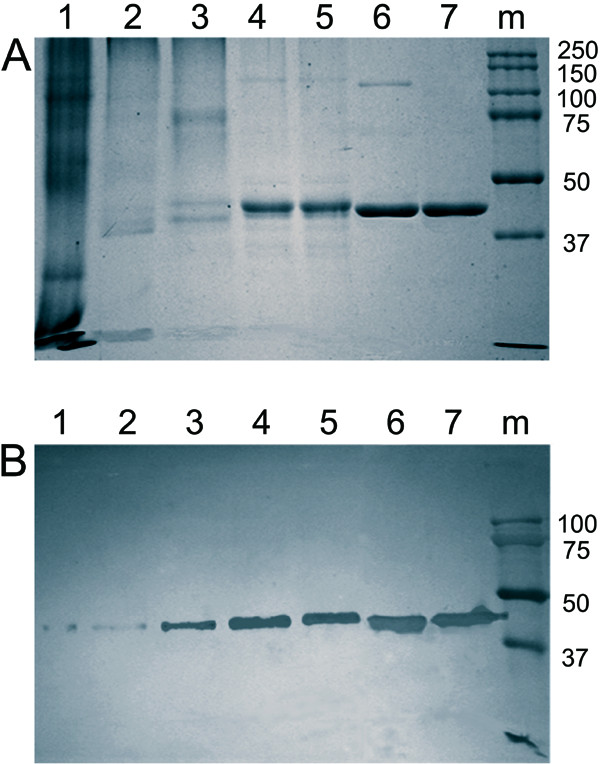
Purification of DSN from the crab hepatopancreas. A: Composition of protein samples obtained at different stages of DSN purification, determined by SDS-PAGE and Coomassie R-250 staining. B: Composition of protein samples obtained at different stages of DSN purification, determined by SDS-PAGE and immunoblotting.Lanes: 1, crude extract; 2, fractions obtained after DEAE MacroPrep chromatography; 3 and 4, combined fractions after first and second Phenyl Sepharose chromatography steps; 5, fractions obtained after hydroxyapatite chromatography; 6, fractions obtained after Heparin Sepharose chromatography; 7, final preparation obtained after Sephacryl S200 chromatography. M, molecular mass marker with molecular mass (in kDa) indicated at right.
Figure 3
Figure 3
A: Relationship between divalent cation concentration and DSN activity. The incubation mixtures (50 mM Tris-HCl, pH 7.15) contained calf thymus DNA (50 μg/ml), 8 units/ml DSN and different concentrations of MnCl2, CoCl2, MgCl2, CdCl2, CaCl2. B: Relationship between DSN activity and concentration of magnesium chloride, calcium chloride and their mixture. The incubation mixtures (50 mM Tris-HCl, pH 7.15) contained calf thymus DNA (50 μg/ml), 8 units/ml DSN and different concentrations of MgCl2, CaCl2, and mixtures of MgCl2 and CaCl2.
Figure 4
Figure 4
A: Effect of temperature on DSN activity. Calf thymus high-molecular-weight DNA (50 μg/ml) was dissolved in 50 mM Tris-HCl, pH 7.15 containing 5 mM MgCl2 and incubated with DSN (1 units/ml) for 2 min at different temperatures. B: Dependence of DSN activity on pH. Calf thymus high-molecular-weight DNA (50 μg/ml) was dissolved in 50 mM buffer containing 5 mM MgCl2. The pH was adjusted to the desired pH using glycine-HCl, sodium acetate, MES-NaOH, Tris-HCl and sodium borate buffers. The sample was equilibrated at 25°C and activity was measured using the Kunitz method.
Figure 5
Figure 5
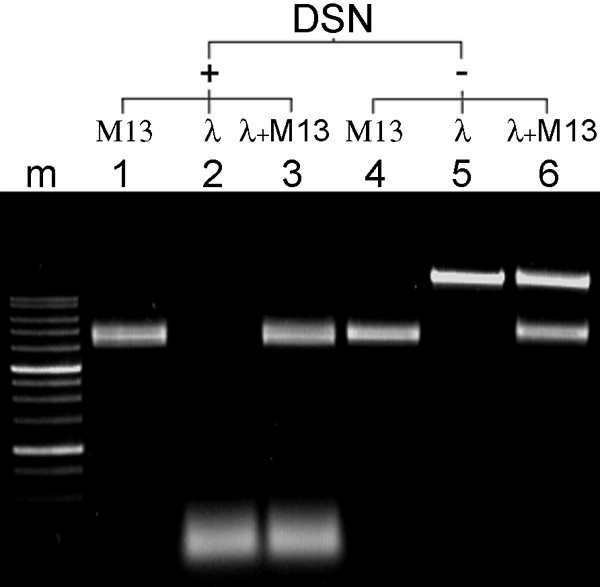
DSN activity against high molecular weigh ss and ds DNA. Agarose gel electrophoresis of M13 and lambda phage DNA before and after treatment for 10 min with 2 units of DSN at 70°C. Lanes: 1, M13 phage DNA treated with DSN; 2, lambda phage DNA treated with DSN; 3, mixture of M13 phage and lambda phage DNA treated with DSN; 4, untreated M13 phage DNA; 5, untreated lambda phage DNA; 6, untreated mixture of M13 phage and lambda phage DNA; m, 1-kb ladder (SibEnzyme).
Figure 6
Figure 6
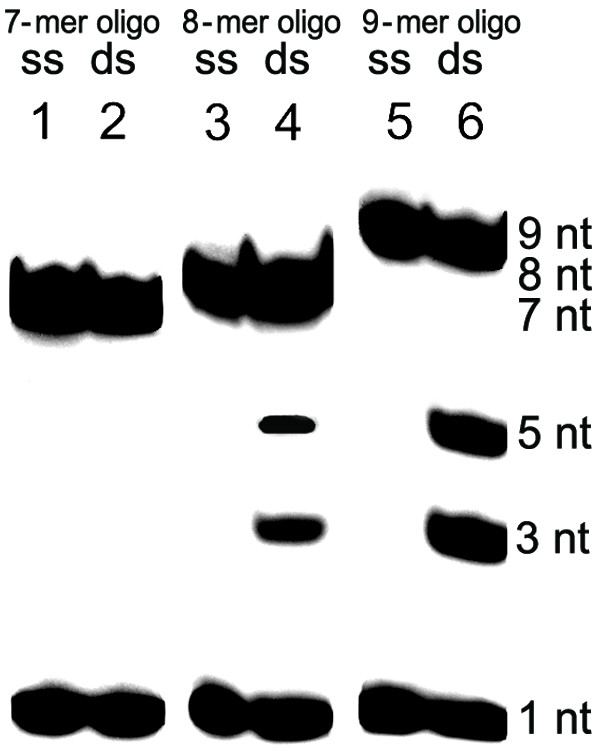
DSN activity against synthetic DNA duplexes. Each oligonucleotide (10 pM) was dissolved in 20 μl 25 mM Tris-HCl, pH 7.5 containing 5 mM MgCl2 and incubated with 1 Kunitz unit of DSN for 1 hour at 30°C. Reactions were stopped by adding EDTA to a final concentration of 5 mM. Products were separated by urea-polyacrylamide gel electrophoresis and analyzed autoradiographically by exposing to BioMax film (Kodak).Lanes: 1, radiolabeled p7 (7-mer); 2, Na21T7 (43-mer) + p7; 3, radiolabeled p8 (8-mer); 4, Na21T7 + p8; 5, radiolabeled p9 (9-mer); 6, Na21T7 + p9.
Figure 7
Figure 7
DSN activity against ds and ss RNA. Agarose gel electrophoresis of ds or ss RNA and ds DNA before and after treatment with DSN. Lanes: 1, untreated lambda phage DNA (500 ng) and total RNA (50 ng) from cultured cells; 2, lambda phage DNA and total RNA after incubation with 2 units of DSN for 30 min at 37°C; 3, untreated lambda phage DNA and synthetic ds RNA (2 μg); 4, lambda phage DNA and synthetic ds RNA after incubation with 2 units of DSN for 30 min at 37°C; m, 1-kb ladder (SibEnzyme).
Figure 8
Figure 8
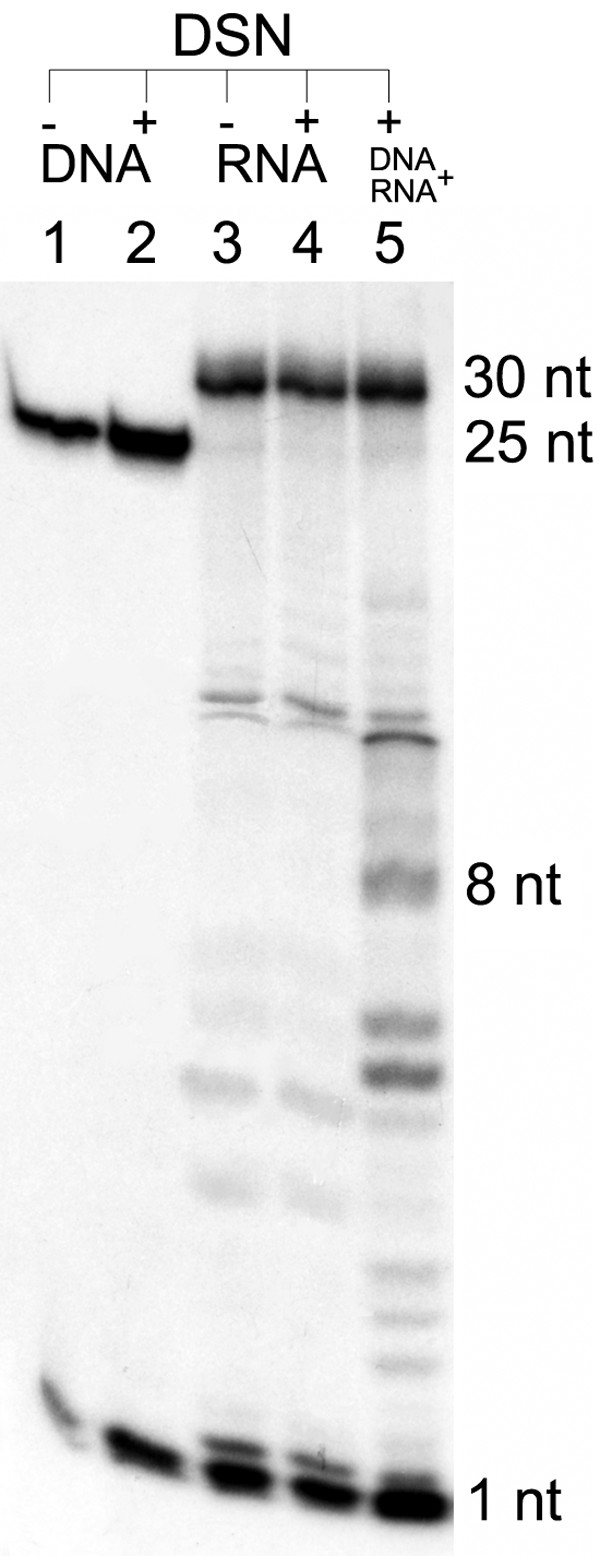
DSN activity against synthetic DNA-RNA hybrids. Ten picomoles of p25 DNA (25-mer) and 10 pM of ribo30 RNA (30-mer) were dissolved in 20 μl 25 mM Tris-HCl, pH 7.5 containing 5 mM MgCl2 and incubated with 1 Kunitz unit of DSN for 1 hr at 45°C. Reactions were stopped by adding EDTA to a final concentration of 5 mM. Products were separated by urea-polyacrylamide gel electrophoresis and analyzed autoradiographically by exposure to BioMax film (Kodak). Lanes: 1, p25, untreated; 2, p25, treated with DSN: 3, ribo30, untreated; 4, ribo30, treated with DSN; 5, ribo30 + p25, treated with DSN.

References

    1. Rangarajan ES, Shankar V. Sugar non-specific endonucleases. FEMS Microbiol Rev. 2001;25:583–613. - PubMed
    1. Zhulidov PA, Bogdanova EA, Shcheglov AS, Shagina IA, Vagner LL, Khazpekov GL, Kozhemiako VV, Luk'ianov SA, Shagin DA. [A method for the preparation of normalized cDNA libraries enriched with full-length sequences] Bioorg Khim. 2005;31:186–194. - PubMed
    1. Zhulidov PA, Bogdanova EA, Shcheglov AS, Vagner LL, Khaspekov GL, Kozhemyako VB, Matz MV, Meleshkevitch E, Moroz LL, Lukyanov SA, Shagin DA. Simple cDNA normalization using kamchatka crab duplex-specific nuclease. Nucleic Acids Res. 2004;32:e37. - PMC - PubMed
    1. Peng RH, Xiong AS, Xue Y, Li X, Liu JG, Cai B, Yao QH. Kamchatka crab duplex-specific nuclease-mediated transcriptome subtraction method for identifying long cDNAs of differentially expressed genes. Anal Biochem. 2008;372:148–155. - PubMed
    1. Al'tshuler IM, Zhulidov PA, Bogdanova EA, Mudrik NN, Shagin DA. [Application of the duplex-specific nuclease preference method to the analysis of point mutations in human genes] Bioorg Khim. 2005;31:627–636. - PubMed

Publication types

LinkOut - more resources