Review
. 2008;12 Suppl 3(Suppl 3):S3.
doi: 10.1186/cc6149. Epub 2008 May 14.

Delirium in the intensive care unit

Affiliations
Review

Delirium in the intensive care unit

Timothy D Girard et al. Crit Care. 2008.

Abstract

Delirium, an acute and fluctuating disturbance of consciousness and cognition, is a common manifestation of acute brain dysfunction in critically ill patients, occurring in up to 80% of the sickest intensive care unit (ICU) populations. Critically ill patients are subject to numerous risk factors for delirium. Some of these, such as exposure to sedative and analgesic medications, may be modified to reduce risk. Although dysfunction of other organ systems continues to receive more clinical attention, delirium is now recognized to be a significant contributor to morbidity and mortality in the ICU, and it is recommended that all ICU patients be monitored using a validated delirium assessment instrument. Patients with delirium have longer hospital stays and lower 6-month survival than do patients without delirium, and preliminary research suggests that delirium may be associated with cognitive impairment that persists months to years after discharge. Little evidence exists regarding the prevention and treatment of delirium in the ICU, but multicomponent interventions reduce the incidence of delirium in non-ICU studies. Strategies for the prevention and treatment of ICU delirium are the subjects of multiple ongoing investigations.


Figures
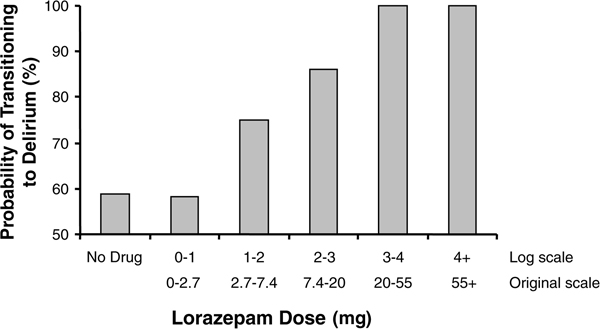
Figure 1
Figure 1
Lorazepam and the probability of transitioning to delirium. The probability of transitioning to delirium increased with the dose of lorazepam administered during the previous 24 hours. This incremental risk was large at low doses and plateaued at approximately 20 mg/day. Data from Pandharipande and coworkers [40].
Figure 2
Figure 2
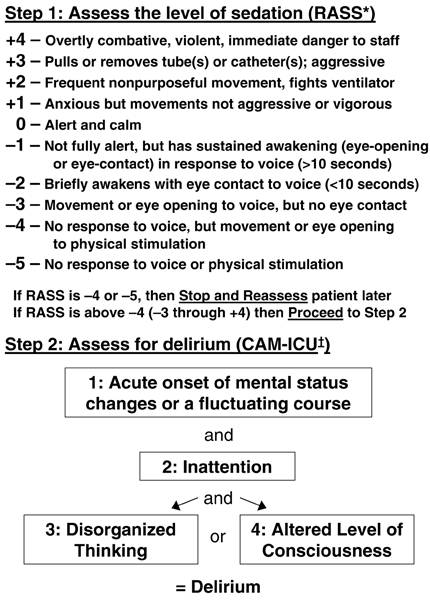
The Confusion Assessment Method for the Intensive Care Unit. *Level of consciousness (depth of sedation) is assessed using the Richmond Agitation-Sedation Scale (RASS) [54,55]. Content of consciousness is assessed (delirium is diagnosed) using the Confusion Assessment Method for the ICU (CAM-ICU) [50,53]. When three of four diagnostic features are present (either features 1, 2, and 3, or features 1, 2, and 4), delirium is diagnosed. Data from Ely and coworkers [50] and the CAM-ICU training manual [51].

References

    1. McGuire BE, Basten CJ, Ryan CJ, Gallagher J. Intensive care unit syndrome: a dangerous misnomer. Arch Intern Med. 2000;160:906–909. doi: 10.1001/archinte.160.7.906. - DOI - PubMed
    1. Ely EW, Gautam S, Margolin R, Francis J, May L, Speroff T, Truman B, Dittus R, Bernard R, Inouye SK. The impact of delirium in the intensive care unit on hospital length of stay. Intensive Care Med. 2001;27:1892–1900. doi: 10.1007/s00134-001-1132-2. - DOI - PMC - PubMed
    1. Ely EW, Shintani A, Truman B, Speroff T, Gordon SM, Harrell FE, Jr, Inouye SK, Bernard GR, Dittus RS. Delirium as a predictor of mortality in mechanically ventilated patients in the intensive care unit. JAMA. 2004;291:1753–1762. doi: 10.1001/jama.291.14.1753. - DOI - PubMed
    1. Jackson JC, Gordon SM, Hart RP, Hopkins RO, Ely EW. The association between delirium and cognitive decline: a review of the empirical literature. Neuropsychol Rev. 2004;14:87–98. doi: 10.1023/B:NERV.0000028080.39602.17. - DOI - PubMed
    1. The Nature and Extent of Medical Injury in Older Patients http://assets.aarp.org/rgcenter/health/2000_17_injury.pdf

Publication types